«These cutlets are bone-dry. Only fit for the cat,» Galina Petrovna remarked without looking at her daughter-in-law. She spoke into the empty air, casually, the same way one might mention the weather or the rising cost of groceries.
Nadezhda looked up from her plate. She paused for a second, then lowered her eyes again.
Outside, the sky was darkening. November had arrived bitter and wet this year—dark droplets crawled down the windowpanes, and the wind howled in the yard, chasing sodden leaves across the asphalt. Inside, the apartment was warm, smelling of food and that slightly sour scent that always appeared whenever her mother-in-law visited. Nadezhda couldn’t explain where it came from—it wasn’t perfume or clothes, just a certain presence that filled the space before Galina Petrovna even had her shoes off.
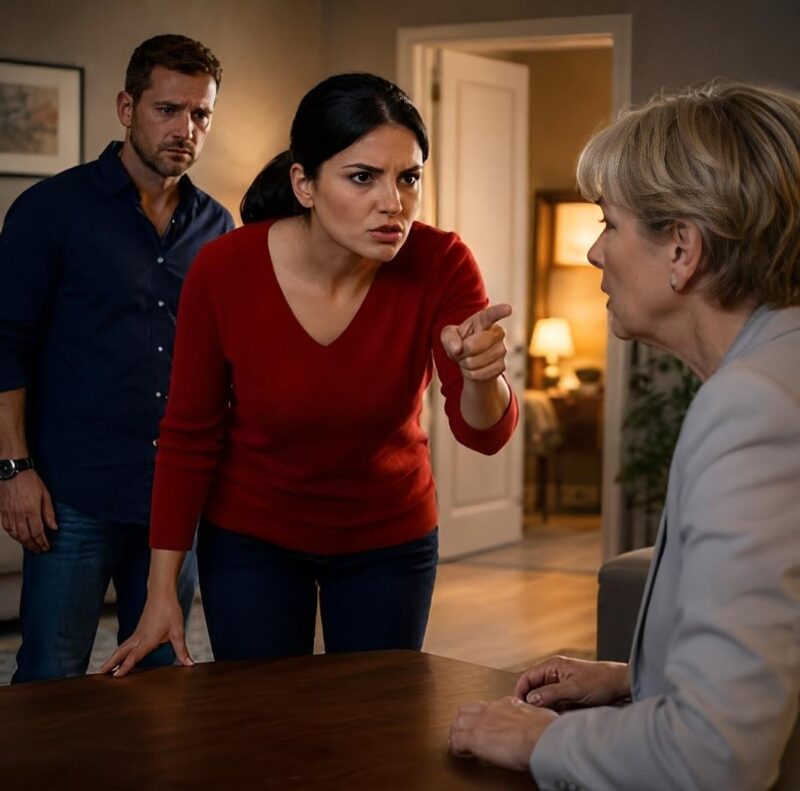
Sergey chewed in silence. Artyom, Nadezhda’s eight-year-old son, was busy meticulously cutting a piece of meat; he had long since learned not to look up when Grandma Galya started talking. Nadezhda had noticed the shift about three months ago: the way her son’s posture changed the moment his grandmother opened her mouth. Shoulders slumped forward, head down—as if he were trying to shrink, to become invisible, to just wait it out.
She recognized that movement. She used to do it herself. And that—not her mother-in-law’s barbs, not her husband’s silence, not the sheer exhaustion—was what weighed on her most. Seeing in her son the very thing she had fought so hard to strip away from herself. That habit of bracing for impact whenever someone spoke with an edge. That readiness to surrender just to keep things from getting worse.
Nadezhda had bought this apartment herself. She’d done it after the divorce, after two years of carrying everything on her own—her job as a design engineer, her son, and the rent while she scraped together a down payment. It hadn’t been a quick story, and it hadn’t been an easy one. She’d counted every cent, denying herself the little things others didn’t even notice. Two years of living like that.
A three-bedroom on the fourth floor, overlooking the park. When the realtor opened the door, Artyom immediately ran to the window to look at the trees. Nadezhda just stood in the middle of the empty living room, listening to the silence. It smelled of new flooring and fresh paint. After she signed the contract, it took a long time for the reality to sink in.
Hers. For the first time, truly hers.
For the first year, it was just her and Artyom. she ordered furniture piece by piece—first the beds, then a sofa, then finally a table and wardrobes. Artyom put stickers on his door; Nadezhda hung the shelves herself with a drill and wall anchors because there was no one to ask and she didn’t want to wait. In the evenings, they ate together in the small kitchen—a quiet, weary kind of happiness. The kind they don’t show in movies because it lacks drama; it only has the truth.
She met Sergey by chance—through mutual friends at a birthday party she hadn’t even wanted to attend. Artyom was with her mother that evening, and Nadezhda only went because her friend Katya had begged for the support. The party was loud; everyone was talking at once, and some people were already dancing. Nadezhda stood by the window with a glass of juice, thinking about how much she wanted to go home.
Sergey was standing by the window, too. Also with juice.
They started talking naturally—first about how neither of them drank, then about work, then books. Before she knew it, three hours had passed. He was quiet, serious, and a little awkward—especially when the conversation turned to Artyom. He didn’t pretend it didn’t matter, and he didn’t put on a show of immediate «excitement» at the idea of someone else’s child. He simply asked, «How are the two of you managing?» That question—sincere, without fluff—stuck with her. There was no pity in it, and no fear. Just a genuine interest in another person’s life.
They dated for eight months. Sergey met Artyom a few times—they went to the movies, the zoo, and once just walked in the park to feed the ducks. Her son was quiet in the car on the way home, but before bed, he said, «He’s okay.» For an eight-year-old who had lived through his parents’ divorce, that was a glowing review.
Then they got married. Sergey moved in. He brought over a suitcase, then boxes of books, then his tools—he had many, all neatly organized in drawers. He hung his clothes in the closet. He put his toothbrush next to hers. Artyom watched the process from his doorway—silent, observant, the way one watches something new before deciding if it’s good or bad.
For the first six months, everything was peaceful. Galina Petrovna lived in Podolsk and visited once a month, bringing jars of jam with neatly wrapped lids and homemade pickles. Nadezhda welcomed her politely and fed her lunch. Her mother-in-law would nod, smile, and say thank you. Then she’d leave. Nadezhda would close the door behind her and think: I got lucky. She isn’t dramatic, she isn’t overbearing, and she stays out of our business.
She was wrong.
The changes were almost imperceptible at first—like a hairline fracture in a wall that you only notice once it’s spread three feet. First, Galina Petrovna started staying later after lunch. Then she started showing up unannounced. «I’m family, why should I call?» she’d say with slight bewilderment whenever Nadezhda gently suggested a heads-up would be nice.
Then came the «observations.» Small at first, almost affectionate: «Is that how you hang the laundry? It’ll get wrinkled that way.» «Nadyusha, why do you keep the bread in a plastic bag?» «You really should store groceries like this.» Nadezhda endured it. She told herself: She’s an older woman, she lives alone, she’s lonely. She needs to feel useful. Sergey told her to just ignore it. So she did—for a while.
But then Galina Petrovna set her sights on Artyom.
In the beginning, it seemed innocent enough. «The boy slumps. Do you ever tell him to sit up?» «He laughs too loud; he’s undisciplined.» «By his age, Seryozha was already washing the dishes, so what is this one doing?» Every time, Nadezhda would briefly reply that everything was fine, that she was handling it, and that Artyom was a good boy. Sergey would wince, but he stayed silent. And Galina Petrovna, meeting no real resistance, pushed further.
One autumn day, Artyom came home from school with a ‘C’ on a spelling test—his first one all year. Galina Petrovna looked at the grade in his planner and said, addressing Nadezhda rather than the boy: «Well, what’s going to become of him?» Right in front of him. In front of an eight-year-old boy who was holding his planner and staring at the floor.
Nadezhda took the planner from her son’s hands, closed it, and put it on the shelf. She told Artyom, «Go change your clothes, I’ll make you a sandwich.» She waited until he left the room. Then she turned to her mother-in-law.
«Galina Petrovna, please—not in front of the child.»
«I’m just telling it like it is,» she said, shrugging. «Does the truth hurt?»
«It’s not about the truth. It’s about how you say it, and who is listening.»
Galina Petrovna looked at her with slight surprise—the way one looks at a person who has suddenly gone off-script. Then she got up and went into the other room.
That evening, Sergey again asked her to just ignore it. Nadezhda looked at him for a long time before answering.
«Seryozha, she does this in front of Artyom. Every single time. Do you even notice?»
«Look, Mom’s just worried. She doesn’t mean anything by it.»
«This is the third time I’ve heard that. She ‘doesn’t mean anything’—so what? He hears it. He hears everything. And he remembers.»
Sergey pulled out his phone. The conversation evaporated, like water disappearing into sand. Nadezhda watched him and wondered: Maybe I’m asking for too much? Maybe he just doesn’t know any better? But then she remembered her son’s face over that open planner—and she realized that whether Sergey knew better or not didn’t matter anymore. Something else mattered.
«Raising other people’s children isn’t like raising your own,» Galina Petrovna said one evening while Nadezhda was clearing the table and Artyom had already gone to bed. She spoke to the room at large, not looking at her daughter-in-law—in the same tone she’d use for a weather forecast. «It requires a special touch. A special kind of patience. Your own child feels you, but someone else’s will always be a stranger.»
Nadezhda stopped. She turned around slowly.
Galina Petrovna was looking past her, out the window where it was already dark.
«Artyom is not a ‘stranger,'» Nadezhda said. Her voice was steady, without a tremor. «He is my son. And he lives in my house.»
Galina Petrovna tilted her chin up, like someone who had just heard something wildly inappropriate. Then she got up and walked out. That night, Sergey asked why she had to be so harsh. «Harsh would have looked very different,» Nadezhda replied. «I told the truth.» He didn’t answer. She turned to face the wall and stared into the darkness until she heard him fall asleep.
Nadezhda remembered that November dinner not because it was special, but because it was the opposite—it was ordinary, sickeningly ordinary. And that was exactly what made it unbearable.
Galina Petrovna had arrived in the afternoon while Nadezhda was at work. She had called that morning to let them know—which was progress after their previous talks—but when Nadezhda opened the door that evening and saw her mother-in-law’s coat on the rack, she felt her muscles tighten. It was automatic. Like a muscle that had cramped too many times before.
Sergey had set the table—cutlets Nadezhda had made the day before, potatoes, pickles from a jar. Galina Petrovna sat in her usual spot across from the window, surveying the apartment with the eyes of a mistress who had been away too long: eyes slightly narrowed, head tilted, checking to see if anything had changed without her permission.
Artyom came home from school a little after five. He called out a greeting from the doorway and shed his jacket. Nadezhda saw him hesitate in the hallway when he spotted her mother-in-law’s winter boots—he recognized them instantly—and something in his expression shifted, turning guarded. It wasn’t fear, exactly. Just… closed off. Like someone shutting a window before a storm.
He went to his room, changed, and came to the table. He sat down carefully, resting his hands on his knees.
At first, the dinner conversation drifted aimlessly. Galina Petrovna talked about their neighbor, Zoya, who had broken her leg; about how the milk prices in her Podolsk grocery store had gone up again; about a new shopping mall and a road closure. Nadezhda nodded. Sergey ate. Artyom meticulously picked his cutlet apart, as he always did when he wanted to eat slowly and stay under the radar.
Then, Galina Petrovna looked at her grandson.
«You’re chewing with your mouth open again,» she said. Not angrily or even rudely—just calmly stating a fact. «How many times do I have to tell you?»
The boy lowered his head. He didn’t argue or look up; he just shrank into himself a little. His shoulders slumped, his head dropped. He became quiet.
Nadezhda saw it. And something inside her—something that had held steady for so long out of respect for old age, out of deference to her husband’s pleas, out of the idea that family requires compromise—suddenly tipped. Like a scale receiving the final ounce.

«You have to be firmer with him,» Galina Petrovna continued, turning her attention to Nadezhda. Her tone was patronizing, almost well-meaning—she genuinely believed she was being helpful. «You’ve let him go completely. Softness does children no favors. You won’t be able to fix him once you’ve let the time slip away.»
Nadezhda slowly set her fork down on the table. No clatter. No fuss. She looked at Sergey.
He was staring at his plate. He didn’t look up. He didn’t do a thing.
Nadezhda’s cheeks flushed—not with shame, but with something harder. She sat up straight. When she finally spoke, her voice was quiet and perfectly steady—the voice of someone who has made a final, irrevocable decision.
«Galina Petrovna.»
The older woman looked up. Something in Nadezhda’s tone stopped her—not volume or sharpness, but that quiet sense of absolute certainty.
«If you open your mouth about my child one more time, you will be packing your bags—quickly and in silence.»
The room fell so quiet you could hear the rain drumming against the glass. In a neighboring apartment, a television was humming. The wall clock ticked away a second.
Galina Petrovna’s mouth hung open.
«Nadya, really, what is this…» she began, her voice trailing off into that bewildered, reproachful tone used by people who aren’t used to being stood up to.
«I wasn’t finished,» Nadezhda cut her off, her voice level. «Artyom lives here. This is his home. He belongs here just as much as anyone else at this table. You will not discuss his behavior, his manners, or his upbringing—not in front of him, not at dinner, and not in his own home. Not today. Not ever again. That wasn’t a request.»
Galina Petrovna slowly shifted her gaze to her son.
Sergey finally lifted his head. He met his mother’s eyes, then his wife’s. His face was tense, like a man who had reached the point where he could no longer pretend nothing was wrong. He remained silent. But this was a different kind of silence—not the usual, cowardly retreat, but the silence of a man who finally understood where the line was drawn.
«I only wanted to help,» Galina Petrovna finally said. Her voice had dropped, carrying a note of genuine hurt. She truly didn’t understand that she had done anything wrong. To her, it was all just caring, experience, and good intentions.
«I know,» Nadezhda replied. «But that isn’t help here.»
No one said another word. They finished the meal in silence. Galina Petrovna stopped looking at Artyom—not in a huff, she just stopped. The boy finished his food, asked to be excused, received a nod, and went to his room. He didn’t rush or run away; he just walked. He walked the way people do when they no longer feel the need to hide.
Galina Petrovna left earlier than usual, citing exhaustion and an early bus. She put on her coat in silence. Sergey called her a cab and walked her out to the landing. Nadezhda stayed behind to clear the table.
She heard a brief goodbye in the hallway—not cold, but certainly not warm. The lock clicked. Footsteps in the corridor. Sergey returned to the kitchen and stood in the doorway.
He watched her clean up for a moment.
«You were too harsh,» he finally said.
Nadezhda set the plates by the sink. She didn’t rush. She turned around.
«Did you see his face?» she asked. «When she started in on him again. Did you see it?»
Sergey paused.
«I saw it,» he said quietly.
«Then tell me: what part of that was too harsh?»
He didn’t answer. He looked away—the look of a man who realizes he’s on the wrong side of the argument. Then he sighed, walked past her, and poured himself a glass of water. He stood by the window to drink it. Outside, the wet yard glistened under the streetlights, the asphalt looking almost alive in the glow.
Nadezhda didn’t press him. She stood by the sink and waited—not for an answer, necessarily. She was just waiting to see who was standing in front of her: the Sergey who always walked away, or the other one—the man she caught glimpses of in the rare moments he allowed himself to be real.
«I should have done it sooner,» he finally said. Not to her, but to himself, almost under his breath. «I should have handled it myself a long time ago.»
Nadezhda said nothing. But she took those words and tucked them away—not as a victory or an apology, but as something to remember.
After that evening, Galina Petrovna stopped visiting—not entirely, but her visits became rare. Once every month or two, no more. She always called ahead now, asking if it was a good time. At the table, she remained polite. She spoke to Artyom carefully—about school, about cartoons, about the book he was reading. Not a single word about his behavior, his manners, or his upbringing.
Nadezhda didn’t know what happened between Sergey and his mother during those phone calls he took in the hallway with the door shut tight. She didn’t ask. That was his conversation, his boundary, his business. The results were enough.
She didn’t celebrate. She didn’t think of it as a victory, and she didn’t tell her friend Katya, who surely would have cheered and said it was about time. Nadezhda simply felt something click back into place—like a dislocated joint being reset. It was painful and sharp, but once it’s back, you start to forget it was ever any other way.
Life settled into its usual rhythm. Artyom went to school, brought home a mix of A’s and B’s, and once even brought home a certificate from an art contest, which he placed on his bookshelf without a word. Nadezhda went to work, drew up blueprints and schematics, and read in the evenings, sometimes falling asleep with the book still in her hands. Sergey fixed everything that broke—a shelf, a faucet, a cabinet hinge—and he did it quietly, as if that were simply the way things were. As if he had always lived there. As if it had always been his home, too—and not just hers.
They rarely spoke about that evening. Once, Sergey mentioned, «I called my mother.» Nadezhda simply nodded. That was it. But something had shifted—subtly, quietly, in a way an outsider wouldn’t even notice. He started telling Artyom «good job» more often. He began to notice what the boy was reading, what he was drawing, and what he brought home from school. He didn’t make a scene out of it or turn it into a performance; he just noticed.
One Saturday, they all watched a movie together. It was a long animated adventure that Artyom had picked out himself. He had spent a long time explaining why they had to see it—there was one part, he said, that was so funny they’d just have to see it to understand. They settled onto the sofa: Artyom in the middle, Nadezhda on the right, Sergey on the left. The boy pulled a blanket up to his chin, a plate of sliced apples resting on his knees—the fruit slowly turning brown as he became too absorbed to eat.
The moment arrived about forty minutes in. A character did something completely ridiculous—tripped, got tangled up, and accidentally knocked a bucket of paint over himself—and Artyom laughed. It was a loud, heartfelt, uninhibited laugh. It was the kind of laugh children have when they feel safe and happy—without looking over their shoulder, without checking for a reaction, just laughing because it’s funny. His shoulders shook, and in his excitement, he even grabbed Nadezhda’s sleeve. She started laughing too, softly at first, then fully. To Artyom’s right, Sergey was smiling, looking not at the screen, but at the two of them.
Nadezhda stole a glance at him.
He wasn’t looking at her. He was looking at the screen, laughing.
She turned back to the TV. Somewhere deep in her chest, something let go—quietly, almost imperceptibly, the way tension releases when you’ve held it so long you’ve forgotten it was there. You don’t even realize you were carrying it until it’s gone, and suddenly, you find you can breathe a little easier.
This is why, she thought.
Just for this.
And perhaps, she thought, so that later—when Artyom is grown and has his own life, his own choices, his own struggles—he would remember this house not as a place where he was taught to be silent and small, but as a place where people stood up for him. Quietly. Firmly. Without unnecessary words.
Nadezhda didn’t know how everything would unfold. She didn’t know if Galina Petrovna would ever truly change—from the inside out, rather than out of polite fear. She didn’t know if Sergey had finally become the kind of man who knows how to protect his own, or if he had simply taken a temporary step back. Life rarely gives those answers all at once; it serves them in small portions over the years.
Sometimes, after tucking Artyom in, she would sit in the quiet of the kitchen and think about how parenting isn’t just a set of rules, or being «hard» or «soft.» It’s an atmosphere. It’s what saturates the very air in a home. You can explain the «right» words to a child, but they will always learn from what they see: how the adults speak to one another, how they react to injustice, and whether they shrink away or stand their ground.
She wanted Artyom to see the latter. Not because she’d read it in the psychology books she occasionally flipped through, but because she knew it from her own life: you remember the adults who stay. Not their words, not even their specific actions, but the fact that they were there and didn’t leave. And that around them, you could be yourself—loud, silly, imperfect—without the fear that it would be «too much.»
That was all she wanted for him. Just that.
But she also knew something else: on that November evening, when she had set down her fork and said what she said, she hadn’t done anything particularly brave or extraordinary. She had simply done what should have been done long ago. And a late truth is still the truth.