My parents told Grandma Eleanor they were taking her out to lunch.
Three hours later, a nursing facility in Ohio called my phone.
“Is this Ivan Sterling?” the voice on the line asked. “Your grandmother listed you as her emergency contact. Her suitcase is sitting right here in our lobby, but the family members who dropped her off left before completing the intake paperwork.”
I stood frozen in my kitchen, a mug of coffee in my hand that I suddenly had no appetite for.
“What do you mean, they left?”
The administrator hesitated. “They claimed they needed to grab a few documents from their car. They never came back.”
I dialed my dad, Arthur. It went straight to voicemail.
I tried my mom, Wendy. Same result.
I hit the road, driving 190 miles with a white-knuckle grip on the steering wheel.
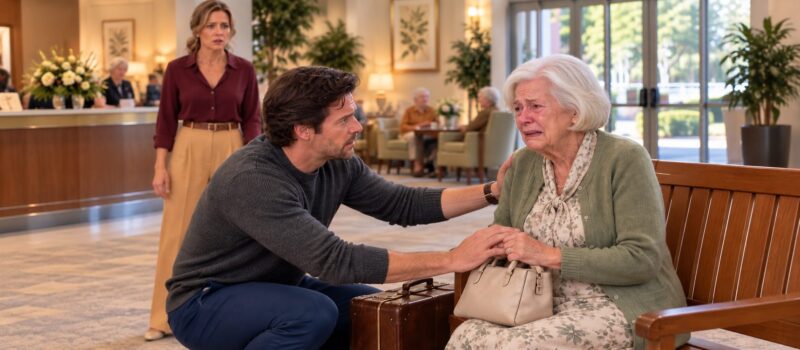
When I finally arrived, Grandma was sitting next to a single brown suitcase and a grocery bag stuffed with prescription bottles. She was still wearing her heavy church coat despite the warm lobby. Her gray hair was neatly pinned, and her face wore that quiet, stone-cold composure she always adopted when she was absolutely livid.
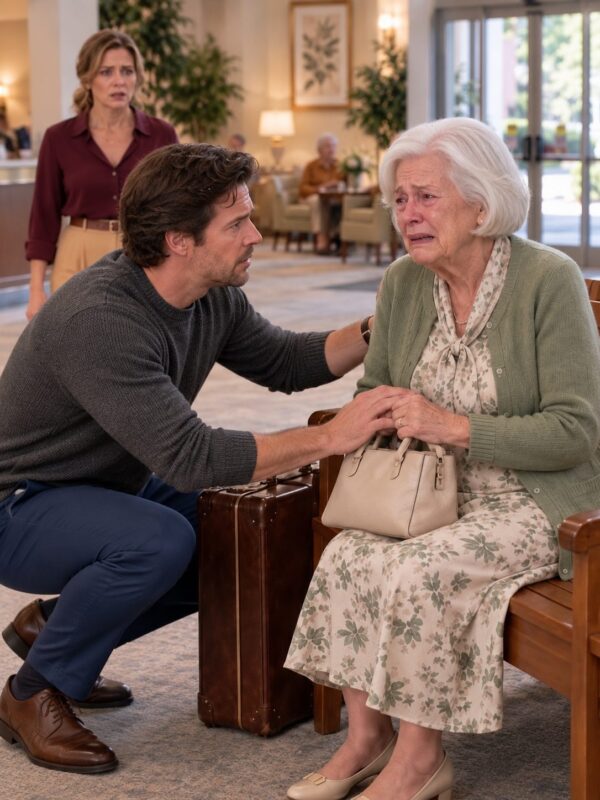
I knelt beside her. “Grandma.”
She looked at me for a few long seconds before standing up. No tears. No questions.
She walked straight to my car, slid into the passenger seat, and clicked her seatbelt into place.
“Don’t bother calling them,” she said.
I turned to look at her.
“I’ll tell you where we’re going.”
“Where?”
“First, the county courthouse.”
That caught my attention real fast.
Once we merged back onto the highway, she reached into her purse and handed me a folded bank statement. Three separate withdrawals were looped in red ink: $12,000, $18,000, and $25,000—all wiped out within a six-week span.
“Your father has temporary power of attorney,” she said softly. “I signed off on it after my knee surgery because I trusted him.”
My stomach dropped.
“He started telling me I was becoming forgetful, that I needed help managing the bills.” She turned her head toward the side window. “Then yesterday, I found that statement.”
“Did you confront him about it?”
“I did.”
“And what did he say?”
“He claimed the money was covering the cost of my care.”
I glanced in the rearview mirror at the solitary suitcase in my back seat.
Grandma let out a bitter, humorless laugh. “At lunch today, your mother told me we were making a quick stop somewhere with a lovely garden. They escorted me into that building, abandoned the paperwork, and vanished.”
My phone buzzed against the console. Dad.
Grandma reached over and flipped the screen face down.
“Courthouse first,” she reiterated. “Then the bank. And after that, one last stop.”
“Where?”
She looked straight into my eyes. “My house.”
I swallowed hard. “Why there?”
“Because if my instincts are right, your parents didn’t just dump me today.”
She reached inside her coat pocket and pulled out a small envelope. Across the front, written in my late grandfather’s distinct handwriting, were two words: **HOUSE DEED**.
“I stashed this away before they came to pick me up,” she said, her voice dropping to a low whisper. “I wanted to see if they’d go searching for it. They needed me out of the way.”
Grandma kept the envelope pressed tightly against her coat as we pulled into the county courthouse parking lot.
For the first time since I’d picked her up, she hesitated before opening the car door.
Inside, the clerk examined the house deed, glanced strangely at Grandma, and turned toward her computer monitor.
Her fingers suddenly froze over the keyboard.
“Mrs. Sterling, has anyone asked you to sign a property document recently?”
Grandma’s eyes shifted toward me.
“No,” she said softly. “Though my son did bring some papers to my house last week.”
The clerk’s entire demeanor shifted.
She angled the monitor away from us and reached for her desk phone.
“What did you find?” I asked.
She didn’t answer right away. Instead, she looked directly at Grandma.
“There’s a quitclaim deed attached to your property record that was filed three days ago. It transfers complete ownership of the Sterling estate to Arthur and Wendy Sterling.”
Grandma went completely still.
Before the clerk could elaborate, my phone started buzzing in my pocket.
Dad.
I hit speakerphone right there at the counter.
“Where are you, Dad?”
Arthur’s voice came through, dripping with dramatic panic.
“Ivan! Thank God you picked up! Your mother and I are beside ourselves! Your grandmother wandered off during lunch! We stepped into the restroom for a minute and she vanished. We’ve been searching for hours—”
“Cut the crap, Dad,” I interrupted, my tone dropping into a razor-sharp register. “I’m standing right next to Grandma Eleanor. I picked her up from the nursing facility where you dumped her three hours ago.”
The silence on the line was absolute.
“Ivan… you don’t understand what’s going on here—” Arthur stammered.
“We’re at the county courthouse, Arthur,” Grandma Eleanor spoke up, her voice ringing clear, commanding, and totally devoid of weakness. “And I’m standing right in front of the land records desk looking at a forged quitclaim deed with my signature on it.”
Arthur’s breath hitched over the speaker.
“You have one hour to meet us at my house,” Grandma ordered. “If you’re not there, my grandson’s next call is going straight to the State Prosecutor’s elder fraud division.”
She hung up the phone herself.
—
### EPILOGUE
When we pulled up to Grandma Eleanor’s brick home forty minutes later, Arthur’s luxury SUV was already idling in the driveway.
My father and mother stood near the front porch—pale, disheveled, and visibly panicked.
Through the front window, stacked cardboard boxes were already visible lining the hallway. They had already started clearing out her belongings to put the house on the market.
The second Grandma stepped out of the car, Wendy rushed forward, her hands fluttering nervously.
“Eleanor! Please, this is all a huge misunderstanding! We were just trying to secure your assets so you wouldn’t have to worry about managing the property—”
Grandma Eleanor held up a single hand, stopping my mother in her tracks.
“Save your breath, Wendy,” Grandma said flatly. “The temporary power of attorney is officially revoked. The clerk at the county office has already flagged the fraudulent deed for a police investigation, and my bank accounts are completely locked against your signature.”
Arthur took a desperate step forward, his voice cracking.
“Mom, please! My business was hit with a temporary cash-flow crisis! We were going to put every cent back as soon as the house sold!”
“You put a price tag on my life, Arthur,” Grandma Eleanor said, her eyes as cold as flint. “You threw me in a lobby like a bag of trash so you could steal the home your father built with his bare hands.”
She reached inside her coat, pulled out her spare set of house keys, and handed them to me.
“Ivan, please help your parents carry their things out to their car,” she said quietly. “They have ten minutes before the deputy I called arrives to escort them off my land.”
Arthur stared at his mother, realizing for the first time that his greed had cost him everything.
He opened his mouth to speak, but the icy finality in Eleanor’s gaze shut him down.
Without another word, my parents grabbed their empty packing boxes and retreated to their car in utter defeat.
Six months later, the legal process wrapped up.
Facing felony forgery and elder financial abuse charges, Arthur signed a full restitution agreement, liquidating his personal investments to repay every single dollar he had stolen from her accounts.
The forged quitclaim deed was expunged from county records, restoring total, unencumbered ownership of the estate to Grandma Eleanor.
I moved into the guest suite shortly after, taking a remote position with my firm so I could make sure she’d never have to deal with predatory relatives again.
On a warm autumn evening, Grandma Eleanor and I sat on the wide front porch, sipping iced tea as the sun dipped below the garden treeline.
Her gray hair was neatly pinned, her face was at peace, and right beside her chair sat her favorite old brown suitcase—unpacked and tucked safely away in the attic where it belonged.
She glanced over at me with a soft, rare smile.
“You know, Ivan,” she said softly, taking a sip of her tea, “people always say blood is thicker than water. But real family doesn’t leave you sitting alone in a cold lobby.”
I reached out and squeezed her hand.
“You’re never sitting in a lobby again, Grandma.”
She patted my hand gently, looking out over her sunlit lawn, knowing with absolute certainty that she was finally, safely home.
—
### PART 3: THE ACCOUNTING OF LOYALTY
The autumn wind rustled through the front yard oaks, carrying the crisp scent of fallen leaves and damp earth.
Inside, the grandfather clock in the entry hall chimed three times—a steady, solemn beat filling the quiet house.
Arthur and Wendy spent their ten allotted minutes loading empty cardboard boxes back into their SUV.
My father’s hands shook so badly he dropped several rolls of packing tape onto the gravel, while my mother kept her eyes glued to the driveway, terrified a squad car would pull up before they could escape.
They didn’t say goodbye.
They didn’t ask where Grandma was going to sleep that night.
They simply slammed the trunk shut, climbed into the front seats, and drove down the long driveway without looking back once.
I stood on the porch, watching their red taillights disappear around the bend.
Grandma Eleanor walked through the front door, draped in a warm wool shawl I’d retrieved from her bedroom.
She stood beside me at the railing, arms crossed, staring down the empty road.
“He was seven years old when his father built this porch,” she said softly, her voice barely above a whisper. “He used to sit right on those steps with a little plastic hammer, pretending he was helping nail down the floorboards.”
I turned to her.
“Do you regret calling the clerk, Grandma?”
She didn’t answer right away.
She looked down at her hands—hands weathered by decades of gardening, cooking, and raising a family.
“I regret raising a son who looked at his mother and saw nothing but a line item on a ledger,” she said, her voice firm and unyielding. “I don’t regret protecting what your grandfather built.”
The local sheriff’s deputy arrived twenty minutes later.
Sheriff Miller was a tall, soft-spoken man who had known my grandfather for over twenty years.
He sat at the kitchen table, sipping hot coffee while reviewing the forged deed and bank statements Grandma had laid across the tablecloth.
“Mrs. Sterling,” Sheriff Miller said quietly, setting his pen down. “This isn’t just a family dispute. Forging a signature on a county property record is a class three felony. If we execute this warrant, Arthur is going to end up in handcuffs.”
Grandma looked across the table at him.
Her eyes held no malice, spite, or desire for drama—only the steady resolve of a woman who had weighed her options and made her choice.
“He has thirty days to return the fifty-five thousand dollars he pulled from my accounts, Sheriff,” Grandma stated flatly. “And he has thirty days to sign a formal relinquishment of any future claim to this trust. If he meets those terms, I won’t press criminal charges for the forgery.”
Sheriff Miller gave a slow nod of respect.
“And if he refuses?”
“Then you execute the warrant.”
Arthur didn’t refuse.
Staring down the barrel of a public trial, a felony record, and the total destruction of his professional reputation, my father liquidated his private investment portfolio within two weeks.
A wire transfer returned every single dollar to Grandma Eleanor’s account.
His corporate attorney delivered the signed, notarized relinquishment documents to our lawyer’s office on a rainy Tuesday morning, officially severing my parents’ legal ties to the Sterling estate for good.
Once the paperwork was finalized, a deep, peaceful silence settled over the house.
I spent the following month clearing away the last remnants of my parents’ short-lived takeover.
We hauled the leftover boxes out to the garage, put the living room furniture back where it belonged, and re-hung the old family photos my father had pulled off the hallway walls.
On a quiet Sunday afternoon, I found Grandma sitting in her favorite armchair by the sunlit study window.
On the side table next to her lay her late husband’s leather-bound journal and a brass fountain pen.
She was carefully writing in the back pages.
I walked in and placed a fresh cup of tea beside her.
“What are you writing, Grandma?”
She looked up with a faint, gentle smile.
“I’m updating my final estate directives, Ivan.”
I paused, feeling a slight knot in my chest.
“You don’t have to rush into any of that right now.”
“I’m not rushing, Ivan,” she said softly, capping the pen and resting her hand on the journal. “I’m just putting things where they belong.”
She turned the journal toward me.
Written in her clear, elegant handwriting were instructions directing the entire Sterling property—the house, the surrounding thirty acres, and the remaining trust—to be transferred into an independent, irrevocable foundation managed exclusively by me.
“Your father believed loyalty was something you inherit automatically, no matter how you treat people,” Grandma said, looking straight into my eyes. “He thought blood gave him the right to strip away my dignity while I was still breathing.”
She reached out and grasped my hand with a surprisingly firm grip.
“You drove one hundred and ninety miles without asking a single question,” she whispered, her eyes shining with quiet emotion. “You stood between me and the people who tried to tear me down. That’s not just blood, Ivan. That’s love.”
I squeezed her hand back, a lump forming in my throat.
Over the months that followed, life returned to the house on the hill.
The garden beds were weeded and replanted with winter perennials.
The kitchen filled once again with the aromas of roasted chicken, fresh bread, and hot tea.
Neighbors dropped by on weekends, bringing fruit pies and catching up on porch visits that had been cut short during her illness.
My parents never set foot in that driveway again. They packed up and moved out of town six months later, unable to face the quiet judgment of a community that knew exactly what they’d tried to pull off.
On a cold, clear December evening—nearly a year after the day I picked her up from that lobby—Grandma Eleanor and I walked out onto the front porch to watch the season’s first light snow fall over the garden.
The air was crisp and still.
Snowflakes drifted down through the pine trees, dusting the porch railing in pure white.
Grandma leaned against my arm, wrapped tightly in her wool shawl, looking out across the land her husband had cleared by hand fifty years ago.
She took a long, quiet breath of the cold winter air.
“Ivan?” she called out softly.
“Yeah, Grandma?”
“Look at the garden.”
I looked out over the serene, snow-covered lawn lit by the warm glow of the porch lamps.
“It’s beautiful,” I said.
She smiled—a real, genuine smile with no weight, no fear, and no regrets attached to it.
“It’s ours,” she whispered. “And we’re home.”