If anyone had told me a few years ago that I’d one day stand up from a holiday dinner, calmly walk into the kitchen, return with a small plate of appetizers, and say those words—I wouldn’t have believed them.
I’m not the kind of person who knows how to «put people in their place.» I’m the type who stays up at night replaying conversations in my head, coming up with brilliant comebacks long after the moment has passed, usually while the person who offended me is fast asleep. But that day, things didn’t go the way I expected. Actually, they didn’t go the way anyone expected.
But let me start from the beginning.
I met Kostya by chance. He helped me pick up some groceries I’d dropped near my apartment entrance. We started talking, and half an hour later, we were still standing by my door, unable to say goodbye. He was funny, kind, and a little scatterbrained—the kind of man who forgets where he put his keys but never forgets to ask how you’re feeling. I fell for him fast and hard.
He spoke about his mother cautiously. Not poorly—just cautiously. «She’s… unique,» he told me once. There was so much packed into that one word that I couldn’t help but feel a bit wary. But I was in love, and people in love have a knack for tuning out the things they don’t want to hear.
Valentina Sergeyevna came to meet me a month after Kostya and I started dating. I prepared for that visit like I was taking a final exam. I scrubbed the apartment until it shone, put out fresh flowers, and set the table. I cooked my best dishes: roasted chicken with rosemary and lemon, potato gratin, an arugula and cherry tomato salad, and a homemade apple-cinnamon pie. Kostya kept sneaking into the kitchen to steal bites, humming with delight and telling me his mother would be thrilled.
His mother was not thrilled.
She walked in—posture straight, hair perfectly styled, with the eyes of someone accustomed to judging. She scanned the apartment in a silence that spoke volumes. She sat down, neatly spread a napkin over her lap, and picked up her fork like a judge picking up a gavel.
«The chicken is a bit dry,» she said after the first bite. «Did you not baste it with its own juices while roasting?»
«I did,» I replied.
«Then you overcooked it. And there’s too much rosemary. It overpowers the flavor of the meat.»
Kostya muttered that he thought it was great. Valentina Sergeyevna looked at him the way you’d look at a child saying something naive, then turned her attention to the gratin.
«Too heavy. This much cream is just excessive.»
She did praise the apple pie. Or rather, she said, «The crust isn’t bad.» As I later learned, for Valentina Sergeyevna, that was the highest form of approval.
After she left, Kostya hugged me and said everything went perfectly. «She’s accepted you,» he said with total conviction. I just looked at him and wondered: Were we even at the same dinner party?
We got married eight months later. I sincerely tried to build a relationship with my mother-in-law. I called her, invited her over for tea, and asked about her health. She accepted it all with a cool politeness. She wasn’t rude, exactly; she just kept her distance—all while managing to regularly critique my cooking.
It became a ritual. At every family gathering—and we saw each other often for birthdays and holidays—Valentina Sergeyevna found something to nitpick. Always. Without exception. She did it with a methodical precision that, in any other context, I might have respected.
«Liza, the layers in your salad are wrong. It should be potatoes, then carrots, not the other way around.»
«Liza, the borscht is too salty. Can’t you taste it? I would have added more tomato paste to soften it.»
«Liza, the salmon in these tartlets is raw in the middle. That’s dangerous.»
«Liza, the cake is too sweet. Modern homemakers use less sugar; yours is a bit dated.»
The most amazing part? She always did it in front of everyone. She never pulled me aside to mention it quietly, woman-to-woman, behind closed kitchen doors. No. It was always at the table, while everyone was listening, right when the other guests had just finished praising the food and were reaching for seconds. That was when Valentina Sergeyevna felt it necessary to deliver her verdict.
Kostya would wince. Sometimes he’d say, «Mom, come on.» She’d just reply, «I’m only trying to help,» and keep going. His sister, Natasha, would roll her eyes but stay silent. His Uncle Viktor would pretend not to hear and help himself to another bowl of «over-salted» borscht.
And I would just smile. I’d clench my napkin into a fist under the table and keep smiling. Because what else could I do? Start a scene at a party? Cry? I’m not the type to do either in public. I knew how to endure and swallow my pride—just as silently and methodically as Valentina Sergeyevna knew how to criticize.
At home, I’d tell Kostya it bothered me. He’d hug me and say, «She doesn’t mean to be hurtful,» or «She’s just used to teaching everyone,» and «Don’t take it to heart.» I’d nod. I loved him. I was trying.
But something was building up inside me.
We were celebrating my birthday at our place. Kostya’s relatives were there, along with my friend Katya and a couple from next door. I had spent days preparing. Not because I wanted to impress anyone—I just love to cook when I have people to feed. It’s my thing. The kitchen is my space, where I think, breathe, and relax.
The star of the show was going to be a slow-roasted pork loin. I was making it for the first time using a recipe I’d pieced together from various sources. I marinated the meat the day before—mustard, garlic, paprika, a hint of honey, herbes de Provence, and coarse black pepper. I roasted it slowly wrapped in foil, then uncovered it at the end to get a golden, crackling crust. The aroma was so good it had Kostya literally groaning in anticipation.
When I brought out the main course, the aroma drew everyone in immediately. Katya said, “Liza, this smells incredible.” Uncle Vitya didn’t waste a second before grabbing a second helping. Kostya caught my eye across the table and mouthed, “You’re the best.”
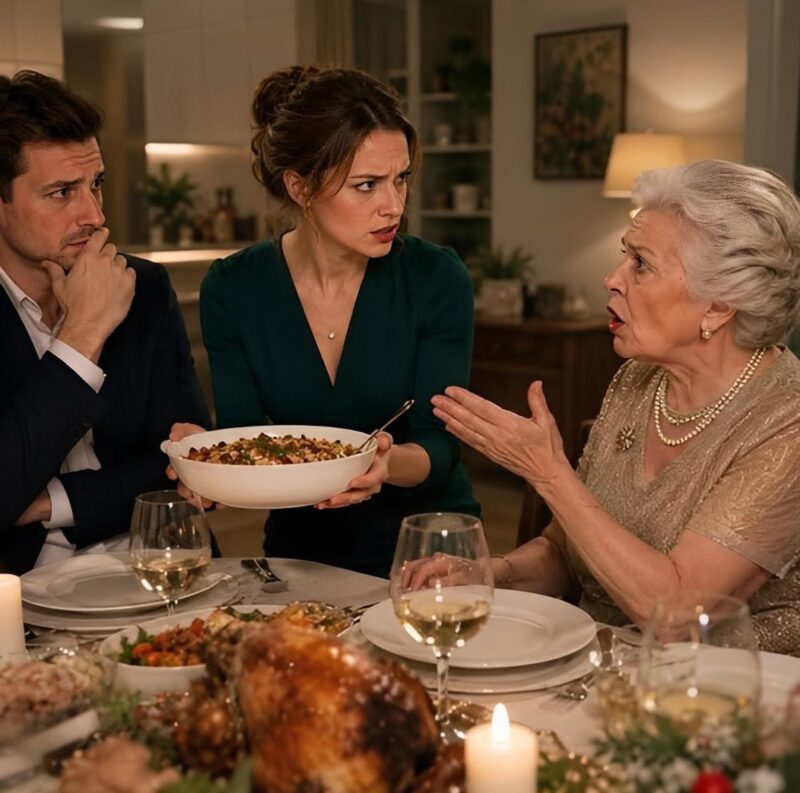
Valentina Sergeyevna chewed slowly, her face fixed in a pensive expression. I knew that look all too well.
“It’s salty,” she finally declared. “And there are too many spices. Meat should speak for itself, not be hidden under a layer of seasoning. It’s also quite fatty—what cut did you use?”
“The shoulder,” I replied evenly.
“There you go. The shoulder is always fatty. You should have used the loin. Now, here’s how I do it: I take the loin, rub it with nothing but salt and garlic—no marinade—and roast it at a very high temperature…”
She went on. And on. She detailed every nuance of her own recipe—how much of what, when, and how. At my holiday table. On my birthday. While everyone else sat in awkward silence, not knowing where to look.
Under the table, Katya found my hand. I felt her grip, firm and warm, like a signal: Hang in there.
I just smiled. I said, “Thanks, I’ll keep that in mind,” then poured more wine and changed the subject.
That night, I lay awake.

I wasn’t angry—not exactly. I was just thinking. My thoughts were clear and cold, the way you think about something you should have dealt with a long time ago.
I had tried. I had spent days cooking for my own birthday. Everyone said it was delicious. Everyone ate with gusto. And at that exact moment—at the peak of my celebration—she felt the need to tear down my recipe and lecture me on the «right» way?
Not later. Not in private. Right then. In front of everyone.
I thought about it for a long time. By morning, I had a plan.
We celebrated Kostya’s birthday at our place too. He wanted it that way—cozy and homey. The same crowd gathered: Valentina Sergeyevna, Natasha and her husband, Uncle Vitya, and a few others.
I enjoyed the cooking this time. I was calm, free of that usual background hum of anxiety—that «what if something’s wrong» feeling. I felt light because I knew exactly what I was doing and why.
I brought out the appetizers first. I went around to everyone with the tray, offering a piece to each guest with a smile. I gave Uncle Vitya an extra slice of the walnut roll he loves. I brought the salmon tartlets to Natasha because I remembered they were her favorite. I made sure Kostya’s friend Seryozha got the herb-and-cheese stuffed peppers he’d raved about once.
I approached Valentina Sergeyevna last.
I held the tray of appetizers in front of me and looked at her—calmly, without defiance, almost gently.
“I’m sorry, but I didn’t cook for you,” I said. My voice was quiet and clear, loud enough for everyone to hear but without a hint of drama or aggression. “At every dinner, you tell me you don’t like my cooking. I don’t want to force you to choke down food you don’t enjoy. That would be quite rude of me.”
The table went dead silent.
Valentina Sergeyevna stared at me. I watched the expressions flicker across her face: first shock, then confusion, then a flash of indignation that searched for an exit but couldn’t find one. Because I hadn’t been mean. I was pointedly, perfectly polite.
“This… this is just…” she began.
“I just want everyone at this table to have a good time,” I said, maintaining that same calm. “Truly.”
The silence stretched for a few more seconds. Then, Uncle Vitya let out a short grunt of a laugh. He grabbed a piece of the roll from the tray and said, to no one in particular, “Liza, this is magnificent.”
Natasha kept her eyes glued to her plate, but I saw the corners of her mouth twitch.
Valentina Sergeyevna stood up. Slowly, with dignity—she always knew how to make a dignified exit. She grabbed her purse. She muttered something to Kostya about her blood pressure and needing a cab. Kostya jumped up to help, but she waved him off with a sharp gesture—she’d handle it herself.
She left.
The door clicked shut quietly. Just a simple click, leaving the hallway empty.
For a few seconds, no one spoke. Then Seryozha said softly, “Well, good for you.”
“It was about time,” Natasha added—and there was so much built-up exhaustion in her voice that I suddenly realized it wasn’t just me. It was her, too. It was everyone.
Uncle Vitya nodded slowly as he chewed. “She’s always like that. To everyone. Her whole life. Everyone just stayed quiet.”
Kostya sat there looking torn—caught between the impulse to run after his mother and the realization that I was right. I placed my hand on his. He looked at me for a long, serious moment, and then he simply nodded. Just once. In silence.
We called Valentina Sergeyevna that evening. Kostya spoke first—at length and gently, showing respect for both her and our marriage. When I spoke, I told her I hadn’t intended to hurt her feelings. It was the truth. All I really wanted was to be heard.
She was silent for a long time. When she finally spoke, she sounded reluctant, as if she were struggling to find the right words.
«Perhaps I really do… overstep sometimes,» she said.
It wasn’t exactly an apology, but it was something. For Valentina Sergeyevna, it was practically a heroic feat.
«Come over next Saturday,» I said. «I’ll make an apple pie.» She paused for a moment before replying, «Your crust isn’t bad.»
I laughed—a real, genuine laugh, without a trace of bitterness.
Not bad. That’s practically a glowing review. I know that now.
You know what the strangest part of this story is? I didn’t have to scream. I didn’t have to let my anger simmer until it exploded, and I didn’t need to stage a massive scene or deliver one of those monologues I’d rehearsed in my head at night. I just had to tell the truth—calmly, politely, and at the right moment.
«I’m sorry, but I didn’t cook for you.»
Seven words. And years of patience behind them.
Sometimes the most important things fit into a single phrase. The key is waiting for the moment you’re actually ready to say it. Not out of spite. Not out of exhaustion. But out of a clear, quiet understanding: things won’t be this way anymore. Not because I’m declaring war, but because I finally respect myself enough to speak up.
The roast pork, by the way, was delicious. I know that for a fact.
And next time, I’m making it again.