A thick, impenetrable shroud of night mist descended over the town of Lisovrat. The ancient, cobblestone road leading to St. Luke’s Cathedral sat deserted. Only an old streetlamp swayed in the wind, casting dancing shadows against the damp stone walls. In this district, where historic manors stood huddled against leaning shanties, life came to a standstill with the final toll of the bell. No one expected that on this starless night, destiny—with its cold, ruthless face—would come knocking at the gates of Grigory Dobroserdov Hospital.
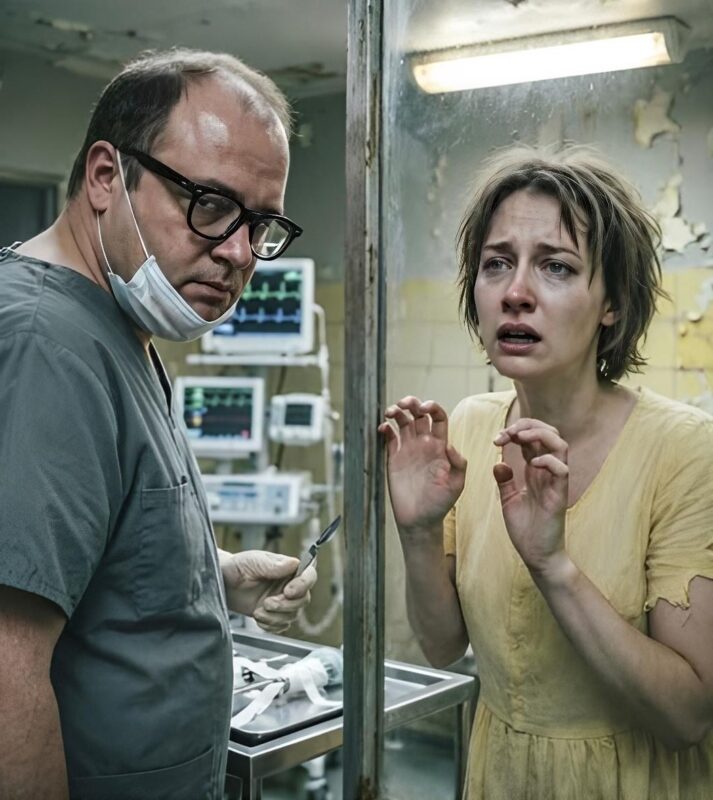
In the receiving ward, thick with the scent of carbolic acid and candle wax, the head nurse, Margarita Leonidovna Zvantseva, stood watch. She was a woman with silver threads in her hair and eyes that had seen far too much sorrow over thirty years of service. She paced, thumbing her prayer beads and glancing at the clock. Her assistant, a young medic named Ksenia Larina, was dozing with her head resting on the registration log. The silence was deceptive, like the eerie calm before a storm. Margarita felt it—a dull, heavy anxiety tightening in her chest—but she couldn’t explain why.
At a quarter to three, the door didn’t just open; it slammed back against the wall. With a crash that shattered the nocturnal silence, two men burst into the hall. They weren’t paramedics. One, a massive man with a face etched in scars, carried a makeshift stretcher cobbled together from rough lumber. The second, short and jittery, clutched a greasy bundle to his chest. On the stretcher lay a boy, no older than twelve. His face, smeared with soot and clay, was twisted in a grimace of agony far beyond his years. He wasn’t moaning; he was silent, and that silence was more terrifying than any scream.
«Help him!» the big man’s voice thundered through the vaulted ceiling. «The mine collapsed! He was pinned!»
Margarita was instantly galvanized. Her weariness fell away like a husk. she stood up abruptly, knocking over her chair. «Get him on a gurney! Ksenia, wake Dr. Miroslavsky—now!»
But Ksenia stood frozen, her eyes wide with horror as she stared at the boy. From beneath the filthy rags wrapped around the child, heavy, dark drops were hitting the clean tile floor. With a practiced motion, Margarita pulled back the fabric and nearly cried out. The boy’s left leg below the knee had been crushed into a bloody pulp. Shards of the tibia protruded through the skin, tangled with shredded muscle and scraps of denim. The tourniquet, tied by an amateur hand, was far too loose; blood continued to ooze in rhythmic pulses.
«We found him in the tailings,» the short man babbled. «We were pulling ore near the Old Shaft, but the shoring was rotten… His name’s Petka. Petr Orlov. The engineer’s son.»
«Where is the doctor?!» Zvantseva barked, feeling a wave of cold fury rising within her. She knew the rules. A patient like this shouldn’t be touched without a surgeon. But the surgeon wasn’t there.
At that moment, a figure appeared in the hallway. It was an elderly man in the loose, grey overalls of a boiler man, his face deeply lined and his hands heavy from years of hard labor. In one hand he held a poker; in the other, a bucket of coal. His name was Efim Savelyevich Platonov. He had worked in the hospital’s boiler room for the last few years—an invisible man, a shadow sliding through the basement corridors. No one really knew where he came from or what his story was. There were whispers he was an exile, but it never went beyond gossip.
Ksenia, rushing out of the office, collided with him, nearly knocking over his bucket. «Dr. Miroslavsky!» she screamed, trying to dodge around the boiler man. «He left half an hour ago! He went to the Mayor’s house—the man had a gout attack!»
The floor seemed to drop out from under Margarita. The nearest surgeon lived three miles away in Zarechnaya; even with a carriage, he wouldn’t be here for an hour. In a situation like this, an hour was an eternity. It was a death sentence.
That was when Efim Savelyevich set his bucket on the floor. The sound was dull and somehow final. He stepped toward the stretcher. His movements were unhurried, but they carried a strange, hypnotic confidence. He nudged Ksenia aside without even looking at her. His eyes, previously dull and weary, suddenly became sharp and piercing, like a scalpel.
«Step back,» he said quietly. His voice was low and gravelly, but possessed an authority that brooked no argument.
«What do you think you’re doing, Efim?» Zvantseva exhaled, grabbing his sleeve. «Don’t touch him! This isn’t like shoveling coal! You’re a boiler man!»
But he gently, almost imperceptibly, freed his arm. His fingers, despite the coal dust ground into the skin, moved with startling grace. He leaned over the boy, squinting slightly as if evaluating a position on a chessboard.
«His popliteal artery is severed,» Platonov said, speaking to no one in particular. «He’s losing too much blood. This tourniquet is garbage. If the vessel isn’t tied off above the crush zone, his heart will stop in five minutes. We’ll have to amputate mid-thigh. Even then, I’m not sure we’ll be fast enough.»
Margarita was stunned. Ksenia stared at the boiler man as if he were a ghost, her mouth hanging open. He didn’t sound like a laborer who had spent his life stoking furnaces. He sounded like a professor delivering a lecture. The terminology, the diagnosis, the prognosis—it all belonged to a world he wasn’t supposed to know.
«How… how do you know all that?» Ksenia stammered.
«It doesn’t matter,» Platonov snapped. His face, lit by the kerosene lamp, looked as if it were carved from ancient oak. «Nurse, I need an amputation kit. And boiling water. Lots of it. And a clean sheet—tear it into strips. Ksenia, prep the chloroform. No ether; he might have a hidden head injury, and we can’t risk vomiting or aspiration. Do you hear me? Move!»
Margarita hesitated for exactly one second. She had seen thousands of deaths and had learned to read the truth in a person’s eyes. In Efim Platonov’s eyes, she saw no madness or ego—only the icy calm of a professional who knew there was no other way. She nodded.
«Do it!»
They wheeled the boy into the procedure room. What followed felt like a fever dream to Zvantseva. The boiler man stripped off his filthy jacket and scrubbed his hands with alcohol. His fingers, which just yesterday were calloused from a shovel, danced over the instrument tray. He selected a scalpel, held it like a violin bow, and with a lightning-fast motion, made the first incision. It was precise, practiced, and without a shadow of a doubt.
Blood surged, coating the table. Ksenia let out a small cry, but Platonov didn’t even look up. He worked with a terrifying focus. He found the artery, nearly lost in the mess of crushed tissue, and deftly clamped it. Then the veins. Then he began to work on the bone. The sound of the saw rasping through bone filled the room. Margarita handed him instruments, mesmerized and terrified all at once. She was watching a man everyone dismissed as a simple stoker perform the highest level of surgical art. He wasn’t just cutting off a leg; he was shaping the stump, suturing nerves, and tying off tiny vessels with a delicate precision she hadn’t seen even from the city’s most famous doctors.
By the time he placed the final stitch and stepped back, exhausted, his face was as grey as his work jacket. He wiped the sweat from his brow with the back of his hand and sank heavily onto a stool. The boy was breathing—steady and deep. The bleeding had stopped. Life was holding on in that broken little body.
At that moment, Dr. Miroslavsky appeared in the doorway. He was flushed and smelled of wine, but looked quite pleased with himself. Apparently, the Mayor’s gout had been cured by a fine dinner. He froze on the threshold, taking in the blood-stained table, the anesthetized boy, and the boiler man sitting in the corner.
«What the hell is going on here?» his voice rose to a falsetto. «Zvantseva! What is this unauthorized madness?!»
Margarita stepped forward, shielding Platonov. «Boris Rudolfovich, the boy’s lower leg was crushed…»
«I can see that!» the doctor shrieked, snatching up the chart. «I’m asking who authorized this surgery? Who dared? Whose work is this?»
Efim Savelyevich rose heavily from his stool. He drew himself up to his full height, looking at the doctor with a gaze of weary resignation.
«It was me.»
Miroslavsky shifted his gaze to the boiler man. His eyes didn’t show recognition, but rather a kind of disgusted bewilderment mixed with horror.
«You? You’re a stoker! You haul coal! Do you have any idea what you’ve done? This is a criminal offense! You’ve killed him!»
«He saved him,» Zvantseva said firmly. «If we had waited for you, the boy would have bled to death. Efim Savelyevich performed a brilliant amputation.»
«Brilliant?!» Miroslavsky let out a hysterical laugh. «He’ll go to prison for this! Immediately! I’m calling the Gendarmerie! And you, my dear, won’t escape punishment for being an accomplice!»
He lunged for the wall-mounted telephone and began furiously cranking the handle.
The Inquiry
Two hours passed. A grey dawn flooded the hospital courtyard. In the office of the Chief Physician—the eminence of the Lisovrat medical district, Professor Aristarkh Veniaminovich Goremykin—a small council had gathered. Goremykin himself, a heavy-set man with a thick, spade-like beard, sat at the head of the table. To his right, Miroslavsky smoked nervously; to his left, Gendarme Captain von Kleist stood with a stony expression. By the door, head bowed, sat Efim Platonov.
«Do you understand,» Goremykin thundered, drumming his fingers on the oak tabletop, «the position you’ve put this hospital in? The position you’ve put me in? Practicing medicine without a license! An underground operation! In my institution!»
«The boy is alive,» Margarita Leonidovna spoke up from the corner. «That is what matters.»
«Silence!» the professor snapped. «A woman of your experience, covering for a criminal!»
«If I may,» Captain von Kleist interrupted. He picked up a thin folder he had brought with him. «This isn’t just about an illegal surgery, Professor. It’s about the identity of the culprit. Citizen Efim Savelyevich Platonov is not who he claims to be.»
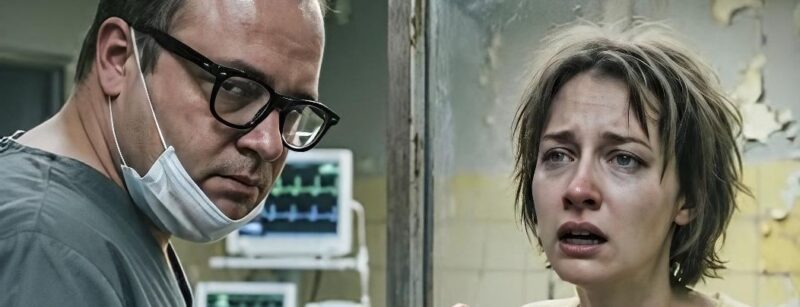
A ringing silence filled the room. Platonov looked up. There was no fear in his eyes, only a profound, endless exhaustion.
«This man’s real name,» the Captain made a theatrical pause, «is Veletsky. Efim Stepanovich Veletsky. Former Surgeon-in-Ordinary of the Imperial Hospital at Tsarskoye Selo. He was convicted by a court-martial twelve years ago. For treason.»
The words hit the room like lead weights. Margarita Leonidovna gasped. Miroslavsky choked on his smoke. Goremykin’s face slowly turned crimson.
«The charge,» the Captain continued, glancing at the papers, «states that during the war, while attached to an enemy field hospital as a Red Cross observer, Dr. Veletsky provided surgical aid to high-ranking enemy officers. He evacuated them under fire, risking the lives of our own soldiers. The military tribunal deemed this aiding the enemy and sentenced him to fifteen years of hard labor. He escaped during transport and has been living under forged documents ever since.»
«My God…» Goremykin breathed. «A war criminal was hiding in my hospital as a stoker! This is… this is a catastrophe! Captain, do your duty!»
Von Kleist approached Platonov and placed a hand on his shoulder. «Efim Stepanovich, you’re coming with me.»
Then, Margarita Leonidovna took a step that erased any hope for a peaceful retirement. She walked to the center of the room and stood between the Gendarme and the surgeon.
«Wait,» she said, her voice trembling not with fear, but with fury. «You call him a traitor. But I saw his hands tonight. Those hands saved a child. I don’t know what happened during the war. I have seen only chaos, blood, and filth—and he brought order to that chaos. A traitor does not risk everything to pull the son of a common miner back from the brink of death.»
«That is sophistry, Nurse,» Goremykin grimaced. «The law is the law. He broke it then, and he broke it now.»
«The law?!» Zvantseva was nearly shouting. «Where was your law when Dr. Miroslavsky went to treat a rich man’s gout, abandoning the ER? Where is the law that says this brilliant doctor must hide in a boiler room because he once showed mercy to the ‘wrong’ people? I am not a lawyer. I am a simple nurse. But I know the truth. The truth is on that operating table, and it has an amputated leg and a beating heart!»
The room fell quiet. Von Kleist looked thoughtfully at the elderly woman. For a moment, something resembling respect flickered in his eyes.
«Very well,» he said finally, removing his hand from Platonov’s shoulder. «I won’t take him just yet. I will conduct an inquiry and interview witnesses. But don’t get your hopes up. This is an old case. The sentence was final.»
The Town Awakens
For the next few days, Lisovrat was a boiling cauldron. The story spread like a wildfire from hospital beds to the streets. Margarita Leonidovna, risking her job and her freedom, called everyone she knew. She found the saved boy’s mother, a quiet, downtrodden laundress. She found the father, who, returning from the mine, fell to his knees at the hospital gates. She summoned Father Mitrofan from St. Luke’s, a priest who had administered last rites to the dying and knew the true price of mercy.
By the evening of the third day, a crowd stood outside the Gendarmerie. Miners, straight from the coal face and black with dust, stood in a solid wall. They didn’t shout slogans. They stood in silence, caps in hand. They were joined by shopkeepers, merchants, cabbies, and even low-level clerks. Many held candles.
The news that an «angel in the boiler room» had saved a boy, pulling him back from the afterlife, did what newspaper editorials never could. The people understood one simple thing: this man, whatever his past, was a saint today. And they would not let him be taken.
Father Mitrofan tolled the bell. A slow, somber chime floated over the city. It wasn’t a knell for the dead, but a cry for justice.
The Verdict
In Captain von Kleist’s office, Professor Goremykin sat with an unexpected guest—a stooped man in an expensive coat, carrying a briefcase stuffed with papers. This was a solicitor Margarita Leonidovna had found using her last savings. He had filed a petition for a royal pardon.
«Do you realize what you’re doing?» Goremykin asked him. «Those at the top don’t like revisiting wartime cases.»
«Times change,» the solicitor replied dryly. «And those at the top can read. Right now, the entire province is reading about the case of this doctor.»
Margarita Leonidovna visited Veletsky in his cell. She had been granted a brief meeting. Efim Stepanovich sat on the cot, hunched over. He looked up, and she saw that he had been crying.
«Why did you start all this, Nurse?» he asked softly. «It wasn’t worth it. My life is over.»
«Your life just saved a boy,» Margarita said firmly. «And it will save others. We won’t let you fade away.»
She handed him a bundle containing a clean shirt, a piece of pie, and a small icon of St. Luke the Healer. «They’re all out there,» she nodded toward the window. «The whole town. They’re with you.»
The final conversation took place late that night in Professor Goremykin’s office. Von Kleist arrived alone and placed a telegram on the desk.
«From the capital,» the Captain said wearily. «The Senate has requested Veletsky’s file. His case was brought up by old comrades—men who knew the truth. It turns out he wasn’t just saving officers. He saved children from a burning hospital. Enemy children, yes, but children nonetheless. He was framed by a staff officer who wanted to hide his own cowardice.»
Goremykin stared at the paper for a long time, then turned his gaze to the portrait of the Emperor. «What happens now?»
«Nothing,» von Kleist gave a grim smile. «In the light of day, cases like this turn to dust. The conviction will be overturned. He will receive a full exoneration.»
The Professor stood up and paced the room, the floorboards creaking under his weight. He stopped at the window, looking at the crowd that refused to disperse despite the freezing rain.
«Very well,» he said at last. «If that’s the case… I am restoring him to his position. Not as a stoker. As a surgeon. I need a master like him desperately.»
A New Beginning
A week later, an event took place at the Grigory Dobroserdov Hospital that people would talk about for years. The entire staff gathered in the assembly hall. Efim Stepanovich Veletsky—clean-shaven, poised, and wearing a blindingly white lab coat—stood before his colleagues. Margarita Leonidovna pinned an «Excellence in Medicine» badge to his lapel. Old Professor Goremykin read the order appointing Veletsky as the Head of Surgery.
In the lobby, people crowded in—not as patients, but as guests. Petka Orlov’s mother presented the surgeon with bread and salt on an embroidered towel. Petka himself, still pale but smiling, sat in a wheelchair. His life had been saved.
That evening, as the hospital grew quiet, Dr. Veletsky stepped out onto the porch. Margarita Leonidovna stood beside him. They looked out at the town sinking into the winter twilight. From the bell tower of St. Luke’s, the bells began to chime again. This time, it was an Easter peal—solemn and joyful.
«You know, Nurse,» Veletsky said quietly, watching the streetlamps flicker to life, «I thought my life ended ten years ago. I was wrong. It’s only just beginning.»
«God doesn’t make mistakes, Efim Stepanovich,» Zvantseva replied, wrapping herself in her wool shawl. «He simply moves some people out of the way to put others in their place. Sometimes, he pulls them from the very dirt. From the coal dust.»
Veletsky smiled, clutching the small icon of St. Luke in his hand. The guardian angel in the blue stoker’s uniform was gone forever. In his place stood a surgeon in a white coat, whose hands no longer smelled of coal, but of carbolic acid and hope.
Over the snow-covered streets of Lisovrat, the bells rang out, announcing the victory of mercy over the letter of the law—the victory of light over the dark. And in every house where a light was lit that evening, people told the story of the miracle created by simple faith in a human being.