In that moment, something inside me snapped. I grabbed the microphone, faced the entire room, and said, “If you wanted a perfect wedding, you should’ve treated my father like a human being.”
What happened next didn’t just ruin the reception—it leveled everything.
The Insult
The humiliation started before the first bottle of champagne was even popped.
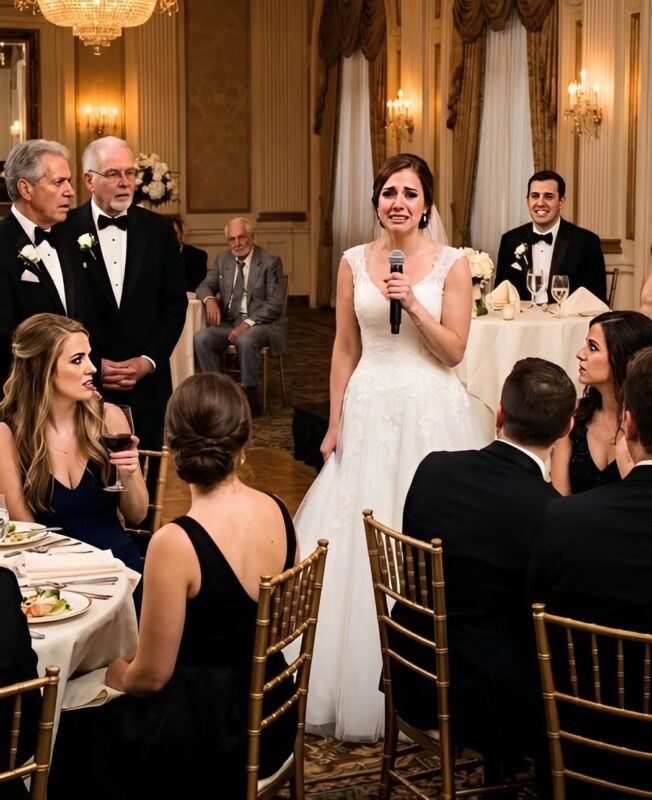
Our reception was held in a restored hotel ballroom just outside Chicago—all golden light and soft music. When my father walked in, he was wearing the only suit he owned: a charcoal gray number, hand-pressed, with cuffs slightly shiny from years of wear. He’d spent thirty years working twelve-hour shifts as a city bus mechanic. If you looked closely, you could see the quiet dignity in the way he carried himself.
But my fiancé’s family didn’t look closely. They looked cruelly.
I was mingling with guests when I heard my future mother-in-law, Diane Whitmore, let out a sharp laugh behind me. “Well,” she said, loud enough for half the room to hear, “I suppose not everyone shops for formalwear in the same places.”
Her husband, Charles, gave my father a dismissive once-over. “Someone should probably show him where the staff entrance is.”
A few people chuckled. My stomach dropped.
My father, Harold, wore the same weary smile he’d used his entire life whenever wealthy people tried to make him feel small. “I’m just here for my daughter,” he said quietly.
The Breaking Point
That should have been the end of it. It wasn’t.
My fiancé’s younger sister, Vanessa, raised her wineglass. “Then maybe he should sit somewhere less visible,” she remarked. “This is a formal event, after all.”
Less visible.
Suddenly, a wedding coordinator I hadn’t even hired approached my father and informed him there had been a “seating adjustment.” They moved him from the family table to a back corner near the service doors, tucked away behind a broken centerpiece.
I looked at Ethan, my fiancé, waiting for him to stop this. I waited for him to call it what it was: insane, humiliating, and unforgivable. Instead, Ethan just smiled. It wasn’t a nervous or confused smile—it was complacent.
He leaned in and whispered, “Please, don’t make a scene. My family cares about presentation. Your dad will be more comfortable back there anyway.”
The Reckoning
For a second, the room felt like it was tilting on its axis.
I looked across the ballroom at my father. He was sitting alone at a table where no father of the bride should ever be, adjusting his old jacket as if he were apologizing for taking up space. This was the man who skipped meals so I could finish college. The man who fixed my first car with his bare hands. The man who never once let me see how hard the world had hit him.
The band kept playing. Glasses clinked. Ethan’s family looked like they’d already won.
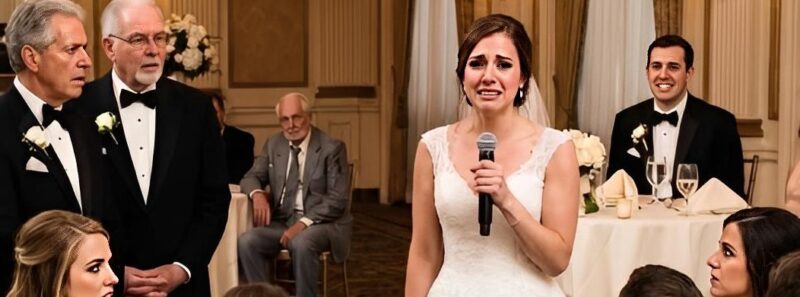
So, I walked over and took the microphone from the wedding singer. I turned to face the room and said, “Before this night goes any further, there’s something every person here deserves to know about the Whitmores—and about the man they just tried to hide at the back of my wedding.”
The music cut out so abruptly that the final piano note seemed to vibrate in the silence.
Every face in the ballroom turned toward me. Ethan reached for my arm, but I stepped back before he could touch me. I had spent two years loving him and six months planning a wedding with him, only to spend the last ten minutes realizing exactly who he was.
“My father,” I said into the microphone, my voice steady and sharp, “is the reason I’m even in a room like this. He worked years of overtime so I could go to Northwestern. He emptied his retirement fund when I wanted to go to law school. He sold his truck when my rent doubled during my second year. And tonight, this family treated his hard work like it was something to be ashamed of.”
The room went stone-cold.
Diane’s practiced smile vanished. Charles stiffened. Vanessa crossed her arms, trying to look annoyed to mask her nerves. Ethan leaned in, hissing through clenched teeth, “Claire, stop.”
I didn’t even look at him.
“You care so much about appearances,” I continued. “So let’s talk about them. Let’s talk about the ‘image’ of success the Whitmores sell to this city.”
That got their attention.
The Whitmores weren’t just rich; they were prominent. Their names were plastered on charity programs, development boards, and political fundraisers. Charles Whitmore ran the Whitmore Hospitality Group, and Ethan was groomed to take over the legal side. But in a twist of pure, ugly irony, I had spent the last eight months helping dismantle them.
As a corporate attorney specializing in labor compliance, I’d been handed a case involving a hospitality shell company. Missing overtime, payroll discrepancies, and kickbacks—at first, I didn’t realize the trail led back to Ethan’s family. But once I found the connection, I didn’t say a word. I wanted proof, not just suspicion. So I kept digging.
I found everything.
“I know about the falsified wage reports,” I said. “I know about the off-the-books settlements and the managers instructed to scrub immigrant staff from the payroll before audits. I know about the real estate transfers used to hide your liabilities.”
The silence that followed was heavy and dangerous.
Charles stood up, his face reddening. “You’ve lost your mind.”
I reached over to the DJ table and picked up a folder I’d set there twenty minutes ago, right after I saw my father being shoved into the corner. I held it up for the room to see.
“No,” I said. “I’m a lawyer. And I’m prepared.”
Ethan went pale. “Claire—”
“I held off on filing this because I thought I was marrying a man with a spine. But you stood there smiling while your family humiliated my father. So, here’s the truth: the report was submitted this afternoon to state labor authorities, the IRS, and two investigative journalists. Oh, and that prenup you kept pushing? I never signed it.”
The room erupted in gasps.
I slid my engagement ring off, set it on the head table in front of Ethan, and said, “This wedding is over.”
For three seconds, nobody moved. Then, the ballroom exploded.
Diane’s chair screeched against the floor as she stood. Vanessa started screaming that I was a liar. Charles lunged toward me, but he was blocked by two guests—both downtown judges the Whitmores had invited to flex their influence. They told him to calm down. Ethan just stared at the ring, looking like he still believed he could manage this with a private conversation and the right PR spin.
That was always his mistake. He thought the truth was negotiable.
My father stood up from the back table, looking more worried for me than for himself. Even after everything, his first instinct was to protect me. I walked down the center aisle, past the candles and the hundreds of staring eyes, and met him halfway. He looked embarrassed, as if this disaster were his fault.
“It’s okay, Dad,” I told him.
He shook his head. “Claire, I never wanted this for you.”
“I know,” I said. “That’s exactly why I’m doing it.”
One of the reporters I’d tipped off was already there, attending as a guest of a guest. He didn’t need to approach me; he had the documents, the scene, and the look of pure panic on the Whitmores’ faces.
My maid of honor, Jenna, appeared at my side with my purse, my keys, and the flats I’d packed “just in case.” Smart woman. Behind her, guests were already beginning to slip out. A few stopped to shake my father’s hand, apologizing for not speaking up sooner. One older woman looked him in the eye and said, “Sir, you have more class than anyone in this room.” For the first time that night, my father truly smiled.
By Monday, the story was everywhere. State investigators confirmed the inquiry, and former employees began coming forward. The Whitmore Foundation canceled its gala, and their properties were placed under review. Ethan sent a barrage of emails—damage control disguised as regret—but I never replied. There was nothing left to say.
A month later, my father and I grabbed dinner at a small steakhouse by the lake. No crystal chandeliers, no performances—just peace. He wore the same old suit jacket because he liked it. This time, I said what I should have said years ago.
“You always looked respectable to me, Dad.”
He looked down at his hands and laughed softly. “That means more than you know.”
I didn’t destroy their empire in one night. They destroyed it themselves with greed and arrogance. I just refused to help them keep the secret.
So, tell me: when the moment comes, would you protect the person who raised you—or the people trying to impress the room?