By the time I spotted my daughter’s sedan in the far corner of the Whole Foods parking lot, the sun was already dropping behind the shopping center, turning the windshield into a sheet of dull orange fire. At first, I thought she was just waiting for someone—maybe finishing a phone call or trying to get a stubborn child to nap before driving home to the suburbs.
Then I got closer. I saw the thin fleece blanket in the back seat and the tiny sneakers on the floorboard next to a pile of toys. My grandson was curled up with the cramped, defensive stillness of a child who has learned to sleep wherever the world allows it.
That was the moment the air in my lungs changed. I knew something was terribly wrong. I knocked once, then harder, the sound sharp against the glass, until my daughter startled awake. Terror flashed in her eyes before recognition finally settled over her face.
She didn’t smile at me. Instead, she lowered the glass just an inch, barely enough for her voice to squeeze through the gap.
“My husband and his mother threw me out of the house you bought for us,” she said. The words landed in my chest like something heavy enough to crack bone. The worst part wasn’t even the statement itself; it was the way she said it—as if she had already accepted this cruelty as reasonable.
I stood there, my heavy purse hanging from one shoulder and my groceries forgotten in a cart somewhere behind me, staring at her. Callista was thirty-one. She was strong and funny when life hadn’t wrung the light out of her, but now her hair was tangled and her skin looked papery with exhaustion.
“Open the door,” I said firmly. She hesitated. That hesitation told me everything—she had been trained to worry about everyone else’s reaction before her own survival.
When she finally unlocked the car, I pulled the back door open first; some instincts never leave a mother. I rested my hand lightly on little Toby’s shoulder to make sure he was actually asleep and not just pretending. Then I looked back at Callista and gave her the only command that mattered: “You and Toby are coming home with me right now.”
She swallowed hard and wiped her face, as if tears were somehow embarrassing under the flickering fluorescent parking lot lights. “Mom, I don’t want to cause any trouble,” she whispered, her voice broken.
“The trouble,” I said, looking her dead in the eye, “is not you.”
We drove back to my place in silence, except for Toby waking up just long enough to ask for chicken nuggets and if my guest bathroom still had the blue shark towels. Children are merciful that way; they don’t always know when they’ve stepped through a door that divides life into «before» and «after.»
Callista kept her hands clenched in her lap the whole ride, staring out the window as if the city of Mesa had become a place where she no longer belonged. That night, after Toby was bathed and asleep, I sat at the kitchen table with a mug of coffee that went cold long before I drank it.
Callista tried to say she was tired and would explain tomorrow, but I could see the way she kept glancing toward the hallway. She was terrified, even here. Fear like that doesn’t arrive in one dramatic scene; it’s built slowly, one humiliation at a time, until it becomes part of the furniture.
Five years earlier, when she married Austin Miller, I wanted to give her a foundation no one could ever threaten. I sold the last piece of acreage my father had left me in Arizona and put the money into a tidy three-bedroom house with a maple tree out front in the Silver Creek district.
The deed stayed in my name because I believed in paperwork even when I believed in love. But in every way that mattered, I gave them a home. Callista cried when I handed her the keys, and Austin hugged me with both arms, promising he’d take care of her forever.
Promises are funny things. The good ones become scaffolding; the bad ones become camouflage for something darker. For the first year, everything looked perfect from the outside—social media posts of Sunday pancakes and backyard birthday candles.
But little by little, my daughter started canceling our lunch plans. She stopped dropping by after work because Austin thought evenings should be «private family time.» Then she stopped working as a librarian altogether because he told her it made more sense for one parent to stay home.
His mother, Frances, insisted a good household needed «structure» rather than daycare. I wanted to believe my daughter had simply entered a busier season of life. But sitting across from her now, I could see how all those small explanations were just stepping stones leading to this moment of total control.
The next morning, sunlight spilled over my kitchen counters as if ordinary life were rude enough to continue despite the tragedy. While Toby watched cartoons in my bedroom, I sat across from Callista with a legal pad and a pen.
“Start at the beginning,” I said gently. “And don’t leave out a single ugly thing just to protect my feelings.”
She stared at her hands for a long time before the words started coming. Her voice sounded raw, as if she were scraped thin from carrying too much weight. It started after Toby was born. Frances began «helping,» but that help soon turned into constant opinions on nap schedules and how a wife should behave.
Austin stopped correcting his mother and eventually started agreeing with her every time she criticized Callista. What followed was a campaign of daily erosion—Frances criticized the way my daughter folded towels or seasoned the food. Austin would ask why she took everything «so personally» until Callista began apologizing for her own emotions before she even felt them.
Then came the financial isolation. Austin handled all the bills because he claimed to be «better with numbers.» He took over the checking account and questioned every purchase as if she were an employee submitting expenses to an irritated manager. By the time she realized she had to ask permission to buy Toby new shoes, the cage was already built.
I wrote it all down without interrupting, but the next part made my fingers tighten around the pen until they ached.
“He changed the security code on the house alarm once and claimed I just kept forgetting it,” Callista said quietly.
Then she told me how Frances started staying overnight more often until her things were everywhere and the house felt like it belonged to everyone except my daughter.
“And what happened yesterday?” I asked.
Callista pressed her lips together. She explained that Frances had called her lazy and claimed she contributed nothing to the household. “I told her she needed to leave, but Austin took her side. He told me to pack my stuff and go ‘cool off’ somewhere else,” she whispered. He even texted her later, telling her not to come back unless she was ready to apologize to his mother for being disrespectful.
I reached into my purse, pulled out the original house keys, and set them on the table beside her phone.
“Mom, the deed is still in your name, right?” she asked, a tiny flicker of hope in her eyes.
“Yes, it is,” I said.
That single word reintroduced reality into a situation built on lies. Austin and Frances had made her feel powerless, but they had never actually made it true.
Houses have paperwork, and paperwork has a memory that doesn’t care who speaks the loudest in an argument. I asked to see her messages, and Callista unlocked her phone. She showed me the texts telling her to leave—orders not to «create a scene.»
The messages from Frances were even uglier. She told Callista she should be grateful she was even «allowed» to stay in the house as long as she had. As I kept scrolling, I found months of belittling messages, questioning where she was and why she had spent twelve dollars more than expected at the grocery store.
None of the texts contained physical bruises, but every single one of them had left fingerprints on her soul. Before lunch, I called my old friend Miranda. She’s the kind of attorney who looks like a sweet piano teacher but acts like a surgeon in a courtroom.
Miranda asked if the deed was still in my name and if I had proof that Austin had thrown my daughter out. When I confirmed everything, she told me not to warn them. “Meet me at the county records office in an hour,” she said.
While Toby played on the rug and Callista paced the kitchen, I dug through my file cabinet. I gathered the original purchase papers and the tax receipts, adding the printed screenshots of Austin’s abusive messages to the stack.
Miranda met me in the records room. She scanned the history of the house, her voice going flat with professional anger. “Someone attempted to file a quitclaim transfer six weeks ago,” she revealed. “It was rejected because the signature didn’t match.”
My stomach tightened. I realized they had tried to steal the house itself while convincing my daughter she had no claim to anything inside it. Miranda requested a copy of the rejected filing. We were no longer just dealing with a family dispute; we were looking at property fraud and an illegal lockout.
She told us we needed to get Callista back into the house immediately with a police standby to retrieve her belongings and inspect the property. Later that afternoon, after leaving Toby with a trusted neighbor, we drove toward the house.
A patrol officer met us in the driveway on Larkspur Lane to keep the peace. The front porch looked exactly as it always had, which felt like an insult given the cruelty that had been happening behind that door. I tried the deadbolt with my original key, but it wouldn’t turn. Austin had replaced the locks to keep us out.
“Try the side door through the mudroom,” Miranda suggested with a knowing look.
That door opened on the first turn. I stood in the doorway for a heartbeat, feeling the strange emotional temperature of the place. It used to hold laughter and crayons, but now it felt curated and cold, as if it were under constant surveillance.
Callista stepped inside like a ghost returning to a place she no longer recognized. The family photos along the hallway had been replaced with bland landscape prints that revealed nothing about the people living there. The first thing she noticed was Toby’s room. It had been stripped of his dinosaur comforter, and his toys were packed into boxes labeled for storage.
I moved through the house and found Frances’s things in every drawer where my daughter’s belongings used to be. Then, Miranda opened the linen closet. Tucked behind the extra towels, she found bundles of mail tied with rubber bands.
Callista knelt on the tile and began pulling out letters from the school district and bank statements she had never seen. One envelope contained a job offer for a teaching position with better pay—an application Callista thought had been ignored months ago.
“I thought they forgot about me,” she whispered, her face folding in on itself with grief.
There were also late notices for credit cards she’d never opened and a change-of-address confirmation she’d never submitted. Each envelope was a tiny verdict on the life someone else had been constructing in her name while she was being isolated.
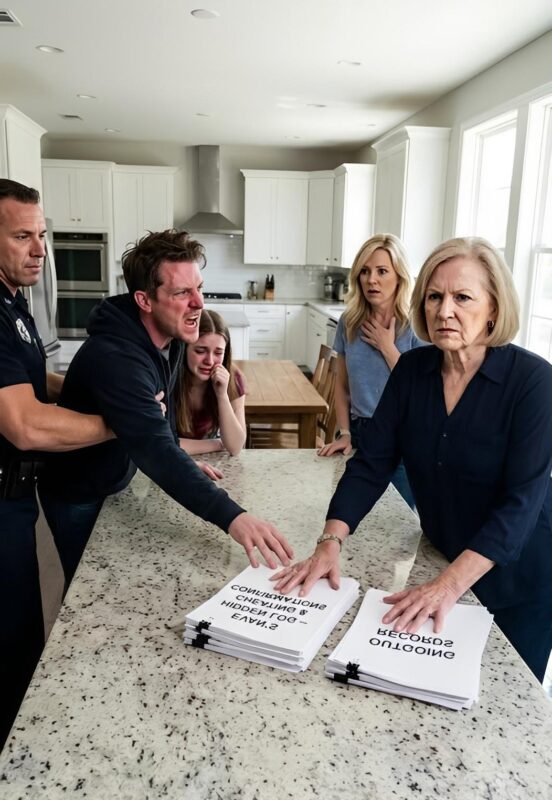
We entered the small home office and found the shelves lined with Austin’s binders instead of my daughter’s books. I opened a file on the desk and found a packet of forms titled Quitclaim Deed with my name typed beneath a signature line. Beside the forms was a yellow sticky note with three shaky practice signatures where someone had tried to forge my handwriting.
Callista covered her mouth in shock while Miranda photographed every page. In the second drawer, we found a spiral notebook in Frances’s handwriting. It was filled with dated notes under a heading that read “CUSTODY.” She had documented every time Callista cried or felt overwhelmed, building a fake case for a kidnapping.
“You said there were cameras?” I asked my daughter. She pointed toward the smoke detector, where a tiny light was blinking. Miranda explained that the whole house had been turned into a surveillance zone.
“Call him,” I said firmly. Callista put the phone on speaker. Austin answered with a smug tone.
“Are you ready to stop being dramatic?” he asked. I spoke before he could say another word.
“She’s standing in the kitchen of the house I own,” I told him. “You and your mother should get here right now to explain the fake deed and the hidden mail.”
The line went dead immediately. We waited in a silence that felt like a stretched wire. Miranda called the fraud unit while the officer stayed near the front door. I told Callista she wasn’t crazy, and that sentence finally broke her. She sobbed into my shoulder.
When Austin’s truck pulled into the driveway, he slammed his door, trying to look like an innocent man being harassed. Frances followed him inside, immediately claiming we had no right to go through their «personal things.»
“This isn’t harassment; it’s discovery,” Miranda replied coolly, showing them the forged paperwork.
Austin tried to claim he was just handling the bills because Callista «wasn’t capable,» but his excuses fell flat against the evidence of the stolen mail. Frances tried to play the concerned grandmother, but her words died when Callista showed her the “CUSTODY” notebook.
Austin made the mistake of trying to snatch the notebook away. The officer pinned him against the wall and handcuffed him on the spot. “Don’t touch the evidence,” the officer warned. Frances began screaming as if she were the victim.
The fraud investigators arrived and began documenting the cameras and the stolen identity documents. When they finally led Austin outside, he tried to blame his mother for «getting carried away,» but Callista finally stood up.
“You told me I had nothing,” she said to him. “But you were living off my mother’s generosity while trying to steal my future.”
Frances was served with a notice that her permission to stay was revoked. We spent the rest of the evening securing the property. I stayed late after Callista went back to my place; the house needed to learn how to be still again.
Over the next few months, we worked with the banks and the school district to repair the damage. The charges for forged documents eventually stuck, and the narrative they used to protect themselves collapsed.
We repainted Toby’s room together. I watched my daughter slowly start to inhabit her own space again without flinching at every sound. One evening, sitting on the porch, I told her she wasn’t foolish for staying—she was simply worn down by people she trusted.
That fall, I handed her a new set of keys and the paperwork for a legal trust to protect the home from any future manipulation. She cried happy tears this time while Toby ran around the yard hunting for fireflies.
Safety had to be rebuilt by hand, but we did it together. The people who tried to throw her out only succeeded in showing her that the door was never theirs to close in the first place.