“She fainted? She’ll live. Our flight with your sister leaves at six,” Dad said, and they walked right out the door.
I spent nine days alone in that hospital ward. Then they strolled back in, acting like they owned the place and ready to sign me out.
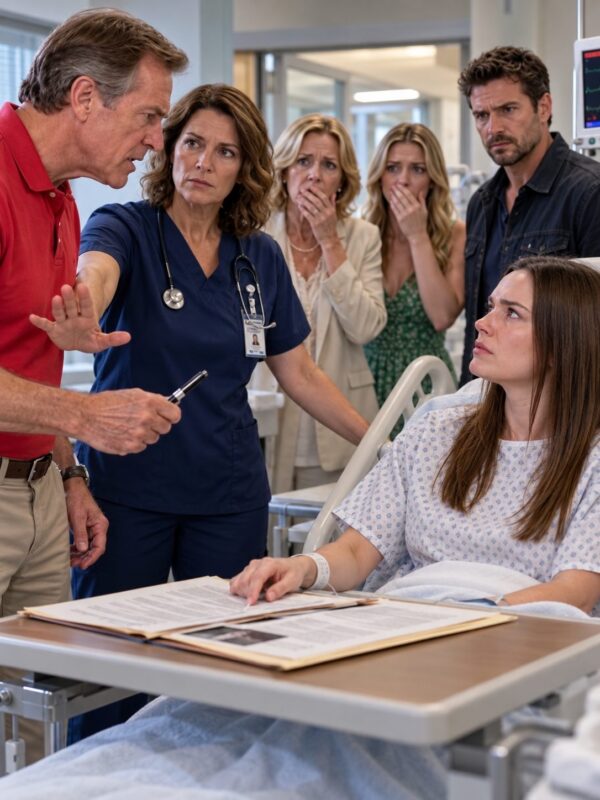
The head nurse blocked the doorway. “She’s not yours to discharge anymore. Ask the man who—”
“Where do I sign?” Dad asked, flashing a smile like this was a cocktail party, not a cardiac unit.
Ruth Vance, the charge nurse, stepped right up before he could reach my bed. “There’s nothing for you to sign.”
His smile barely wavered. “We’re her parents.”
Ruth didn’t even blink. “That doesn’t give you authority here.”
I stayed quiet.
For thirty-four years, my family had treated my silence like surrender. They had no idea that, resting on the tray table beside me, an old manila folder had already changed everything.
Nine days earlier, I had driven to my parents’ house before dawn to see them off. My younger sister, Camille, had an engagement gala in Charleston, and they were flying out that morning. Suitcases lined the hallway. My mother was fixing her lipstick, and my father kept refreshing his phone to check the flight status.
Then my heart lost its rhythm.
I hit the kitchen tile hard enough that my world narrowed down to the sight of their shoes, the cabinet doors, and the underside of a chair. My sister’s immediate reaction wasn’t panic; it was pure irritation.
“Is she doing this right now?”
A paramedic knelt beside me and studied the monitor. His expression instantly shifted.
“This isn’t a fainting spell. We need to transport now.”
My father already had his keys out.
“She’ll live,” he said, waving a hand. “Our gate’s at six.”
Then they left. All three of them. They went to celebrate Camille while an ambulance rushed me in the opposite direction.
—
I spent the first few days in that cardiac unit with an empty visitor chair parked right beside my bed. No one came. The family group chat lit up instead with champagne dresses, glittering chandeliers, smiling photos, and captions boasting about how proud they were of “our girl.”
My phone never rang.
That hurt, but it wasn’t new.
I had been fainting since childhood—at nine, at eleven, at seventeen. Every single time, my parents came up with a new excuse. I was too sensitive. I was dramatic. I was jealous. Overwhelmed. Just looking for attention.
Eventually, I stopped asking them to believe me.
I grew up, went to college, and became an engineer instead. I learned how to calculate stress loads, figuring out precisely what a structure could carry before it failed. I got very good at knowing when something was under too much weight.
I just never applied that math to my own family.
—
Then Dr. Lindren, the electrophysiologist assigned to my case, found something buried in my records.
A gap.
A pediatric cardiology referral from when I was nine years old. A small note about a prolonged QT interval. And then… nothing. No follow-up. No medication. No monitoring.
“The file just stops,” she told me.
The next morning, she came back into my room carrying a physical record. Not a tablet, not a laptop—a real, tangible folder. Old manila, soft and frayed at the corners. My childhood name was written across the tab in faded ink.
She placed it gently on my tray table and opened it. Inside was an ECG from twenty-فاive years ago. Inside was a specialist’s direct recommendation. And behind that was one final page she refused to read to me at first.
She turned the folder around. “You should see this yourself.”
I did.
And from that exact moment on, I stopped wondering whether my parents had simply failed to understand.
—
Now, they were standing in my hospital doorway, sun-tanned and relaxed from their trip, and my father still believed he was entirely in control.
“We are taking our daughter home today,” he said, his voice dropping into that calm, dangerous, practiced tone people use when they expect institutions to automatically bow to them. “If you need a supervisor, get one.”
“I *am* the supervisor,” Ruth said flatly. “And Florence is not being released to you.”
My mother’s face tightened. Camille stopped smiling entirely.
Dad looked past Ruth, locking eyes with me, waiting for the version of me who always fixed things for him. The daughter who softened every rough edge. The daughter who always said, *It’s fine. Let’s just go home.*
I said nothing.
His jaw shifted.
Ruth continued, “You are not authorized to make medical decisions for this patient.”
That was the first real crack in his armor.
My father let out a single, short, disbelieving laugh. “That’s absurd.”
Then, a chair scraped against the floor behind me.
Someone who had been sitting quietly in the corner stood up.
My father’s face drained of color before the man even spoke. It wasn’t anger on his face—it was sheer recognition. And fear.
“Hello, Dad,” Reed said.
My brother hadn’t been part of our family for six years. At least, that was the official story my parents always told people.
What they didn’t know was that a single piece of paper had kept his name legally connected to mine the entire time. And they knew even less about the folder sitting right on my tray.
Dr. Lindren picked it up, stepped across the room, and placed the yellowed medical record under the bright fluorescent lights, directly in front of my parents.
My mother stared blankly at the wall. My father stopped clicking his pen.
Dr. Lindren turned to the very last page. Two signatures were clearly visible at the bottom. She rested a single finger beside a handwritten note, then looked straight at my mother.
“Mrs. Young,” she said quietly, “would you like to read what you wrote here twenty-five years ago… or shall I?”
My mother finally looked down.
Doctors read charts. That’s their job.
I didn’t know that one of the best doctors in the building had spent her night tracing twenty-five years of my medical history, and discovered—buried in the oldest pages—a gap shaped exactly like the truth.
Dr. Lindren arrived at nine carrying a laptop. There was a stillness about her that made the room feel heavy before she even spoke. She introduced herself as an electrophysiologist, explaining that she specialized in the heart’s electrical system: its rhythm, its timing, its signals.
My entire problem, apparently, had always been about timing.
My heart knew how to beat. It simply couldn’t always be trusted to keep to a schedule.
“I’ve been going through your records,” she said, settling into the chair. The empty chair finally had a body in it, though not one I was related to. “Florence, I want to ask you something, and I want you to think carefully before you answer.”
Okay.
*When were you first told there was something wrong with your heart?*
My first instinct was to say never. That was the official family version, after all. Nothing was wrong. I was fine. I was just being dramatic. I was fine.
But Dr. Lindren watched me with an intensity I wasn’t accustomed to. Her question carried weight, like she already knew the answer and just wanted to see if I did, too.
“They said I was sensitive,” I said slowly. “I fainted a lot as a kid. They took me to a doctor once, I think, when I was really little, and then… we just never went back.”
Dr. Lindren turned the laptop toward me.
“That’s the part I want to talk about,” she said. “Because according to your own chart, someone flagged this when you were nine years old.”
The monitor continued beeping above us—steady, slightly fast, counting out the years I had lost.
Then she said softly, “The file just stops.”
Those four words changed the room.
On the screen was an entry from when I was nine. A referral. A specialist. And a phrase I didn’t yet understand: *Prolonged QT interval.*
It sat in the medical record like a stone beneath clear water, visible all along if anyone had bothered to look. Below it was nothing. No follow-up. No treatment. A lifetime of silence recorded as blank space.
“I remember that doctor,” I said.
The memory returned cold and complete. An office with a fish tank. Cold metal stickers pressed across my chest. My mother holding my hand in the waiting room, telling me to sit still and not make a scene.
“Do you remember going back?”
“No.” I searched my memory honestly. “We never returned.”
For years, I had assumed that meant there was nothing to return for. They had checked. I was fine. The fainting was just me being me.
Dr. Lindren stayed quiet for a long moment, choosing her words with care.
“Florence, I don’t want to get ahead of the record. I’ve ordered your full pediatric cardiology file from the archive—the actual paper pages, not just the digital summary. It should be here tomorrow.”
She closed the laptop. “But I need you to know something right now, so you can rest tonight understanding it. What you have is a real, physically dangerous condition. It is not sensitivity. It never was. And it doesn’t go away just because someone decides not to look at it.”
I went completely still.
Twenty-five years. Twenty-five years of being treated like the girl who cried wolf, who invented her own symptoms for attention. And proof that I hadn’t invented a damn thing had been sitting in a file the entire time. One records request away from anyone who actually cared enough to look.
“Who?” I started, stopped, and forced myself to finish. “Who decided not to look at it?”
Dr. Lindren stood up, tucked the laptop under her arm, and gave me the only honest answer she had.
“That,” she said, “is what the rest of the file is going to tell us.”
—
Now, let me tell you what happened on the third day, when a stranger at a computer said a name I hadn’t allowed myself to think in six years.
It happened quietly, the way the biggest things often do. A woman from patient registration arrived with a clipboard to update my information—insurance, emergency contacts, the administrative skeleton of being sick. She clicked through a few screens until something made her pause.
“Oh,” she frowned at her monitor. “There’s an advanced directive that just pulled in from the state records exchange. You must have filed one somewhere years back, and it only synced over when I ran the full update. Intake wouldn’t have seen it Saturday; it doesn’t show on a quick admit.”
She looked up, smiling pleasantly. “It names a healthcare agent. That’s actually great—most people your age don’t have one. Do you want to confirm the information is still current? Medical power of attorney listed from… let’s see, 2020.”
For an entirely different reason, I stopped breathing.
“My what?”
“Your healthcare agent. The person authorized to make medical decisions if you’re unable to.” She angled the clipboard toward me. “It says here your designated agent is—”
“I know who it is,” I said, because I did.
The entire night came back at once, the way a scent can suddenly transport you to a year you thought you had buried. I had signed that directive on the worst night of my adult life in an emergency room two states away. And the name I had written in that blank belonged to the person I had spent six years training myself not to mention.
Reed, my brother.
Let me tell you how I lost him, because you can’t understand what happened next without it. And then I’ll leave the past where it belongs.
Reed was three years older. Growing up, he was the family workhorse. He repaired cars, covered financial shortfalls, and drove four hours to move Camille into every dorm and apartment she drifted through. My parents called him reliable. Now I understood what they really meant: *useful.*
Six years ago, during a Thanksgiving I had replayed a hundred times in my head, Reed finally said what everyone else refused to. They had bled him dry for Camille, left me trapped inside their narrative that I was dramatic, and expected him to remain the family’s personal checkbook and mule.
He refused.
Then he said the one thing they never forgave.
“One day, Florence is going to have a real emergency, and you’re going to treat it like an inconvenience. And I’m not going to be there to clean it up.”
My father ordered him out of the house. They cut him off completely. One family, minus one son. His name disappeared from dinner conversations. Within a year, my mother could say, “We’ve always been a family of four,” without even blinking.
Everyone nodded. So did I.
*God help me.* It was easier than risking becoming the next person erased.
—
There was something I had never told them, though.
That same winter, I had another terrifying episode alone in my apartment and drove myself to an ER. When the intake nurse asked, “Who’s your person? Who should we call?” I sat in a plastic molded chair at 2:00 AM and found I couldn’t write my parents’ names.
My hand simply refused. Some deep instinct already knew they wouldn’t come.
So I called the only person I trusted not to turn me away.
Reed answered on the second ring, dead of night. No hello. Just, *Where are you?*
He stayed on the phone with me all night. Before leaving the hospital the next morning, I completed an advanced directive and wrote his name in the blank. Then I sent him a photo of the signed form.
He replied with four words: *I’ve got you always.*
Then life happened. Pride happened. We drifted. I stopped calling. I told myself Reed had built his own life, that I was fine on my own. And I forgot the most important thing someone can forget: somewhere out there, a legal document still said he was mine to call.

On my fourth day in the hospital, I found an old voicemail.
I don’t know why I scrolled that far back. Hospital nights do strange things to your thumbs. But there it was—a Tuesday from two years earlier. Thirty-one seconds long. Never returned.
I held the phone to my ear.
*“Hey, it’s me. I… uh—”* A long breath, with traffic rushing behind him. *“I saw it’s your birthday. I’m not going to make it weird. I just wanted you to know I think about you. And if you’re ever in trouble—real trouble—you still have my number, and it still works, and I’ll still come. That’s it. That’s the whole message. Okay. Bye, Flo.”*
Nobody else called me *Flo.*
I listened to it four times in the dark. On the fifth, I finally did what I should have done two years earlier.
I called him.
The phone rang once.
He reached the hospital in ninety minutes.
I heard him before I saw him: heavy work boots hitting the linoleum in the hallway, too loud for a nurse’s stride. His low, urgent voice at the front desk. Ruth answering. Then the doorway.
Reed filled it the way he had filled doorways throughout my childhood—bigger than I remembered, a bit grayer at the temples, wearing a heavy work jacket with his company’s name stitched above the pocket: *Young Mechanical.* Of course he had built something with his own hands while the family that discarded him rented ballrooms.
He stopped dead when he saw me. Really saw me. The pale gown. The heart leads. The bruised skin.
“Flo,” he said, and his voice broke entirely on that single syllable.
“You came,” I whispered. It was all I had.
“You called.”
In three long strides, he crossed the room and took the chair that had remained empty for four days. He didn’t hug me because of the tangle of wires. Instead, he placed his rough, calloused hand carefully over my forearm—avoiding the IV line—and kept it right there.
“I’d have come six years ago,” he said softly. “You know that. I never went anywhere. I’ve been ninety minutes up the road the whole time, running a business, waiting for a phone that never rang.”
His eyes drifted to the monitor, and his jaw tightened. “They left, didn’t they? For Camille’s thing. They left you like this.”
I said nothing. I didn’t need to.
Reed closed his eyes. When he opened them, his face held something I hadn’t seen in six years, and hadn’t realized how desperately I needed: someone was finally angry *for* me.
We talked past midnight in the low-lit room while the monitor kept time. It wasn’t all heavy and painful; nobody ever tells you that grief and reunion still leave plenty of room for stupid, easy jokes.
Eventually, my throat felt like sandpaper, and I reached for the plastic cup of ice chips.
Empty.
Before I could even press the nurse call button, Reed stood up. “Still can’t keep yourself in ice, huh?” he muttered, taking the cup. I heard the ice machine down the hall rattle out a fresh scoop.
When he came back, I said, “You remembered the ice.”
“I remember everything about the bad nights, Flo. That’s my whole problem.”
He returned the full cup and gently folded my fingers around it, exactly the way Ruth had. And sitting there in the quiet room, I realized something staggering: the only two people who had shown me basic human care in nine days were a nurse I had known for four days, and a brother I had abandoned for six years.
Not a single person who shared my blood or my last name.
“You should sleep,” he said.
“You should go home.”
“I’m not going anywhere.” He settled back into the chair like he was planting a flag. “You called me. That means you’re stuck with me now. That’s the deal. It was always the deal.”
That night, I slept properly for the first time since my heart gave out.
At dawn, Reed was still there, his neck bent at an impossible angle, snoring softly, one large hand resting firmly on my bed rail. The chair was no longer empty. It hadn’t been all night.