A homeless man held up a cardboard sign that read, “Marry me. I only have one month left.”
I said yes out of pity.
But after his funeral, a letter showed up in my mailbox. By the time I finished reading the first few lines, my blood ran cold.
For nearly two years, I passed Larry every single morning on my way to work. He was a quiet, polite guy who usually sat near the entrance of my subway station. Over time, we fell into a little routine. I’d stop at the coffee cart, grab two cups—mine with cream, his black—and sit with him for a few minutes before heading into the office.
Most mornings, we talked about nothing: the weather, the traffic, the pigeons. Sometimes he’d crack a joke about my work shoes or complain that commuters walked way too fast.
Then, on a bitterly cold Tuesday morning last month, everything changed.
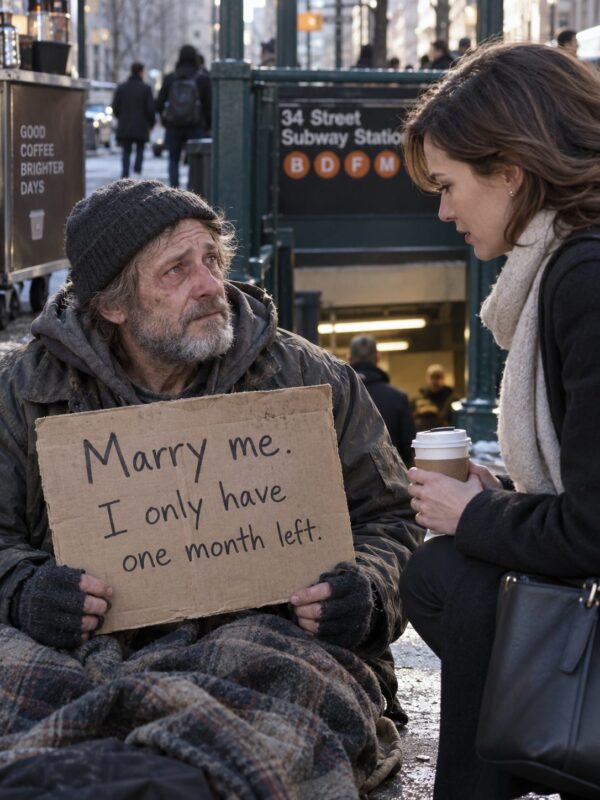
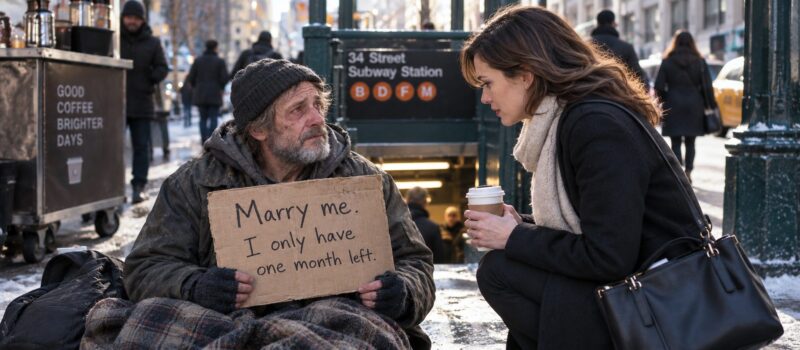
Larry wasn’t asking for spare change. Instead, he sat on the pavement with a piece of cardboard resting across his knees. Written in thick, black marker were the words:
*“Marry me. I have only one month left to live.”*
I froze. I crouched beside him and handed over his coffee. “Larry, what’s going on?”
He looked worse than I’d ever seen him. His skin was pale, and his hands trembled as he wrapped them around the warm cup.
“The clinic said I’ve got about a month,” he said softly.
I stared at him, my stomach sinking. “What happened?”
“Liver failure.”
“Larry… I’m so sorry.”
A heavy silence fell over us. I pointed to the sign. “But why are you asking someone to marry you?”
He looked down, his voice cracking. “I don’t want to die a nobody, Sarah. I just want one person whose name is tied to mine. Someone who can say I belonged to them. I don’t want the city handling my affairs when I’m gone. I don’t want to end up as just another forgotten name on a government form.”
That was all it took.
I’ve always had a soft spot for people in need. I was single, Larry was dying, and in my head, this wasn’t *really* a marriage—it was just paperwork. It was a practical favor to give a dying man a shred of dignity.
Two days later, Larry and I walked into City Hall. We signed the papers. No rings, no guests, no flowers, no reception. Eleven minutes later, I was legally his wife.
I kept telling myself it was just a technicality, not a real marriage.
Three weeks later, Larry passed away at a state hospice facility. I stayed by his side during his final hours, convinced that was the end of our strange little chapter.
Until yesterday.
I checked the mail and found a thick white envelope with my name written across the front in Larry’s shaky handwriting. The postmark was dated the day before he died.
I brought it inside and sat down at the kitchen table. I actually smiled at first, assuming it was a final thank-you note, a goodbye, or maybe one last joke.
I opened the envelope and unfolded the handwritten pages.
I expected something sweet or bittersweet—something that might bring a tear to my eye. Instead, just a few sentences in, my hands went numb and the color drained from my face.
Larry had finally confessed the truth he kept hidden while he was alive.
The real reason he asked me to marry him…
Coffee.
Food.
Warm socks.
Shelter phone numbers.
Once, during a brutal cold spell, I spent half my lunch break calling shelters until I found an available bed.
Larry always thanked me.
But it had never occurred to me that during those two years, he had also learned something about me.
He had learned exactly how to ask me for help.
Near the bottom of the page, he had written:
“Before you decide what kind of jerk I was, go back to the courthouse where we got married. Ask for Margaret. Tell her you’re my wife.”
For a few minutes, I seriously considered throwing the letter away.
Instead, an hour later, I was standing inside the courthouse lobby.
Couples filled the plastic chairs.
A woman in a white jumpsuit adjusted her lipstick while her fiancé held a bouquet.
A toddler crawled beneath a row of seats while his father tried to catch him.
Three weeks earlier, Larry and I had sat in those same chairs.
I remembered him rubbing his palms against his trousers again and again.
“You’re shaking,” I had told him.
“I’m dying. I think I’m allowed to shake.”
At the time, I accepted that explanation.
Now I wondered how many things I had accepted simply because asking another question had seemed unnecessary.
At the records counter, someone pointed me toward an older woman wearing red glasses.
“Margaret?”
She looked up.
“Yes?”
“My name is Sarah.”
I hesitated.
“I’m Larry’s wife.”
Her hands froze above the keyboard.
“Larry?”
I nodded.
Her chair rolled backward.
“Oh, sweetheart.”
Before I understood what was happening, she walked around the counter and hugged me.
I stood stiffly in her arms.
When she stepped back, her eyes were wet.
“When did he pass?”
“A week ago.”
She looked away for a moment.
“I knew he was sick. I didn’t know it was that close.”
I stared at her.
“You knew Larry?”
Margaret frowned slightly.
“Of course I did.”
“How?”
She glanced around the courthouse.
“He worked here.”
I stared at her.
“Here?”
“For twenty-eight years.”
My mouth fell open.
“Then how did he end up homeless?”
Margaret’s expression softened.
“His health started failing after retirement. Medical expenses ate through his savings. Then he lost his apartment.”
She shook her head.
“Larry was too proud to call any of us.”
“What did he do here?”
“Mostly marriage licenses.”
She removed her glasses.
“He never told you?”
“No.”
A faint smile touched her face.
“That sounds like Larry.”
“What does that mean?”
She paused.
Then she stood.
“Come with me.”
Margaret led me down a hallway and into a small civil ceremony room.
Against the wall stood a wooden wedding arch.
I recognized it immediately.
“This is where Larry and I got married.”
“I know.”
I turned toward her.
“You were here?”
“No.”
She walked toward a cabinet.
“But Larry was here the afternoon before.”
I stared at her.
“Why?”
Margaret unlocked the bottom drawer.
“I asked him the same thing.”
She pulled out a thick binder and placed it on a table.
“He sat in that chair for almost an hour.”
She pointed toward a seat beside the arch.
“What did he want?”
“Nothing.”
Margaret smiled.
“He said he was nervous.”
I almost laughed.
“A man who worked around weddings for twenty-eight years was nervous about getting married?”
“That’s exactly what I said.”
She rested her hand on the binder.
“He stared at that arch and told me, ‘Tomorrow, I’m standing on the other side of the desk.’”
Suddenly, I remembered Larry’s shaking hands on our wedding day.
I had blamed the illness.
Maybe I had been watching something else entirely.
Margaret opened the binder.
“Look.”
Inside was an old marriage record.
Two names I didn’t recognize appeared at the top.
Near the bottom was a familiar signature.
Larry.
Next to his name was one word.
Witness.
Margaret turned the page.
Another couple.
Larry.
Witness.
Another page.
Different couple.
Different year.
Same signature.
Again.
Larry.
Witness.
I looked at Margaret.
“What is this?”
“Sometimes couples came in without anyone with them,” she explained. “Larry would leave his desk and sign as their witness.”
She turned another page.
“He hated the idea of someone getting married with nobody standing beside them.”
I ran my finger over one of his old signatures.
It was strange seeing Larry’s handwriting from decades before I knew him.
The same narrow L.
The same crooked y.
“How many times did he do this?”
Margaret shrugged.
“Hundreds, probably.”
She smiled.
“He used to joke that he had attended more weddings than anyone in the courthouse but never had an anniversary to remember.”
A laugh escaped me.
Then another question occurred to me.
“Was Larry ever married before?”
Margaret slowly closed the binder.
She didn’t answer.
“Margaret?”
“Once.”
My stomach tightened.
“To whom?”
She looked directly at me.
“You.”
I sat down.
For twenty-eight years, Larry had watched strangers walk into that building as separate people and walk out legally connected.
Whenever someone had no friend or family member beside them, Larry stepped forward.
His name appeared again and again in those records.
But always beside the same word.
Witness.
Never husband.
Never spouse.
Not until me.
Margaret opened another drawer.
“There’s something else.”
She pulled out a clear plastic sleeve.
“Larry asked me to keep this after your marriage was recorded, in case you ever came looking for me.”
Inside was a copy of our marriage certificate.
My name was there.
So was Larry’s.
And beside his name was the word:
SPOUSE.
I remembered how carefully he had folded his copy after our ceremony.
How he had asked the clerk twice where he needed to sign.
I had teased him about it.
“You’re acting like this is an actual wedding.”
For a moment, Larry had gone quiet.
Then he smiled.
“First marriage. Let me be nervous.”
I laughed then.
Sitting in that courthouse, I couldn’t.
Margaret took the chair beside me.
“Did Larry tell you why he wanted to marry you?”
“He gave me a reason.”
I explained the letter.
The story about burial arrangements.
His confession that he had made the situation sound more desperate because he knew I would help if there was a problem to solve.
Margaret listened without interrupting.
When I finished, she didn’t defend him.
“That wasn’t fair to you.”
I looked at her.
“He knew you would say yes to a problem,” she continued. “Larry was always much better at asking someone for practical help than asking someone to choose him.”
I looked down at his signature.
“What was I actually saying yes to?”
Margaret glanced at our marriage certificate.
“That isn’t my story to tell.”
For a second, I wanted to demand an answer.
Then I remembered that the rest of Larry’s letter was still inside my purse.
He had specifically told me to visit the courthouse first.
He wanted me to see those records.
The hundreds of witness signatures.
Our marriage certificate.
The word spouse.
I left the courthouse and took the subway home.
But when the train reached Larry’s old station, I stepped off.
The woman at the coffee kiosk recognized me immediately.
“Two?”
For a second, I nearly said no.
Then I looked toward Larry’s empty place beside the station entrance.
“Yeah.”
She handed me my coffee with cream.
And Larry’s black coffee.
I carried both cups outside and sat in his usual spot.
In two years, I had never stayed there long enough to finish an entire cup.
I placed Larry’s coffee beside me.
Then I unfolded the next page of his letter.
At the top, he had written:
“I didn’t need a wife to make my life matter, Sarah.”
Underneath that was another sentence.
“But I wanted to know, just once, what it felt like to have somebody choose that word with me.”
I stopped reading.
Steam rose from the black coffee beside me into the cold air.
Then I continued.
“I knew that if I had told you the truth, you might still have said yes.”
My eyes filled with tears.
I whispered, “Then why didn’t you?”
Larry’s answer was written directly beneath it.
“Because then I would have had to listen while you decided whether loneliness was a good enough reason.”
Suddenly, two years of mornings with Larry looked different.
The next line read:
“I made it easier for you by turning loneliness into paperwork. I knew you would understand paperwork. You had the right to know the truth. I’m sorry.”
I stared at his words.
“You should have told me.”
A subway train rumbled beneath the pavement.
The letter continued.
“You were always trying to fix things for me. I liked that about you, even when you drove me crazy.”
Despite myself, I smiled.
During our three weeks of marriage, I had bought Larry warm socks, toiletries, a phone charger, and a new blanket.
Probably enough supplies to last six months.
Every hospice visit went exactly the same way.
I would enter carrying something.
Larry would say, “Sit down, Sarah.”
And I would answer, “In a minute.”
There was always another nurse to find.
Another form to complete.
Another problem to solve.
Then I reached the next sentence.
“I didn’t need better socks nearly as much as you thought I did.”
I laughed through my tears.
“You’re welcome, Larry.”
Then I read the line beneath it.
“I needed you to sit down.”
I looked at the empty place beside me.
Our final Tuesday together came rushing back.
I had brought his usual black coffee.
“You staying?” he asked.
“Five minutes.”
“Big spender.”
I ended up staying twelve.
Maybe those twelve minutes had been worth more to him than anything I had brought through the hospice doors.
The final paragraph began:
“Don’t turn me into another person you failed to save.”
My fingers stopped moving.
Because since Larry’s funeral, that was exactly what I had been doing.
If I had noticed sooner.
If I had found a better doctor.
If I had found permanent housing.
If I had done more.
Then I read the next line.
“You were not my failed rescue. You were my wife for three weeks. I liked it.”
A laugh escaped me.
“Idiot.”
I folded the letter around our marriage certificate.
For decades, Larry’s name had appeared beside one word.
Witness.
For three weeks, it appeared beside another.
Spouse.
A shadow fell across the pavement.
“Excuse me. Is anyone sitting here?”
A man carrying a worn backpack pointed toward the empty space beside me.
Instinctively, my hand moved toward my purse.
Then I stopped.
“No.”
He sat down.
My first impulse was to ask whether he wanted coffee.
Then I remembered one of Larry’s final instructions.
“Next time you start trying to fix somebody’s life, ask what they actually want first.”
So I said nothing.
For a while, the two of us simply watched commuters hurry toward the station.
Then I extended my hand.
“I’m Sarah.”
The man looked surprised before shaking it.
“Jeremy.”
“Nice to meet you.”
I picked up the second cup and took a sip.
Black.
I immediately made a face.
Jeremy glanced over.
“Bad?”
“No.”
I looked toward the empty space where Larry used to sit.
“Just not mine.”
I stood and walked back toward the kiosk.
The woman behind the counter saw me approaching.
“Another black?”
I shook my head.
“Actually, could you put some cream in this one?”
When I returned to the bench, Larry’s letter and our marriage certificate rested beside me.
For once, I wasn’t rushing to work.
I wasn’t making phone calls.
I wasn’t filling out forms.
I wasn’t trying to rescue anyone.
I simply sat there.
And for the first time, the coffee in my hands tasted like it belonged to me.