We had already raised three boys and laid our dream of having a daughter to rest, when my husband called me from the hospital to say he was holding a newborn baby girl—and when he whispered his confession, I completely fell apart right there in the hallway.
My husband called me on a Tuesday afternoon.
«I need you to come. There’s a baby here.»
«James—whose baby?»
«Please. Just come.»
I drove straight there wearing the shirt I’d been using to clean the kitchen.
You have to understand what the word *baby* meant in our house.
We have three boys.
Ages nine, seven, and four. Loud, filthy, wonderful.
After our third, my doctor sat across from us with my chart open and asked James to sit down too, wanting him to hear the truth directly from her rather than through me.
She didn’t use words like *could* or *risk*.
She told us a fourth pregnancy would probably kill me, and if it didn’t, I would likely spend most of it confined to a hospital bed, entirely away from the three children I already had.
I asked her if there was any universe where it could be safe.
She said no. I asked her two more times over the next two years, phrasing it differently each time. The answer never changed.
We wanted a daughter. God, we wanted one so badly.
I had a girl’s name picked out since I was nineteen years old.
James never said much about it, but he was the one who kept the box of newborn clothes tucked away in the garage instead of giving it to charity. Whenever I mentioned finally clearing it out, he’d always say *next month*.
Eventually, I stopped bringing it up. He stopped bringing it up, too. That’s what putting a subject to bed looks like when it isn’t actually settled—you just stop giving it a voice.
The last time I allowed myself to speak of it, he took my hand and said, «Our boys need their mother more than we need a daughter.»
He meant it. I believed him.
I truly thought that chapter of our lives was closed forever.
Then, eleven years into our marriage, my husband stood at the end of a maternity ward corridor with his coat still on and his eyes red—and I had never, not once in my life, seen that man cry.
Through the glass behind him, I could see the corner of a plastic hospital bassinet.
«I need you to sit down,» he said.
«James, tell me right now why I’m here.»
He stared at the floor for a long, heavy moment.
«Because there’s something I have to ask you,» he said. «And I need you to hear all of it before you give me an answer.»
I peeked through the glass again.
A pink blanket.
A tiny hand.
My stomach sank.
«Is she yours?»
James looked genuinely horrified.
«What?»
«Don’t make me ask twice.»
«No.» His answer came instantly. «No. God, no.»
I stared at him. «Then whose is she?»
He rubbed both hands over his face. «Do you remember when I told you about Anna?»
The name sounded familiar, but barely. He had mentioned her once or twice years ago, long before me, long before us. His first love. They had been twenty-two, talking about marriage, kids, and all the neat milestones people at that age assume they have mapped out. Then life happened. They split up. Anna married someone else. James eventually met me. That was the extent of it.
«I remember,» I said.
«I haven’t spoken to her in eleven years.»
I stayed silent.
«Eleven years,» he repeated. «Not a single call, text, or message. I need you to know that before I say anything else.»
My heart hammered against my ribs. «Why is she here?»
James looked toward the room. «She *was*.»
*Was*. I caught it immediately.
«Was?»
He nodded, then stumbled through the details out of order, the way people talk when a nightmare still feels like a glitch in reality.
Anna had been seven months pregnant when her husband walked out. No warning, no attempt at fixing things—he just packed up and moved several states away. Her mother had passed away the year before, and her father had died when she was a teenager. No siblings. No close relatives nearby.
She went into labor around four that morning. She tried driving herself to the hospital until the contractions became too blinding, pulled over at a gas station, and called an ambulance.
She gave birth that morning. A little girl, weighing six pounds and change. The baby was healthy. Anna wasn’t.
Something went wrong after delivery. Hemorrhaging. Then more bleeding, followed by medical terminology James had latched onto but couldn’t quite explain. Her body shut down fast.
«How did they even call you?» I asked, the one piece of the puzzle that made zero sense.
James swallowed hard. «They didn’t at first.»
Just then, a nurse stepped out into the hallway, holding a clipboard against her chest as she looked between us.
«Are you his wife?»
«I am.»
She gave a soft nod. «Ma’ai, I think this might help.»
I waited.
«When she was slipping away, we asked if there was anyone she wanted us to call.»
My chest tightened.
«She wasn’t fully conscious by then,» the nurse continued softly. «Not really. But she kept repeating one name.» She glanced at James. «His.»
I stared at him. James kept his eyes glued to the floor.
«Over and over,» the nurse said. «Nothing else.»
Eleven years. Anna had married another man, built an entirely different life, and been abandoned inside of it. Yet at the very end, the only anchor left in her memory was a boy she had once trusted with her youth.
My first reaction should have been jealousy. It wasn’t. Instead, a cold wave of terror washed over me. A woman dying alone, a newborn baby just a few rooms away without a mother, a father, or any family in sight—and one lingering name surviving through the fog.
«How did they track him down?» I asked.
The nurse answered. «She managed to spit out enough of his last name before losing consciousness. Social services ran her records and personal effects, and found an old emergency contact entry with his full name.»
James nodded. «They called me about an hour ago.»
«And you came straight here?»
«Yes.»
«Did you see her?»
He shook his head. «She was already gone.»
That single sentence flattened the air out of the room.
From the space behind us, the baby let out a tiny, hiccuping cry. All three of us turned. The nurse’s expression softened. «She’s doing great.»
I looked back at James. He looked terrified—not of the hospital, but of me.
And that was when it finally clicked. Whatever he was about to ask me had nothing to do with Anna wanting him back. Anna was gone. This was entirely about the baby.
James took a shaky breath. «She doesn’t have anyone.»
I didn’t move an inch.
«Her father isn’t coming. Social services tracked him down, and he signed paperwork stating he wants no part of her.»
My mouth went bone dry. «Already?»
«He left months ago. Apparently, he washed his hands of the whole thing.»
A sharp spike of anger flared inside me.
James pressed on. «The hospital social worker explained what happens next.»
«What happens?»
«Temporary foster placement while they look for extended family and sort out permanent guardianship.» He glanced back through the glass. «They don’t think there are any relatives left.»
I already knew what was coming. Even so, hearing it out loud carried an overwhelming weight.
«I want us to ask to be considered,» he said.
I stared at him. «For what?»
He looked right into my eyes. «For her.»
My eyes stung with sudden tears. «James.»
«I know.» His voice cracked. «I know how this sounds.»
«No, you really don’t.»
«I probably do.» He reached a hand out toward me, then let it drop. «I already told the social worker I’m married, that I’d never make a decision like this without you, and that this isn’t something I can just promise on my own.»
I looked through the glass once more. The bassinet had been wheeled closer. A tiny, button nose, a cap of dark hair, and tightly closed eyes.
«I want to apply for her,» James said, his voice steadying. «Whatever that entails—foster placement, legal guardianship, adoption down the road if we’re lucky. I want to bring her home.»
He swallowed hard. «If this is too much for you, just tell me, and I’ll never mention it again.»
I let out a wet laugh through my tears. Not because anything was funny, but because I finally understood the kind of fear he had walked into this conversation with.
«You actually think I’m jealous?»
He didn’t say a word.
«You thought I heard Anna’s name and assumed this was some weird soap opera?»
«I honestly didn’t know what you’d think.»
I wiped my face with my sleeve. «I honestly thought she might be your biological baby.»
His eyes widened in panic. «Okay. That is definitely worse.»
Despite everything, I laughed again—which only made me cry harder.
James reached for me this time, and I let him pull me in.
My mind kept racing back to Anna. Not as James’s old college girlfriend, and not as some ghost from the past, but as a terrified woman alone in a hospital room, using the absolute last shred of her lucidity to make sure her newborn daughter didn’t vanish into the system unnoticed. She had one name left in her arsenal, and she spent it on her child.
«Can I hold her?» I whispered.
James looked stunned, glancing at the nurse, who smiled gently. «I’ll go ask.»
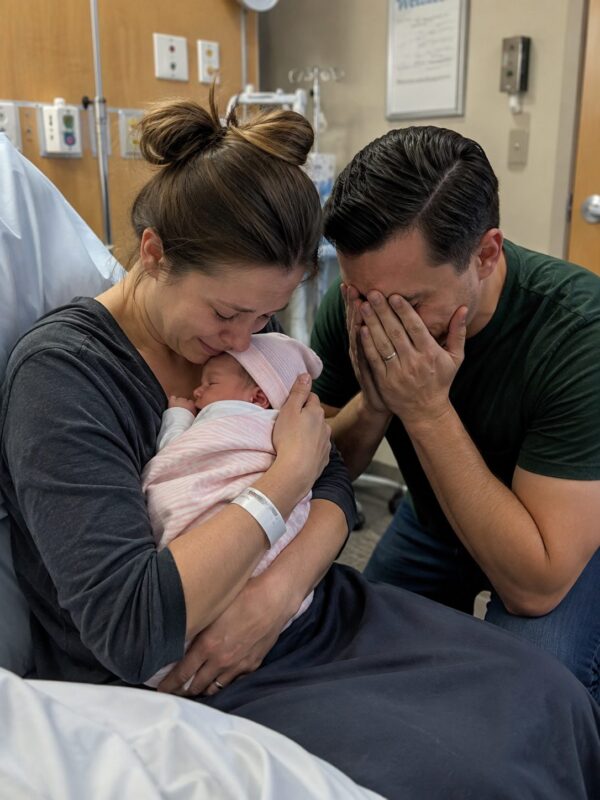
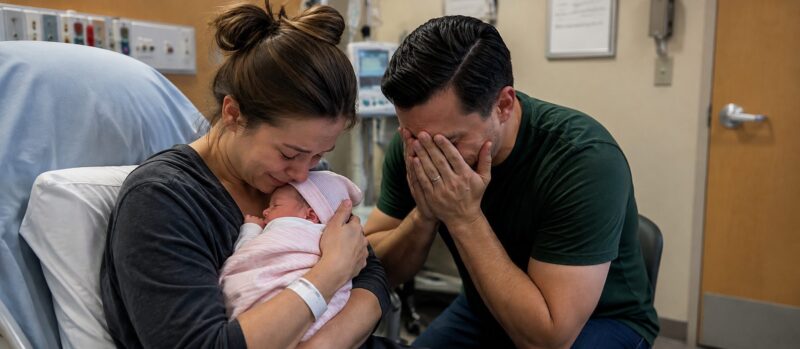
Ten minutes later, I was sitting in a stiff armchair with a newborn girl resting flat against my chest. Six pounds and change. Twelve hours old. Her hands were impossibly small, and her fingers twitched once against my shirt.
I stopped breathing.
James knelt beside the chair. «Are you sure? Because if you’re having doubts—»
I looked at him. «We spent years wishing our boys could have a little sister.»
He froze.
I looked back down at the infant. «Maybe we were just waiting for the wrong miracle.»
James covered his face with his hands. That was only the second time in our entire marriage I had ever seen him cry.
Nothing about what followed was easy.
The legal process dragged on for nine brutal months. Nine long months of home studies, background checks, endless interviews, court dates, and temporary foster placement while our application crawled through the system.
We weren’t automatically handed the baby just because Anna had dropped James’s name. That detail mattered—Anna could express who she trusted, but she couldn’t bypass the law. The biological father officially signed away his rights. Social workers combed through family trees until they tracked down a distant cousin who ultimately declined custody. At one point, a caseworker warned us that another qualified family might still be chosen over us. That threat hurt worse than anything else. I drove home and sat sobbing in the garage right beside that dusty box of baby gear we had never been able to part with.
We didn’t fill our boys in on all the heavy details right away. We simply explained that there was a baby who needed a temporary home and that we were trying to help out.
Our oldest asked if she was going to stay forever. *»We don’t know yet,»* we told him.
Our seven-year-old asked if she would eventually be allowed to play in his room. *»Eventually.»* He thought about it for a second, then burst into tears when we said yes.
Our four-year-old wanted to know if babies ate chicken nuggets. He was definitely the easiest to manage.
Eventually, our foster status became permanent. Months later, the adoption was finalized, and she came home for good just as spring hit.
The day before the final paperwork went through, James and I sat at the kitchen table trying to settle on her legal name. Anna had already chosen one: *Clara*.
I stared at the birth certificate in disbelief. Out of all the names in the world, Anna had picked the exact one I had kept locked in my heart since I was nineteen years old. Nobody had known—not Anna, not James, not anyone. Sometimes, coincidence feels entirely too heavy to process.
We kept Clara’s first name, but I had one specific request for James. He started tearing up before I even finished explaining it.
I wanted Anna in her name. Not buried where nobody would ever see it, and not reduced to a footnote in a closed adoption file. Her full name became **Clara Anna**.
Anna would be spoken out loud. Written down. Called up the stairs for dinner. Printed on school report cards. Sung to on birthdays.
Our boys practiced immediately, marching down the hallway chanting, *»Clara Anna!»* so loudly they woke the baby up twice. I didn’t stop them.
Because one day, years from now, my daughter is going to sit across from me and ask about the woman who brought her into this world. She’s going to want to know who Anna was. Whether Anna wanted her. Whether she was loved. Whether she was scared.
And I won’t have to invent a gentler version of the truth.
I’ll tell her exactly what happened: That her mother was alone, fading fast, and terrified. That there was almost nothing left in the world she had control over. Yet, she didn’t use her final moments of clarity to ask for comfort or try to save herself. She used them to hand her daughter a family.
She whispered a single name—and it led all the way home.