For seven years, my husband hauled away the harvest in sacks for his sister. So, I planted the field with flowers.
I bought twenty packets of flower seeds at the hardware store, simply sweeping everything off the display—marigolds, zinnias, lavatera, nasturtiums—and right there at the checkout, I realized something inside me had snapped. Up until then, I had never bought flowers for our summer house.
It was always potatoes—thirty kilograms of seed potatoes at a time; onion sets by the bucket; zucchini and pumpkins that wouldn’t keep in the cellar anyway and would be rotting by October. And there I stood with these bright little packets. The cashier, a woman around my age, asked, «Big plot?» I nodded. «Twenty acres.» She let out a low whistle and added that I’d also need grass seed if I was planning to plant the whole thing properly. I went back into the sales floor and grabbed a five-kilogram bag of lawn mixture.
In the car—an old sedan my husband and I bought before he retired—I sat for about ten minutes without starting the engine, just staring at the white seed packets scattered across the passenger seat.
It was early May, the air had warmed up, and the asphalt in the parking lot already smelled of dust and heated rubber. I knew that in three days, my husband would start loading buckets and shovels into the trunk. Just like always. Because in his mind, the dacha wasn’t a place to relax; it was a supply depot for his entire extended family.
I worked as an economist in the city’s municipal utilities department for almost thirty years. Numbers, estimates, financial statements, accounts receivable. For the first two years after we bought the plot, the dacha was my escape from the office. Then it started: my husband decided that since he owned land, it was his duty to feed everyone.
His sister and her husband, his cousin, his nephews, even some distant relatives from the regional center whom I’d seen maybe twice in my life—all of them received net bags of potatoes, crates of onions, and jars of canned goods every autumn. I couldn’t keep up.
After a work week, on Friday evenings, we’d head out to the dacha, and I wouldn’t stand up straight until Sunday night. Weeding, hilling, watering with a hose that was forever kinking, battling Colorado potato beetles, picking off larvae by hand because my husband didn’t trust chemicals. I’d go to bed with my back throbbing, and on Monday morning I could barely get out of bed, as if I’d just worked a double shift.
My husband, Viktor Semyonovich, never said I was doing a bad job. He just hauled everything we grew off to his relatives, and that was considered normal. «We have land, we have to share,» he’d repeat, not a shred of doubt in his voice. He grew up in the country in a large family where a shared garden fed everyone, and he genuinely believed he was doing the right thing.
He wasn’t greedy; on the contrary, he was generous—only somehow, that generosity always came at the expense of my spine. I tried talking to him about it twice. The first time, he just brushed it off: «The fresh air is good for you.» The second time, he got offended: «What, are you against my family?» I fell silent. For a long time. Seven years.
This spring, things didn’t change all at once. It’s just that by March, my arthritis flared up—the joints in my fingers would swell so much by evening that I couldn’t zip up my boots. The doctor at the local clinic said, «You really need to reduce the physical strain; your fine motor skills are suffering.» I nodded and thought: fine motor skills—that’s precisely what it takes to sort through potato tubers before planting, cut them into «eyes,» and drop them into holes.
Four days spent just on planting. Two thousand holes. I counted them. I happen to love counting. Twenty acres, eighteen of which were dedicated to potatoes. Ten acres for early potatoes, eight for late ones. The harvest was about six hundred kilograms in a normal year. Out of that, two hundred and fifty went to my husband’s sister, Galina Petrovna; another one hundred and twenty to his brother in the regional center; seventy to his niece for the winter; and the rest was dumped into the cellar to be eaten until February, when what was left started sprouting.
At the end of March, I sat down at the kitchen table, pulled out a calculator and an old grid-paper notebook where I usually jotted down dacha expenses. In the left-hand column, I listed everyone who received potatoes; in the right, the approximate weight. It turned out that every year I was growing nearly four hundred kilograms of food for complete strangers. People who had never once come out to help with the weeding. Even saying «thank you» over the phone was a coin toss. Galina might call and say, «The potatoes were a bit small this year; last year’s were better.» I’d stay silent on the other end of the line because my husband was standing right next to me, looking at me with a «don’t you dare answer back rudely» expression.
And then in April, I looked at that notebook and realized I couldn’t do it anymore. Not in an «I’m mad» kind of way, but physically unable. My back wouldn’t bend, my hands hurt, my blood pressure spiked. I’m sixty-one years old. I’ve been retired for three years, but essentially I haven’t had a single summer of rest. My dacha was twenty acres of forced labor surrounded by chain-link fencing. I had never even planted roses because my husband believed flowers were a useless waste of land.
The plan came together by mid-April. I didn’t consult with anyone, because I only had two advisors in my inner circle: my husband and his sister, and I already knew what their opinion would be. I simply called a local nursery run by a family from the neighboring village and ordered perennial saplings: phlox, peonies, hostas, daylilies, astilbes—everything that doesn’t need to be dug up every year and can live in the same spot for a decade. The young woman on the other end of the line, who introduced herself as Valeria, clarified, «How many are you looking for?» I gave her a number: forty root clumps. She fell silent for a moment, then asked, «Are you starting a commercial nursery?» I replied, «No, I’m starting my life.»
Then came the hardest part: getting all of this to the dacha without my husband noticing ahead of time. He had gone to the regional center to visit his brother for three days at the end of April to help fix a porch. I asked our dacha neighbor, Stepan—a quiet guy, a former bus driver who did private driving gigs on the side in his retirement—to help with the unloading. He had an old, canvas-covered Gazel truck. I paid him for delivery, and in a single day, we brought over and unloaded all forty pots of perennials. I hid them behind the old greenhouse, covered them with spunbond fabric, and weighed it down with bricks. It looked just like a pile of construction debris.
For seven years, my husband hauled away the harvest in sacks for his sister. So, I planted the field with flowers.
In the car—an old sedan my husband and I bought before he retired—I sat for about ten minutes without starting the engine, just staring at the white seed packets scattered across the passenger seat.
It was early May, the air had warmed up, and the asphalt in the parking lot already smelled of dust and heated rubber. I knew that in three days, my husband would start loading buckets and shovels into the trunk. Just like always. Because in his mind, the dacha wasn’t a place to relax; it was a supply depot for his entire extended family.
I worked as an economist in the city’s municipal utilities department for almost thirty years. Numbers, estimates, financial statements, accounts receivable. For the first two years after we bought the plot, the dacha was my escape from the office. Then it started: my husband decided that since he owned land, it was his duty to feed everyone.
His sister and her husband, his cousin, his nephews, even some distant relatives from the regional center whom I’d seen maybe twice in my life—all of them received net bags of potatoes, crates of onions, and jars of canned goods every autumn. I couldn’t keep up.
After a work week, on Friday evenings, we’d head out to the dacha, and I wouldn’t stand up straight until Sunday night. Weeding, hilling, watering with a hose that was forever kinking, battling Colorado potato beetles, picking off larvae by hand because my husband didn’t trust chemicals. I’d go to bed with my back throbbing, and on Monday morning I could barely get out of bed, as if I’d just worked a double shift.
My husband, Viktor Semyonovich, never said I was doing a bad job. He just hauled everything we grew off to his relatives, and that was considered normal. «We have land, we have to share,» he’d repeat, not a shred of doubt in his voice. He grew up in the country in a large family where a shared garden fed everyone, and he genuinely believed he was doing the right thing.
He wasn’t greedy; on the contrary, he was generous—only somehow, that generosity always came at the expense of my spine. I tried talking to him about it twice. The first time, he just brushed it off: «The fresh air is good for you.» The second time, he got offended: «What, are you against my family?» I fell silent. For a long time. Seven years.
This spring, things didn’t change all at once. It’s just that by March, my arthritis flared up—the joints in my fingers would swell so much by evening that I couldn’t zip up my boots. The doctor at the local clinic said, «You really need to reduce the physical strain; your fine motor skills are suffering.» I nodded and thought: fine motor skills—that’s precisely what it takes to sort through potato tubers before planting, cut them into «eyes,» and drop them into holes.
Four days spent just on planting. Two thousand holes. I counted them. I happen to love counting. Twenty acres, eighteen of which were dedicated to potatoes. Ten acres for early potatoes, eight for late ones. The harvest was about six hundred kilograms in a normal year. Out of that, two hundred and fifty went to my husband’s sister, Galina Petrovna; another one hundred and twenty to his brother in the regional center; seventy to his niece for the winter; and the rest was dumped into the cellar to be eaten until February, when what was left started sprouting.
At the end of March, I sat down at the kitchen table, pulled out a calculator and an old grid-paper notebook where I usually jotted down dacha expenses. In the left-hand column, I listed everyone who received potatoes; in the right, the approximate weight. It turned out that every year I was growing nearly four hundred kilograms of food for complete strangers. People who had never once come out to help with the weeding. Even saying «thank you» over the phone was a coin toss. Galina might call and say, «The potatoes were a bit small this year; last year’s were better.» I’d stay silent on the other end of the line because my husband was standing right next to me, looking at me with a «don’t you dare answer back rudely» expression.
And then in April, I looked at that notebook and realized I couldn’t do it anymore. Not in an «I’m mad» kind of way, but physically unable. My back wouldn’t bend, my hands hurt, my blood pressure spiked. I’m sixty-one years old. I’ve been retired for three years, but essentially I haven’t had a single summer of rest. My dacha was twenty acres of forced labor surrounded by chain-link fencing. I had never even planted roses because my husband believed flowers were a useless waste of land.
The plan came together by mid-April. I didn’t consult with anyone, because I only had two advisors in my inner circle: my husband and his sister, and I already knew what their opinion would be. I simply called a local nursery run by a family from the neighboring village and ordered perennial saplings: phlox, peonies, hostas, daylilies, astilbes—everything that doesn’t need to be dug up every year and can live in the same spot for a decade. The young woman on the other end of the line, who introduced herself as Valeria, clarified, «How many are you looking for?» I gave her a number: forty root clumps. She fell silent for a moment, then asked, «Are you starting a commercial nursery?» I replied, «No, I’m starting my life.»
Then came the hardest part: getting all of this to the dacha without my husband noticing ahead of time. He had gone to the regional center to visit his brother for three days at the end of April to help fix a porch. I asked our dacha neighbor, Stepan—a quiet guy, a former bus driver who did private driving gigs on the side in his retirement—to help with the unloading. He had an old, canvas-covered Gazel truck. I paid him for delivery, and in a single day, we brought over and unloaded all forty pots of perennials. I hid them behind the old greenhouse, covered them with spunbond fabric, and weighed it down with bricks. It looked just like a pile of construction debris.
The main problem remained—the land. Ten acres dedicated to early potatoes. They had already been plowed with a walk-behind tractor back in the fall, and the ground went into the winter in neat furrows. According to my husband’s plan, we were supposed to start planting in the first days of May. I arrived at the dacha alone, saying I wanted to get the herb beds ready ahead of time, and over three days, I dug up half of the potato field. Alone. With a shovel. My hands shook for two days afterward, but I pulled it off. On the cleared land, I laid out four large flower beds, edged them with old bricks left over from a dismantled stove, and planted the perennials. Around them, I scattered grass seed and smoothed it out with a rake.
When my husband returned, I met him on the property with a watering can in my hand. He got out of the car, looked over the field, and froze. He stood in silence for a minute. Then he asked, very quietly:
— And where are the potatoes?
I wiped my hands on my old work jacket hanging on the porch railing.
— There will be potatoes on ten acres. That’ll be enough for us and then some.
— And what’s this? — he pointed to my flower beds.
— This is a flower bed. And a lawn.
He sat down on the porch step. He didn’t collapse, he didn’t yell—he just sat down, like a man who had completely run out of steam. I got scared. In twenty-eight years of marriage, I had never seen him sit down like that. Usually, he was loud, active, waving his arms, taking charge—and here he just deflated like a punctured ball.
— Do you realize Galina’s going to get less? — he asked.
— I do, — I said. — Galina can buy potatoes at the store. Like everyone else.
— She’s used to ours. She says store-bought ones don’t taste good.
— Viktor, — for the first time in many years, I called him by his name in that tone, — Galina hasn’t worked a single day on this field. In seven years, she never once came to help. She only calls in the autumn to ask when to pick up her sacks.
He was silent. I could see how tense he was. He wasn’t angry—he didn’t understand. In his worldview, I had just shattered something important, something that held his entire family system together. He was responsible for making sure his sister had food. He had promised his parents before they passed to take care of his younger sister. He was seventy-three, and he was still carrying that burden. I understood his truth. But I had my own, too.
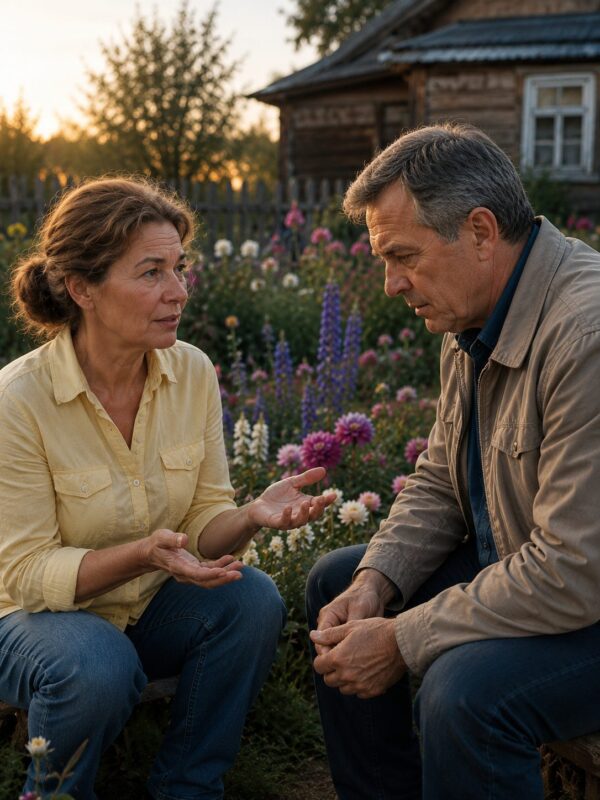
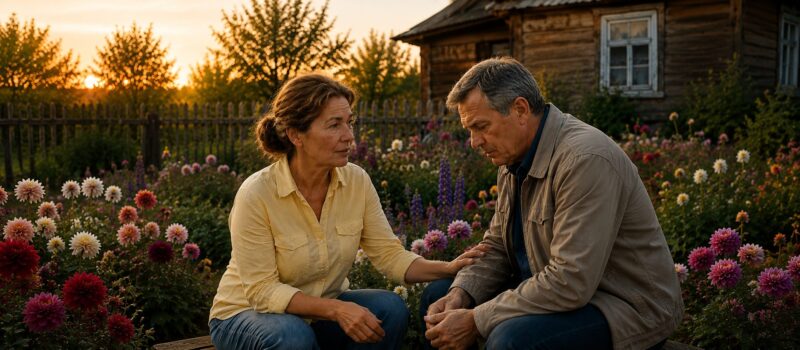
I sat down next to him on the step.
— Have you ever seen how swollen my hands get by evening? — I asked.
He didn’t answer.
— I’ve lived for sixty-one years. Twenty-eight of them with you. And all of these last seven years, I’ve hated May. Do you understand? I was terrified of spring. Every April I’d start getting insomnia because I knew: soon the field again, soon the holes again, soon the back and knees again, soon you saying «we must» when it actually meant «I must.»
He raised his head.
— Why didn’t you say something before?
— I did. Twice. You didn’t hear me.
I noticed he was sitting with his fingers gripping the edge of the step. From tension, not old age. He looked at my flower beds, at the young peony shoots with their burgundy stems, at the neat mounds of earth around the phlox, at the smooth strip of future lawn already dusted with sand. He looked and stayed silent, and I realized: this was the first time he was truly seeing it. Not the flowers themselves, but the result of my choice. For the first time, I had done something on this land not because he ordered me to, but because I wanted to.
The week passed in silence. We barely spoke. He planted the remaining potatoes on the ten acres, and I took care of the flower bed and the lawn. We ate separately: he inside the house, I on the porch. We had never experienced anything like that before. Before, we might argue over a burned pot or a left-open faucet, but this was a different kind of silence. Not resentment—more like we were getting used to each other all over again. He was getting used to the idea that I was no longer an appendage to the vegetable garden.
The call from Galina Petrovna came in mid-June. I was alone at the dacha; my husband had gone to town to see a doctor. My phone vibrated on the windowsill, and I picked up.
— You need to explain to me what’s going on over there, — her voice was sharp, with no preamble. — Vitya said you planted half as much.
— Vitya said right, — I replied. — We planted less.
— And how am I supposed to get through the winter? My pantries are going to be empty.
I remembered the notebook, the calculator, the four hundred kilograms.
— Galya, you can buy potatoes at the market. It’s summer now, and by autumn they won’t cost much.
— Those aren’t the same potatoes. Yours are homegrown, without any chemicals.
— Galya, I can’t do it anymore. My health doesn’t allow it.
She fell silent. I expected her to say something about duty, about family, about our late parents. But she said something else:
— You’ve always looked out for number one. I understand Vitya—he’s soft, he pities you, and you take advantage of that.
I didn’t say anything and hung up. Not because I was offended, but because I didn’t want to waste words. Everything I needed to say, I had already said—with flowers, with a lawn, with my own hands, which now hurt a little less.
By the end of June, my flower bed came alive. The peonies bloomed first—huge, white and pink, with heavy heads that bowed toward the ground after the rain. I tied them up to stakes and felt something I had never experienced at the dacha before: peace. I would step out onto the porch in the morning with a cup of tea, sit in the old wicker armchair that used to gather dust in the attic, and just watch. Bumblebees buzzed in the phlox, the lawn grass rose in a smooth green carpet, and the daylilies thrust up their orange spikes. This was mine. I created this.
My husband arrived on Friday, brought groceries, and the first thing he did was walk out to the flower bed. He stood there, shoved his hands into the pockets of his windbreaker, then bent down and touched a hosta leaf—broad, with a waxy coating.
— Beautiful, — he said quietly.
I almost dropped my cup. In twenty-eight years, he had never once called anything at the dacha «beautiful.» «High-yielding,» «came up well,» «grew thick»—yes. But not «beautiful.» I didn’t comment, afraid to scare it off.
In July, the relatives arrived. My husband’s sister and her husband—the one who never crawled out of his workshop—and their cousin’s son. They were used to being greeted at the dacha with a spread table, shish kebabs, and the mandatory tour of the garden beds followed by the distribution of promises for the autumn. This time the table was set, but I didn’t give a tour. Galya walked out to the plot herself, saw the flower bed, and stopped.
— Where’s the field?
— The field is half the size, — I said calmly.
She turned to her brother.
— Vitya, did you actually let her waste the land? Grow little flowers? You have a family, people are waiting on you.
My husband stood by the grill with skewers in his hands and looked at me. I expected him to say, as usual, «We’ll discuss this later,» and brush the conversation aside. But he said something else:
— Galya, this is her dacha too. She has the right.
— Fine, — she said with an expression like she had swallowed something bitter. — Just don’t come crying to me for pickles in the fall. Since you’ve got little flowers now instead of a garden.
— We won’t, — I said.
Galya looked at me, then at the flowers, then at the lawn. And I realized I didn’t care. I could buy pickles myself. And the summer that had been stolen from me seven times in a row—no one was going to give that back. This summer was mine.
In August, the phlox bloomed—pink, lilac, white. I cut the first bouquet and put it in a three-liter jar on the porch. My husband came from the potato field, dirty, tired, with a bucket of new potatoes, saw the jar of flowers, and stopped.
— Are these from your beds?
— From mine.
He set the bucket on the floor, walked over, leaned down to the bouquet, and took a breath. The phlox had a faint, almost imperceptible scent, but he stood there sniffing them anyway. Then he straightened up and said:
— I guess I was wrong.
I didn’t try to correct him. I just poured him some tea and slid a plate of dried bread rings closer.
In September, we dug up the potatoes. The harvest was smaller than usual—about three hundred kilograms. My husband laid them out in crates, poured sawdust over them, and lowered them into the cellar. Galya didn’t call. The nephew didn’t call. The brother from the regional center sent a text: «How are you guys holding up?» My husband replied: «We’re holding up. Less potatoes this year, sorry.» And that was it. The world didn’t end. The relatives didn’t stop talking to us. They just stopped expecting food provisions from us like we were a collective farm.
In October, I covered the perennials with spruce branches, cut back the faded stems, and put the lawn grass to bed for the winter. It was a cold, clear day, smelling of rotting leaves and damp earth. I sat in the wicker armchair, already in a warm cardigan, looking at the empty flower beds. It wasn’t sad—it was peaceful. I knew that in the spring they would grow again, and I wouldn’t have to dig anything up, plant anything over, or prove anything to anyone.
My husband came out of the house with two cups of tea, handing one to me. He sat down next to me on the old stool.
— I was thinking, — he said. — Maybe next year we should plant a lilac bush? By the fence.
I took a sip of my tea. It was hot, with lemon.
— Lilac is good, — I said. — Only you’ll be the one planting it. I’ve fulfilled my lifetime quota with the shovel.
He nodded. And I saw him smile—for the very first time all summer. It was barely noticeable, but he was smiling.
And I find myself wondering—if it weren’t for the arthritis, would I have ever taken the plunge with that flower bed? And why on earth did I need to get sick just to give myself permission to rest?