It was 11 p.m. when the doorbell rang. My husband’s daughter, Madison, walked in with her husband in tow, dragging two massive suitcases.
«Dad said we’re moving in,» she announced. Before I could even react, she shoved a printed list into my hand. It was a manifesto: breakfast at 6 a.m. sharp, no greasy food, fresh sheets weekly, bathroom cleaned every night, and specific instructions for their work clothes—hand-wash, iron, hang, and heaven forbid, never fold them.
I looked at my husband, Robert. He said nothing.
I just smiled. «Okay.»
At 6 a.m. the next morning, I delivered my response. Breakfast was served on cheap paper plates: two plain, boiled eggs, a slice of dry toast, and black coffee. No butter, no jam, no bacon.
Madison strutted into the kitchen, eyes glued to her phone, only to stop dead when she saw the table. «What the hell is this?»
«Breakfast,» I said.
She glared at the plate like it was an insult. «Dad told you I only eat protein pancakes! And where is Evan’s oat milk? You’re supposed to pour it for him!»
I glanced at Robert—who was suddenly very busy tying his robe to avoid eye contact. Maintaining that same calm smile from last night, I slid a single sheet of paper onto the kitchen island.
«What is that?» Madison scowled.
«My list,» I replied, tapping the page. «These are the house rules. Rent is due every Friday: two thousand dollars per person, per month. Utilities are split three ways. You handle your own laundry, you cook your own food, and no one steps foot in my bedroom.»
Madison let out a mocking laugh. «Are you crazy? You can’t charge us rent. This is my dad’s house!»
«No,» I corrected, my voice steady. «This is *our* house. My name is on the deed, and half the down payment came from my personal savings.»
Robert’s face drained of color. «Laura, please, don’t make things unnecessarily complicated…»
Without a word, I pulled a heavy folder from the drawer. I’d spent the night preparing it: the property deed, bank statements, and the ironclad prenuptial agreement Robert had insisted I sign to «protect» us. I spread the documents across the counter one by one. The arrogance on Madison’s face began to shatter into pure panic.
«You have until noon,» I said coldly. «Sign the roommate agreement and pay up, or pack your bags and get out.»
Just then, the doorbell rang sharply. Madison smirked. «Good. Maybe someone reasonable is here to talk some sense into you.»
I walked over and opened the door. There was no «reasonable» guest—just a uniformed police officer and a locksmith with a heavy toolbox.
Behind me, Robert’s voice cracked. «Laura… who did you call? What the hell are you doing?»
I turned to look at my spineless husband, a chilling smile on my lips. «I’m just doing exactly what you should have done.»
At 3:18 a.m., while Robert slept on the sofa pretending I’d offended him, I had called the non-emergency line. I’d explained that two adults had entered my home without my consent and announced they were moving in permanently. Because Robert had let them in, the legal situation was murky—but «complicated» didn’t mean I was powerless. I’d requested a police report and a neutral witness to ensure the facts remained clear.
Officer Daniels introduced himself, followed by the locksmith, Vince.
Madison folded her arms, her voice trembling. «This is ridiculous. We’re family.»
«You are Robert’s daughter,» I replied. «You are not my dependent or my tenant. You are only a guest if I agree to it.»
Robert stepped forward, pleading. «They lost their apartment. Madison called me crying. What was I supposed to do?»
«Tell your wife.»
The kitchen went dead silent.
That was the real problem—not the suitcases or the insulting list. Robert had promised our home to his daughter without saying a word to me. Then, he’d watched her assign me chores as if I were a piece of furniture included in the house.
Madison pointed a finger at me. «She’s turning you against me.»
«No,» I said, meeting her gaze. «Your father made a decision behind my back. Now, all three of you are finding out that I am not invisible.»
I first met Ashley when she was just a sullen ten-year-old. It was two years after her mother had abandoned Mark, fleeing to Arizona with a man whose primary source of income was selling pontoon boats. Initially, Ashley visited every other weekend, but as she entered high school, those visits dwindled, eventually becoming sparse holiday appearances during her college years.
Throughout it all, I was the steady background hum of her life. I bought the expensive winter coats Mark forgot. I baked her favorite red velvet cakes for birthdays, shipped meticulous care packages for finals, and endured agonizingly long middle-school band concerts where she squeaked out three discordant notes on a clarinet, looking as though she wished the floor would swallow her whole.
I never asked her to call me Mom; I never tried to replace her biological mother. I just aimed to be reliable. However, I was starting to learn a painful truth: to people who only respect dominance, steadiness is often mistaken for an invitation to walk all over you.
By 7:30 a.m., Mark had fled to his office, cowardly escaping the tension he’d created. Tyler was upstairs, luxuriating in a forty-minute shower in the bathroom I had scrubbed on my hands and knees. Ashley was roaming the second floor, opening my linen closets and loudly declaring which shelves would now be hers.
I stood alone in my kitchen, watching the pale morning light stretch across the honey-colored hardwood floors. My father had refinished these boards with his own calloused hands shortly before cancer took him. This wood was older than my marriage to Mark.
So was the house itself.
My parents bought the property in 1979, inheriting the deed long before Mark ever put a ring on my finger. Later, as my mother’s mind succumbed to dementia, she insisted the house be placed in a family trust to protect my future. Mark knew this. He had sat in a stuffy lawyer’s office twelve years ago, signing documents acknowledging he had no legal claim to the property. But people have a convenient way of «forgetting» facts that don’t suit them.
Around noon, Ashley marched into the kitchen, arms laden with clean towels. “These are ancient,” she declared, dropping them onto the island with a look of profound disgust.
“They are washed and folded,” I replied evenly.
She wrinkled her nose. “I prefer pristine white towels. It feels more like a hotel.”
I stared at the pile of plush, powder-blue towels—a gift from a rare shopping trip with my mother months before she forgot how to navigate a department store. A cold, heavy knot formed in my stomach.
“I’ll keep your preference in mind,” I whispered.
Ashley beamed, clearly thrilled with herself, as if she had successfully house-trained a stubborn dog with a single command.
That afternoon, I went to the grocer. I meticulously purchased the ingredients Ashley demanded for breakfast, but when the cashier rang me up, I bypassed the joint marital account and used my personal credit card.
I sat in the grocery store parking lot for twenty minutes, engine off, watching the theater of everyday life. A tired father loaded paper towels into a minivan. An elderly woman inspected eggs for cracks. The world kept spinning, even as the tectonic plates beneath my marriage were violently rupturing.
When I returned home, I heard Ashley on the living room sofa, feet tucked under her, laughing loudly on her phone. “Yeah, things are crazy right now, but we’re at Dad’s house. It’s just way easier. He has so much space here, and we’re not paying rent.”
*Dad’s house.*
I stood in the entryway, my pulse thrumming in my ears. I didn’t interrupt. I didn’t demand a correction. I wanted her to build her entire fortress on that fragile lie, because I knew exactly how hard it was going to crumble.
That evening, Mark lingered in the doorway of our master bedroom as I undressed.
“Are you… upset?” he asked softly.
“Should I be?”
He let out a heavy, exasperated sigh. “Rachel, please. Ashley and Tyler hit a financial rough patch. You know how the economy is. It’s family. We help family.”
“Family calls before showing up at midnight with a U-Haul’s worth of luggage,” I countered. “She didn’t look embarrassed when she handed me a chore list.”
“She is my daughter.”
I turned to face him, letting the weight of eighteen years hang in the space between us. “And I am your wife.”
For the first time that day, Mark looked me in the eyes. He held my gaze for three seconds, then looked down at the carpet. That cowardice did more damage to my soul than if he had screamed at me. I knew then: the betrayal was complete.
The next few days were a blur of robotic precision. I scrubbed, I cooked, I laundered. I executed Ashley’s list perfectly, not because I was a maid, but because I was studying the enemy. They equated kindness with weakness, and Mark had made a fatal error: he had authorized the use of power he didn’t legally possess.
By the end of the week, I was a ghost in my own home, armed with a smartphone and an iron will. I documented everything. Every demand, every «Dad said,» every box dropped in the foyer. I was building an arsenal.
On the second Monday, Ashley slammed a travel mug onto the counter. “Can you froth mine with almond milk today? Tyler’s digestion is totally wrecked from regular dairy.”
“I don’t have almond milk,” I said, rinsing blueberries in the sink.
“I explicitly wrote it on the grocery list,” she snapped.
“I didn’t write that list, Ashley. I buy groceries to maintain the household. I don’t fulfill unprompted specialty orders for adults.”
She wasn’t used to defiance. She wanted me to mold my existence around her comfort until the illusion that she was a guest evaporated. She was a parasite, and she was doing exactly what I expected.
After they left the kitchen, I retreated to the small, sunlit office—my father’s old den—and locked the pocket doors. I opened my laptop and went to work. I rerouted my corporate salary to my individual account and updated all billing for the property taxes and insurance managed by the family trust. I didn’t steal a cent of Mark’s money; I simply built a financial dam.
Then, I emailed Elaine Porter, the attorney who had handled my mother’s estate:
*Dear Elaine, there are uninvited, long-term occupants currently residing in my property. My husband authorized their presence without my legal consent. I need a breakdown of my legal options for removal before this escalates into a squatter’s rights issue.*
I clicked send. My hands trembled, but it was the tremor of resolve.
Shortly before lunch, Ashley rattled the office door handle and pushed it open. “What are you doing in here?”
“Working,” I said.
“Oh. I thought you mostly just did, like, house stuff.”
I lifted my gaze, letting the silence grow uncomfortable. “Did Mark tell you that?”
“Dad just said your schedule was super flexible.”
*Flexible.* The code word for «available to serve me.»
“I manage a high-level consulting portfolio,” I stated. “I also administer the legal affairs of this property’s trust.”
She blinked, confused. “What trust?”
I snapped my laptop shut. “Nothing that requires your bandwidth.”
She stared at me, sensing the faint click of a trap springing shut. She recovered with a condescending laugh. “Well, Tyler needs this room for his Zoom calls. Maybe you could take your laptop to the kitchen island?”
“No.”
The word was soft, but heavy as an anvil. Ashley’s expression curdled. “It is my Dad’s house, Rachel.”
I smiled—a chilling, genuine smile. “Is it?”
That night, Mark cornered me in the laundry room. “Did you seriously kick Ashley out of the office?”
“I informed her that Tyler could not commandeer my workspace.”
“Rachel, they are under immense pressure! Can you please show some grace? They lost their apartment.”
I paused, holding one of his dress shirts. “Did they lose it? Or did they voluntarily break the lease because they knew you’d let them crash here indefinitely? How long did you know, Mark?”
He hesitated. “A few weeks.”
I felt a hollow, cold clarity. “You didn’t ask for my understanding, Mark. You volunteered my subservience.”
He opened his mouth to argue, then clamped it shut. Years ago, I would have rushed to fill that silence. I would have offered a compromise. But I looked at the man I had loved for eighteen years and felt absolutely nothing. I picked up the laundry basket and walked past him, leaving him alone with the hum of the dryer.
The atmosphere in our home devolved into a bizarre, toxic pantomime. I woke at dawn, cooked the mandated meals, and ironed the clothes, spacing the hangers exactly two inches apart in the guest closet. Ashley, mistaking my methodical documentation for capitulation, grew increasingly bold and careless.
She began ordering daily Amazon packages, leaving the cardboard carcasses piled by the front door. Tyler practically moved his makeshift office into my living room, balancing his heavy laptop on my grandmother’s antique glass coffee table. Mark started working late, pathetic in his gratitude for any excuse to avoid the catastrophe he’d orchestrated.
And all the while, I gathered my ammunition.
Elaine Porter replied to my email on a gloomy Thursday. Her response was concise and legally devastating:
*Rachel, the property remains wholly held within the family trust. Your husband holds zero ownership interest. These individuals are unauthorized long-term occupants. Do not accept a single penny for rent until we convene in my office. – E.P.*
On Friday, Ashley’s hubris peaked. Without warning, she invited friends over for drinks. I found them clustered around my kitchen island, cackling over flutes of my expensive sparkling wine, while Tyler clumsily operated my father’s gas grill on the patio.
As I approached the refrigerator, Ashley lifted her phone for a selfie. “We’re just so happy to finally be celebrating a stable place to live again,” she loudly proclaimed to the camera.
A friend of hers offered me a polite, awkward smile. “This house is stunning. Ashley was just telling us it’s her dad’s place.”
I stopped. I turned to look directly at Ashley. She stared back, chin tilted, eyes gleaming with a defiant dare. *Correct me,* her eyes said. *Make a scene in front of my friends. I dare you.*
I took a slow sip of ice water. “Actually,” I said, my voice as serene as a Sunday morning, “this house has been in my family’s trust for decades.”
The friend’s smile evaporated. Ashley’s jaw clamped so tight I thought I heard a tooth crack.
Before she could counterattack, Mark stepped inside, smelling of lighter fluid and panic. “Rachel,” he barked, his voice tight. “Can we not?”
He didn’t tell his daughter to stop lying; he issued a public, humiliating command for his wife to choke on the truth so his spoiled daughter wouldn’t have to suffer the indignity of being exposed as a fraud. That night, I called Elaine. «I’m ready. Execute this clinically. I want them out before they permanently forget they were never invited by the only person who holds the keys.»
The following week, I met with Elaine. She spread the documents across her mahogany table: the original 1979 deed, the trust documents, and the waiver Mark had signed twelve years ago acknowledging his lack of equity.
“He knew,” I whispered.
“He was legally informed,” Elaine corrected. “Whether his ego allowed him to absorb the reality is irrelevant.”
That evening, I waited until Mark, Ashley, and Tyler were seated around the dining table. I placed a stark white folder next to the salt shaker.
“What is this?” Ashley demanded.
“Since you are residing here,” I said, “these are the homeowner’s stipulations.”
I opened the folder, revealing a *Temporary Occupancy Agreement*. “This outlines utility contributions, guest restrictions, parking zones, and a hard thirty-day move-out date.”
Ashley snatched the papers and, with a theatrical smirk, tore them in half. The sound was shockingly loud. Mark flinched, but said nothing.
I gathered the pieces, tapped them neat, and said softly, “Thank you.”
“For what?”
“For making your legal position undeniably clear.”
The first formal *Notice to Vacate* arrived via certified mail on a Wednesday. Tyler signed for it, and ten minutes later, Ashley stormed in, waving the envelope.
“What the hell is this? You had a lawyer send us a legal notice?!”
“I utilized legal counsel to communicate officially,” I replied, drying my hands. “You are unauthorized occupants. This notice gives you formal warning to vacate.”
Mark came screeching into the driveway an hour early. He found me in the laundry room, peacefully folding my own clothes. “You are terrifying Ashley,” he pleaded.
“She ought to be terrified. She’s facing eviction.”
“She is family!”
“She is a grown woman who staged a home invasion and handed the homeowner a chore list,” I snapped. “And you allowed it.”
As the week dragged on, the temperature in the house plummeted. Because I had severed my income from the household accounts, Mark was suddenly forced to bear the full financial weight of four adults. I stood in the dark hallway one night and listened to the alliance fracture in the kitchen.
“I thought you said this was temporary,” Mark hissed, desperate.
“It is temporary!” Ashley shot back. “But we can’t sign a lease until Tyler secures income.”
“You told me that a month ago,” Mark groaned. “And you swore Rachel would just roll with it.”
I retreated upstairs, a grim satisfaction settling in my bones. They weren’t fighting because of a moral awakening; they were fighting because their comfort had become too expensive to maintain.
The final legal notice was served the following Monday. Ashley tore it open and let out a hysterical, forced laugh. “This is textbook harassment. Dad, tell her this is illegal.”
Mark looked at me, his eyes begging for a reprieve that wasn’t coming. “Rachel… you can’t throw my child onto the street right before Thanksgiving.”
“It is October, Mark. You have all been legally notified.”
Ashley stood up, bracing her hands against the table. “I am not leaving this house.”
“Then a county judge will forcefully remove you.”
She smiled, but for the first time, it was built on pure, unadulterated terror. “You wouldn’t dare. Dad owns this property.”
Mark sat frozen, staring into his bowl. He didn’t confirm the statement, but he didn’t correct it either. Ashley turned to him, dawning uncertainty in her eyes. She was standing on the bridge she’d built her life upon, and for the first time, she heard the boards splinter.
The court date was set for November. The next afternoon, Tyler knocked on my office door. “I came to apologize,” he said quietly. “I shouldn’t have assumed this was ours to take. I believed what Ashley believed—that if Mark said yes, that was the end of the discussion.”
“It wasn’t,” I said.
“I know that now.”
That evening, a nuclear explosion detonated on the second floor when Ashley found out Tyler had apologized. She stormed into the dining room where Mark sat in the dark.
“Say something to him!” she demanded. “Tell Tyler to pack his bags—we are staying!”
Mark opened his mouth, but only a dry rasp came out. He looked up at her, utterly defeated. “Ash… please.”
“No! You told us this was your house, Dad!”
Mark stared at his glass, his hand trembling. “It is…” He closed his eyes. “It isn’t.”
The silence that followed was absolute. Ashley’s expression morphed from fury to raw, naked panic. She looked at Mark as if he had peeled off a human mask. She turned on her heel, ran up the stairs, and slammed the bedroom door.
The house shook. But it wasn’t from the impact of the door; it was the sound of the grand illusion finally collapsing into dust.
The morning of the hearing arrived under a bruised, slate-gray sky. A biting November wind whipped fallen leaves across the concrete courthouse steps.
Elaine met me near the metal detectors. She was dressed in a sharp charcoal suit, carrying two thick, heavily tabbed binders—one black, one navy blue. She looked like a general preparing for the final battle.
“Are you ready?” she asked.
“As ready as I’ll ever be,” I replied, pulling my coat tight.
Inside, the courthouse was a study in mundane bureaucracy. It smelled of floor polish, damp wool, and nervous sweat. We took our seats in the gallery of Courtroom 4B. The proceedings moved with a terrifying, mechanical efficiency. True legal justice rarely requires theatricality; the facts generate all the drama necessary.
When our docket number was called, I stood up, my legs surprisingly steady. Elaine walked beside me to the plaintiff’s table. Ashley strutted down the aisle, chin held high, projecting an aura of untouchable confidence in a conservative blazer. Mark walked beside her, shoulders slumped like a man marching to the gallows. Tyler trailed behind, eyes fixed on the scuffed linoleum.
The judge scanned the summary and looked over his glasses at the defendants. “Good morning. Miss Collins, what is your legal standing in this property?”
Ashley leaned into the microphone. “Your Honor, we reside with my father. He invited us.”
The judge made a swift note. “And who is the legal owner of the property in question?”
“My father,” Ashley stated with absolute certainty.
Elaine didn’t object. She stood beside me, exuding the patient, lethal calm of a predator watching its prey wander into a snare.
The judge pivoted toward Mark. “Sir? Do you concur?”
Mark leaned toward the mic, then hesitated. One second. Two. Three. The courtroom was so quiet I could hear the hum of the fluorescent lights.
“I… I…” Mark stammered, sweat beading on his lip.
“Dad, just tell him,” Ashley urged.
Mark looked at me, then at Elaine, whose eyes were like chips of flint. Finally, he looked at the judge. “Your Honor… I have resided at that address and contributed to expenses for eighteen years.”
The judge frowned. “That was not the question. Do you hold the legal title?”
Mark swallowed. “I…”
Elaine smoothly slid the heavy blue binder toward the clerk. “Your Honor, with the court’s permission?”
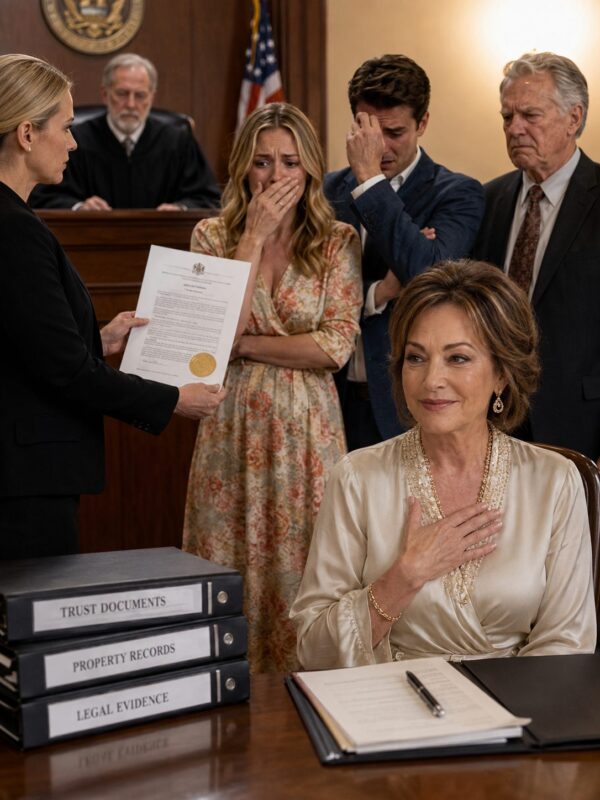
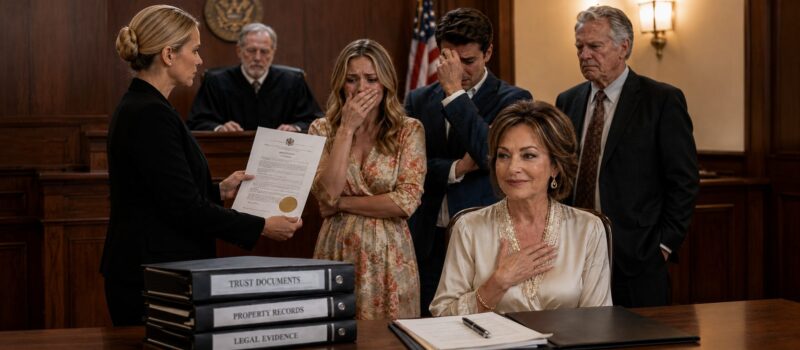
The judge opened the binder. Inside was the irrefutable history of my family’s legacy: the 1979 deed, the trust documents, and, prominently tabbed, the waiver bearing Mark’s blue-ink signature, explicitly surrendering any claim to the estate.
The judge flipped through the pages in silence. Finally, he closed the binder with a heavy thud and stared at Mark. “Mr. Collins, can you produce a single shred of documentation demonstrating your ownership?”
Mark closed his eyes, his face contorting in agony.
“Dad, what is he talking about?” Ashley hissed, digging her nails into his arm.
“No,” Mark whispered. The word echoed through the PA system. Final. Devastating.
Ashley’s face underwent a catastrophic transformation. The smug entitlement vanished, replaced by blind panic. “Dad! You promised me! You said this was yours!”
Elaine stood perfectly still. I didn’t look at Ashley; I kept my eyes locked on Mark. He had stolen my power, handed it to his child, and hid like a coward when the bill came due.
The judge struck his gavel—a sharp crack that severed my past from my future. “Based on the evidence, the defendants are unauthorized occupants with zero legal standing. Occupancy is terminated immediately. A writ of possession is granted. You have seventy-two hours to vacate, or law enforcement will execute a forced removal. Adjourned.”
I walked out of the courtroom, leaving the cold, clinical reality of the law to finish what I had started.
Three days later, the deadline expired. At 9:00 a.m., two sheriff’s deputies arrived at my door with Elaine.
Mark opened the door, looking haggard. Ashley stood behind him, her arrogant confidence entirely gone. As the deputies served the final order, Elaine stepped forward.
“Mr. Collins,” she said, her voice professional but cold. “I want to be unequivocally clear. You have never owned a single square inch of this property.”
The sentence landed on Mark like a physical blow. He slumped, the last vestiges of his ego crumbling. Ashley didn’t scream this time. She just looked around the foyer—at the photographs of my parents, the hardwood floors, the history of a home she had tried to steal without ever wondering whose blood, sweat, and tears had built it.
Near noon, the suitcases were finally dragged to the door.
“I shouldn’t have given you that list,” Ashley whispered, her voice trembling.
“No,” I replied. “You shouldn’t have.”
“I honestly thought he had talked to you. I thought you had agreed to it.”
“Even if he had,” I said softly, “that would not have made the disrespect acceptable.”
She nodded, a jerky, painful motion, and walked out to the truck.
Mark lingered in the doorway. “Rachel,” he choked out. “Can we… can we go to counseling? Can we fix this?”
I looked past him toward the street. “I don’t know, Mark. But we certainly can’t fix it while you still believe that ‘fixing it’ means I just go back to forgetting what you did.”
He covered his face with his hands, a broken sob escaping his throat.
“I loved you,” I told him. “I built my adult life around you. But love is not a license for you to mortgage my dignity, my labor, or my home.”
He didn’t defend himself. He just turned, walked down the steps, and drove away.
In the quiet months that followed, the divorce was finalized without conflict. Ashley eventually found a small duplex near Tyler’s new job.
Around Christmas, a small box arrived on my porch. Inside, perfectly folded, were my mother’s blue towels. I kept them. Sometimes, closure doesn’t look like a dramatic apology; sometimes, it looks like clean laundry returned by a ghost.
I stayed in the house. I repainted the guest room, turned my office into a bright, commanding workspace, and hosted dinners for people who understood that my home is a sanctuary, not a hotel.
I learned that true revenge is a quiet, architectural thing. It is the radical act of refusing to carry another person’s entitlement for one more second.
If this story reminds you of someone who mistook your kindness for weakness, carry this truth with you: Enforcing your boundaries is never cruelty. Protecting the sanctuary you built does not make you selfish. Sometimes, the most devastating revenge is not begging for respect from those committed to misunderstanding you. Sometimes, it is simply standing calm and immovable in the truth, until the liars have nowhere left to hide.