At my father’s birthday party, he slapped me across the face in front of everyone. «What kind of garbage did you bring me?» he roared, tossing my gift aside while the room erupted in laughter. I walked out with stinging eyes and didn’t look back. An hour later, he finally opened the box—and turned ghost-white. By midnight, my phone showed a hundred missed calls, but I only smiled. He had finally discovered what I had taken from him.
The slap rang out before the orchestra even finished its note. For a stunned moment, two hundred guests stared as my father held his hand in the air, seemingly proud of humiliating his own daughter.
«What kind of garbage did you bring me?» he shouted.
The silver gift box had landed near the champagne tower. My stepmother, Celeste, laughed first, followed by my half brother, Grant, who was loud enough to give the rest of the room permission to join in. Soon, the ballroom was filled with thin, sycophantic laughter.
I tasted copper where my tooth had cut my cheek.
«Open it,» I said.
My father’s expression darkened. «You don’t give orders in my house.»
Technically, it had been my mother’s house, but no one in that room knew that yet.
I knelt, retrieved the box, and placed it on the gift table with steady hands. «Then open it later.»
Grant raised his glass. «Maybe it’s another résumé. Evelyn loves pretending she has a career.»
More laughter.
For six years, my family had painted me as a failed accountant living off my father’s allowance. In reality, I had refused his money for years. I worked quietly at Harlow & Finch, a top-tier forensic accounting firm that served banks, prosecutors, and corporate boards. My father never asked what I did; he only enjoyed telling people I did nothing.
Celeste leaned in, her perfume sharp as poison. «You should apologize for embarrassing him.»
I looked at the red welt reflected in the mirrored wall. «No.»
My father grabbed my wrist. «You will not walk out on me.»
I yanked my arm away. «You should have opened the box.»
I walked out beneath crystal chandeliers that had been bought with money he’d stolen from my mother’s company.
Rain lashed at my face as I stepped outside. I cried in my car—not because the slap hurt, but because a foolish part of me had still hoped he might choose decency if given one last chance. For years, I had mistaken my silence for patience. I’d attended the dinners, swallowed the insults, and waited for his regret. That night taught me the truth: cruelty doesn’t vanish when you tolerate it; it only gets bolder. By the time I turned the ignition, my grief had hardened into cold, clear resolve.
At 10:17 p.m., the first call came in.
At 10:19, twelve more followed.
By midnight, my screen displayed a hundred missed calls, seventeen voicemails, and one text from Grant: *WHAT DID YOU DO?*
I wiped my eyes, opened my laptop, and watched the live corporate registry update:
**MERCER INDUSTRIES — CHIEF EXECUTIVE OFFICER: EVELYN MERCER.**
I smiled. Inside that box, my father finally saw what I had taken from him.
Everything he had stolen first.
—
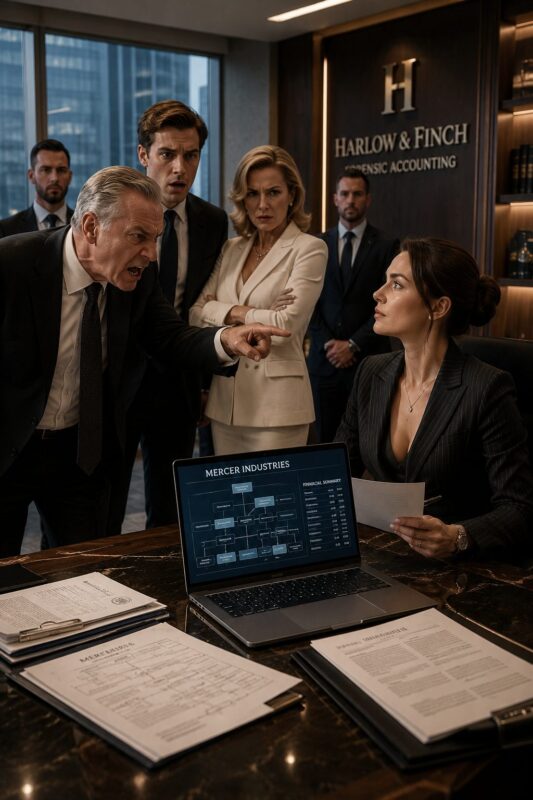
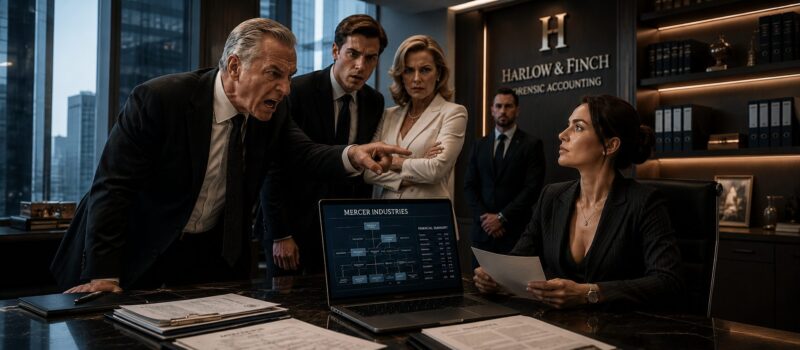
The next morning, my father stormed into my office with Grant, Celeste, and two private security guards in tow, waving the documents from the silver box.
«You forged these!»
My managing partner, Naomi Finch, stepped out of the conference room. «Lower your voice, Mr. Mercer.»
He slammed the papers onto my desk. The top document was a certified copy of my mother’s voting trust. The next was a court order freezing three corporate accounts. Beneath that sat notice of an emergency board meeting that had already taken place at dawn.
«She is my daughter,» my father snapped. «She has no authority.»
Naomi offered a cold smile. «She holds fifty-eight percent of the voting shares.»
Grant went pale.
Celeste recovered first. «Impossible. Victor inherited everything.»
«No,» I said. «He inherited temporary management rights until I turned thirty-five.»
My father’s birthday had been exactly one day before mine.
For nineteen years, he had hidden the trust, siphoned company assets into shell corporations, and forged an amendment claiming my mother had disinherited me. He believed the original document had been destroyed in the archive fire he’d ordered Grant to set.
But my mother had deposited a duplicate with a Swiss custodial bank. Three months earlier, while investigating a bribery scheme, I stumbled upon a wire transfer linked to her old trust number. I followed that thread to the original documents—and then to everything else.
I tapped my screen, bringing up a flowchart: twelve shell companies, forty-three fraudulent transfers, six bribed suppliers, and nearly thirty million dollars funneled into properties owned by Celeste.
Grant lunged for my laptop, but one of Naomi’s investigators pinned his arm.
My father turned on him. «You said the servers were clean!»
«They were!»
«Not the off-site backups,» I said.
The room went silent. My mother had built Mercer Industries on a system of redundancies—data, contracts, ownership, everything.
My father’s shock curdled into rage. «You ungrateful parasite. I gave you a name.»
«My mother gave you hers.»
Celeste folded her arms. «This family still controls the board.»
Naomi slid another document across the desk. «Not anymore. Three directors resigned after seeing the evidence of kickbacks. Two are already cooperating with federal agents.»
My father turned to the guards. «Take the computer.»
Neither of them moved.
«Sir,» one said, «Mercer Industries terminated our contract at 8:00 a.m. this morning.»
Their phones began to buzz—bankers, lawyers, reporters, and partners, all realizing the empire they admired was built on fraud.
«You planned this for my birthday?» my father demanded.
«I delayed it just for that. I wanted to give you one final chance before you raised a hand to me.»
«And if I had opened the box?»
«I still would have removed you. But I might have let you surrender before the criminal evidence went public.»
The office door opened, and two federal agents stepped in.
My father’s face collapsed. It was already too late.
I closed my laptop. «You targeted the daughter you thought was too weak to fight back.»
The lead agent stepped forward with a warrant.
«You really should have checked what she did for a living.»
The arraignment took place three weeks later in a packed federal courtroom. My father walked in wearing a navy suit, with Celeste clutching his arm.
When he spotted me, he smirked.
That smile vanished the moment Naomi authenticated the forensic report.
One by one, the evidence was displayed on the courtroom screens: falsified invoices, secret property deeds, offshore transfers, payment records for the arson, and security footage of Grant entering the archives twenty minutes before the alarm went off.
Celeste hissed, «Victor, you told me there was no footage.»
«There wasn’t,» he muttered.
«There was,» I said. «The city bus across the street captured the loading dock.»
My father turned, pure hatred in his eyes. «This is your family.»
«No,» I replied. «This is your conspiracy.»
Then came the final piece of evidence. My mother’s voice filled the courtroom, pulled from the Swiss bank’s sealed archive.
*»If Victor ever tells Evelyn she is worthless, let this document remind her: the company exists because of my work, and its future belongs to my daughter. Power is not the ability to frighten people. It is the courage to protect what others would steal.»*
Hearing her voice there nearly broke me, but I kept my back straight.
My father, however, did not. His shoulders slumped, as if the woman he had spent years trying to erase had finally returned to face him.
Grant pleaded guilty to conspiracy, destruction of records, and wire fraud. In exchange for his testimony, he got five years. Celeste was convicted of money laundering and tax evasion; she received a seven-year sentence and forfeited nearly everything she owned.
My father, though, refused every deal.
At trial, he painted me as vindictive, unstable, and greedy. The jury deliberated for four hours.
Guilty on all counts.
Before sentencing, he asked to speak.
«Evelyn,» he said, gripping the defense table, «I made you strong.»
When the judge granted me a moment to respond, I stood up.
«No. You made cruelty look like power. My mother taught me the difference.»
He was sentenced to fourteen years in federal prison, hit with massive restitution orders, and slapped with a permanent ban from serving as a corporate officer.
The mansion was sold. I used the proceeds to reimburse the employees whose pensions he had raided and to fund scholarships for women entering forensic accounting and engineering.
Six months later, Mercer Industries reopened under a new board, with my mother’s original name restored above the entrance: **Lillian Mercer Medical Systems.**
I hired an experienced CEO and stayed on as chairwoman. Revenge had never been about sitting in my father’s chair; it was about making sure no one like him could ever misuse it again.
On the first anniversary of his birthday party, the staff gathered to unveil a plaque honoring my mother.
My phone buzzed with a call from the prison.
I watched it ring once, then declined it.
Naomi handed me a small silver box. Inside, resting on velvet, was my mother’s original company seal.
Behind us, the factory doors opened. The machines hummed to life. People went to work without fear.
My father had slapped me in front of a room full of people to prove I was powerless. A year later, he had no company, no mansion, no audience, and no one left to laugh.
I slipped the seal into my pocket and walked inside.