A childless woman defied the town’s spiteful gossip and adopted an abandoned baby whom the entire village branded as «cursed.» Her choice shocked the community, but no one could have predicted what would happen in the years that followed.
### Part I: The Road
That November, the Zalesye backwoods were wretched—no snow, just a bone-chilling, soul-piercing drizzle. The old Siversky tract, long abandoned since the construction of the new highway, snaked between slick, weeping aspens, looking more like a scar on the earth than a road. It was along this path, taking a shortcut to the far hayfields, that Roman Danilovich Shelukhin, a forest ranger, was driving his Niva.
The headlights cut through the gray mist, illuminating the skeletons of dried burdock and moss-covered boulders. Suddenly, the beam hit something out of place. Not a sack, not an animal carcass. A bundle. Roman, a man hardened by life and war, who had seen everything, instinctively tapped the brakes. Stepping out of the car, he heard a sound—faint, strained, like the squeal of a hare caught in a snare. But this wasn’t a hare.
Tucked into a rough army coat soaked through with dampness, an infant was stirring. Not a newborn—a girl, about three months old. She wasn’t crying aloud, just gasping for air in a silent, desperate wheeze. Roman picked her up, trying to warm her, and that was when his flashlight revealed her face.
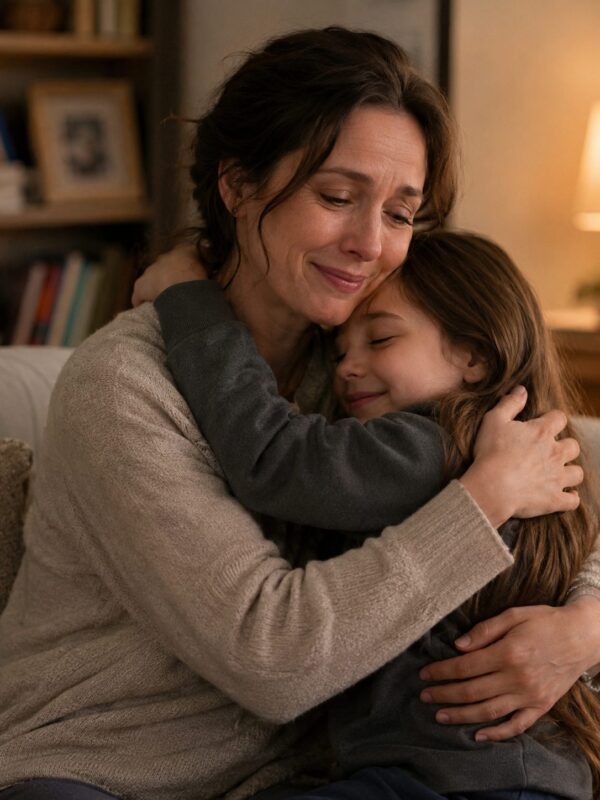
Sprawling across the right side, from her temple to the corner of her mouth, was a patch of skin—not just a birthmark, but a complex, wine-colored pattern, shaped like a bird’s wing or a flame. It looked as if nature itself had branded the child without asking if she wanted to be marked.
«Good God…» was all Roman could breathe, feeling the tiny heart hammering against his palm.
He laid the bundle carefully on the seat and, forgetting all about the hayfields, raced his car back to the village of Olkhovka.
### Part II: Shadows Behind Her Back
The news of the foundling flew through Olkhovka faster than the morning mail delivery. It wasn’t the kind of village where people kept secrets. By the general store, the well, and the bread line—everywhere, the same hive of whispers buzzed.
«Did you hear, Mikhailovna? They dumped a girl! Right by Black Ravine.»
«You don’t say? Is she alive?»
«Stubbornly so. But her face… it’s like a scorched log. Branded, that’s what it is.»
«Those are the sins of Tanya ‘The Flirt’ coming to light. She was pregnant, and now she’s vanished. Ran off to the district with some drifter.»
«And what will happen to the girl? Off to the state orphanage in Novoretsk?»
«Who would want her with a mark like that? Maybe a circus freak show…»
Only one woman, standing a bit further off with a pail of milk, didn’t say a word. Her name was Anfisa. Anfisa Sergeyevna Zvonareva.
She was thirty-seven. She had lived in the village in total isolation, working as a veterinary assistant—treating cows, dogs, and sometimes people, since the licensed doctor only visited Olkhovka on rare occasions. Anfisa was known for being aloof. She had arrived ten years ago, bought a crooked shack by the river, and lived as if she were serving a sentence. No friends, no men, no complaints. People whispered behind her back: «She’s not right in the head. Maybe she’s a fugitive? Maybe her husband beat her, and she’s hiding?»
Anfisa never reacted to the rumors. She had her own deeply buried grief: years ago, back in the city, she had lost her daughter. The baby had died in infancy from a congenital defect, and ever since, Anfisa had lived with a frozen heart.
Hearing about the foundling, she didn’t sleep all night. She kept hearing crying—not the sound Roman had heard on the road, but another, from long ago, in a hospital maternity ward. The next morning, she put on her clean coat and set out for the clinic where the girl was being temporarily kept.
### Part III: The Pull
The room smelled of diapers and disinfectant. The baby lay on a wide bench, wrapped in a government-issued blanket. Anfisa approached and froze.
The girl wasn’t sleeping. She was staring at the ceiling with dark, unnaturally mature eyes that held no fear, no hope—only patient resignation. In the daylight, the mark on her face looked even more startling: crimson and raised, it covered her eyelid and gave her gaze a tragic depth.
But Anfisa didn’t see the mark. She saw a living soul. Small, warm, and trembling on the edge of existence.
«I’m taking her,» she said, quietly but with a finality that made arguing impossible.
The clinic nurse, an elderly and weary woman, threw up her hands. «Anfisa Sergeyevna, for the love of God! You’re all alone! How will you manage? She needs care, money. And who knows, she might be simple-minded. With a face like that…»
«With a face like that, she shouldn’t be lying in an orphanage, but at home,» Anfisa cut her off. «I’m a vet. I can handle it. It won’t be harder than dealing with rabid dogs.»
She leaned over the child and extended her index finger.
The baby immediately grabbed onto her with her entire hand—the grip was unexpectedly strong, tenacious. Anfisa shuddered. It felt as though an electric charge had passed through that tiny palm and into her deadened heart.
«Well, hello there,» she whispered. «My name is Anfisa. And we shall call you Taisia. Taya. Let it be Taya.»
The battle with the bureaucrats was brief. The village was in a state of decay, and the state had no desire to deal with a «problem» child. The paperwork was processed quickly, and they washed their hands of the matter. Just like that, Anfisa became a mother.
And the war began.
### Part IV: Grudges and Bitterness
Olkhovka met the news with hostility. If they had simply disliked Anfisa before for her detachment, they now outright hated her. She had broken the unspoken rule: don’t stand out, don’t take on more than you’re supposed to, and don’t act holier than the rest of us.
When she walked down the street pushing the stroller, neighbors would spit in her wake.
«Witch!» the shopkeeper, Zinka, would hiss. «She took a spoiled thing; now she’s spoiled herself.»
«So proud,» the mail carrier echoed. «Thinks that just because she took pity on a brat, her sins will be forgiven. I bet she’s got a past of her own.»
Anfisa heard it all, but she stayed silent. She didn’t know how to make excuses, and she didn’t want to. But she did know how to wait. And how to protect.
The first major conflict occurred when Taya turned seven. She went to the village school with her head held high. Anfisa had taught her the most important thing: «Your face is a map. Only a fool sees ugliness on it. A wise person sees a sign. Seek out the wise ones.» But as it turned out, there were few wise ones at that school.
Taya returned home with a torn dress and a split lip. «Mom, they pelted me with mud,» she said without crying. «They screamed that I was a devil from the underworld and that my face was a burn from a demonic claw.»
Without a word, Anfisa took her coat off the hanger, grabbed her daughter’s hand, and walked to the house of her tormentor—the son of the local foreman.
She didn’t shout. She walked into the house, waited for the owner to come out, and said in an icy tone, «If your brat comes within a meter of my daughter again, I will break his arms. And yours, too, if you decide to intervene. You know I know how to set bones. But I’m even better at breaking them.»
The foreman, a robust man accustomed to submissiveness, was taken aback by this quiet fury. He tried to argue, but he met Anfisa’s gaze—and stopped mid-sentence. It was the look of a person who had nothing left to lose.
After that incident, people stopped shying away from Taya on the street, but the nickname «The Marked One» stuck to her like a shadow.
### Part V: The Science of Survival
Time passed. The dull hatred of those around them, strangely enough, hardened them both. Their house on the edge of the river became a fortress. In the evenings, Anfisa taught her daughter not just school subjects, but things the locals didn’t know: music, Latin, botany. They ordered crates of books from the city by mail.
Anfisa noticed a strange trait: Taya possessed a phenomenal memory and an almost animal-like intuition. She could unerringly predict the weather, soothe an animal’s pain with a simple touch, and, most surprisingly, she could hear nuances in conversation that were invisible to others. She was growing up not just beautiful—despite the mark—but captivating. Her features were as delicate as an old fresco. Over time, the mark faded slightly but didn’t disappear, evolving into a complex pattern that, at twilight, truly resembled the feather of a firebird.
«Mom, why don’t we leave?» Taya asked one day when she turned fifteen. «Why must we endure this backwater?»
«Because running away solves nothing,» Anfisa replied, sorting through dried herbs. «As long as you hide, your fear grows. But when you stand your ground and look your enemy in the eye, the fear shrinks. We will leave when you can leave as a victor. You must rise above them. Prove that it’s not about the skin, but the essence.»
And Taya proved it. She won the regional, and then the state, biology Olympiads, outperforming all the city prodigies. Taisia Zvonareva’s name appeared in the local papers. The village was in an uproar. It was a defeat no one expected. The locals couldn’t understand: how could this «Marked One» be smarter than their «normal» children?
One day, at the school graduation, where Taya arrived in a modest gray dress, an incident occurred. A group of her former tormentors, already tipsy, surrounded her in the hallway. «So, ugly, they say you’re a genius now?» chuckled the hulking Egor. «How about a parting kiss? Or is the mark contagious?»
Taya looked at him calmly and suddenly smiled. The smile transformed her face—the mark ceased to be a deformity, becoming part of a wild, predatory beauty. «A kiss?» she asked. «I would gladly, Egor. But I’m afraid that after me, you won’t want to kiss those chickens running after you now. And living with that disappointment in Olkhovka—that’s a hellish boredom. Have some mercy on yourself.»
She turned and left, leaving the boys standing with their mouths open, feeling like village idiots. It was her first victory won not with wit, but with spirit. When Anfisa heard about it, she smirked for the first time in a long while: «Now, you are ready.»
### Part VI: Mirrors and Shadows of the Past
Taya left for the Northern Capital (St. Petersburg) to enter the medical academy. She chose surgery—a field where a doctor’s face is often hidden behind a mask, and only hands and brains are valued.
Her studies came easily. She fell in with a crowd of science fanatics who paid no attention to her appearance. Only one person looked at her differently: the professor of dermatology, Vikenty Arkadyevich. He was a dry, world-renowned old man, a luminary in the field of vascular pathology.
One day, he called Taya into his office. «Listen, Zvonareva,» he began without preamble, examining her face through a special lamp. «A stunning case. Capillary angiodysplasia, but what a shape! No chaos at all, the structure is almost artistic. I could remove this in three sessions. I have an experimental technique. No scars. Do you want it?»
Taya froze. She looked out the window at the gray St. Petersburg rain. The offer was tempting. To erase it, to scrub away the past, to become «normal.»
«No,» she replied, more sharply than she intended. «Thank you, Professor. But no.»
«Why?» the old man asked, genuinely surprised. «It would free you from your complexes.»
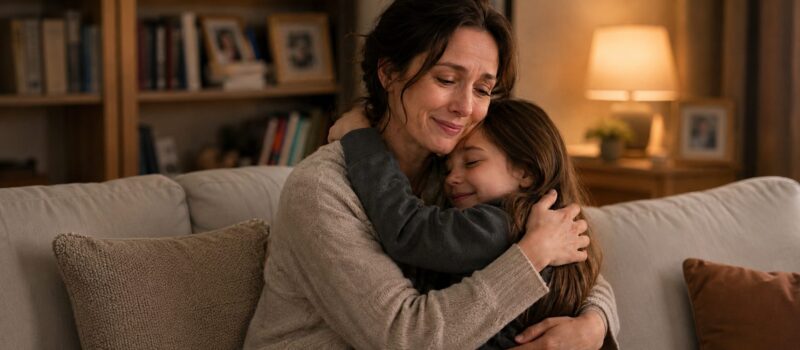
«It would free you from a clinical case,» Taya retorted. «But for me… this is like a memory. You know how it is? You have an old scar that aches before a storm. It’s a beacon. I don’t want to lose my radar.»
She didn’t explain that she was afraid of becoming a blank slate. That the mark was a part of her mother, a part of their struggle. To remove it would be to betray those years in Olkhovka.
### Part VII: The Script of Fate
In her fourth year, Taya received news: Anfisa had fallen ill. Her heart. Taya rushed from her classes and headed home. The trip took two days, and all night on the train, she had the same dream: she was standing on the Siversky tract, at the very spot where she had been found, and she saw a woman in a black shawl. The woman had no face, only a blurred patch. And she was reaching out to the child.
A rotten winter hung over Olkhovka. The house on the outskirts greeted her with the creak of floorboards and the smell of medicine. Anfisa lay in bed, gaunt, gray-haired, but with that same steel glint in her eyes. «Don’t you dare cry,» she rasped when she saw her daughter. «I didn’t raise you to make puddles by my bedside. I’m going to live. We have unfinished business.»
«What business, Mom?»
«I was looking for her,» Anfisa coughed. «Yours… that woman. Tanya. I found her trail. She’s alive. She’s in a nursing home in Novoretsk. You must decide if you need her before it’s too late.»
Taya stepped onto the porch. The frosty air burned her lungs. Her biological mother. The one who had dumped her in a dirty coat on the side of the road. Why had Anfisa looked for her? Out of a sense of justice? Or to test her daughter one last time?
She made up her mind.
### Part VIII: Meeting at the Abyss
The nursing home in Novoretsk resembled a train station from which no trains ever departed. In a room smelling of bleach, sitting by the window, was a hunched woman with empty, watery eyes.
«Hello, Tatyana… Nikolaevna,» Taya sat down opposite her. «You don’t remember me. My name is Taisia.»
The old woman slowly shifted her gaze. She stared for a second, then suddenly recoiled, pressing herself against the back of the bed, and muttered: «Go away! Go away, I didn’t call for you! You’re dead! I put you out in the frost, you were supposed to freeze!»
Taya silently pulled her hair back from her face, revealing the wine-colored mark. The effect was staggering. The old woman howled, covering her head with her hands. «Forgive me! The devil possessed me! They told me you were cursed, that one can’t live with a face like that! It’s a disgrace! I thought you’d be picked up or die quickly, without suffering…»
Taya listened to this drivel. She thought she would feel anger, pain, or at least contempt. But inside, there was only a ringing emptiness. «I didn’t die,» she said quietly. «And I wasn’t cursed. You committed a crime. But you know… if it weren’t for you, I would never have met my mother. My real one.»
«You have no mother,» the old woman whimpered. «You are the devil’s seed.»
«You are mistaken. My mother is a saint. And you… you are just a cowardly woman. And I came here to tell you: I forgive you. Because my mother taught me that anger is a burden. And I need to travel light.»
Taya stood up. She realized she didn’t want to see this person anymore. She felt no hatred—only disgust mixed with pity.
«Goodbye,» she said, and walked toward the exit.
«Wait!» a piercing scream caught her at the door. «What is your name? What did they name you?»
«Taisia. It means ‘reborn’.»
She stepped outside. The world didn’t turn upside down, no thunder cracked. Another chapter had simply come to an end.
### Part IX: Connecting Threads
Returning to Olkhovka, Taya didn’t recognize the village. Or rather, she recognized it—it hadn’t changed; the same poverty and bleakness. But *she* had changed. The scale of her personality had outgrown this place.
Anfisa was recovering. In the evenings, they sat by the stove and talked about the future. «I’m taking you to St. Petersburg,» Taya said. «Enough. You’ve stood your ground.»
«No,» Anfisa shook her head. «My place is here. This house, the river, your roots… I will wait for you here. But I have one request.»
«What is it?»
«Look at this,» Anfisa brought out an old jewelry box. Inside lay documents, yellowed clippings, and… a photograph. The very same one. The small bundle on the tract. And the number of Roman’s car.
«I dug into the old archives when I was looking for your biological mother. And I found something else,» Anfisa smiled enigmatically. «Roman Shelukhin, that ranger. He disappeared two days after he found you. He left for the north, for the taiga. Abandoned his family. People said he lost his mind—that he had found not only a baby in the bundle but some jewelry, antique earrings with rubies. An heirloom of your lineage. And he went chasing the mirage of gold.»
«What heirloom? Mom, what are you talking about?»
«Have you never wondered why your mark has such a perfect shape? Why you feel people? It’s a family trait. Your lineage comes from the Old Believers. They lived in remote sketes, possessed secret knowledge. In their family, a mark on the face was considered a blessing, not a curse. That’s where that woman’s fear came from. She was an outsider to that family.»
Taya was stunned. The story that had seemed to her a story of wretchedness had turned into a mystical saga. «I must find Roman? Or these earrings?»
«You must find yourself. The rest will follow,» Anfisa took her daughter’s hand.
### Part X: The Circle Closes
Five years later, Taisia Zvonareva became a leading vascular surgeon at the Pirogov Clinic. She specialized in surgeries once considered impossible. The professor who had once offered her a laser removal now proudly called her his successor. But her main passion was the charity program «Ash Cradle»—a foundation helping children with craniofacial anomalies abandoned by their parents.
She traveled the country giving lectures, and one day, in a remote Siberian village, an elderly, haggard man approached her. «You are that girl, aren’t you? From the Siversky tract?» he asked in a cracked voice. «I am Roman. I am the one who found you.»
Taya froze. Standing before her was that very same ranger. His eyes were wild, yet kind. «I stole the earrings back then,» he admitted, weeping. «I thought I’d get rich. But they burned my hands. I couldn’t sell them. I hid them in the taiga my whole life. And now I am dying. Take them. They are yours, by right.»
He handed her a dirty bundle. Inside lay two heavy, antique earrings with scarlet stones that resembled drops of dried blood. The exact same color as the birthmark on her face.
### Epilogue
Summer in Olkhovka smelled of honey and pine needles. By the river, on a bench, sat two women. One was completely gray, majestic as an ancient queen. The second was young, with a striking face where, instead of an ugly blemish, there was now only a light pinkish shadow—the faint trace left after the complex correction procedure she had finally decided to undergo in memory of her mother.
Nearby, in the grass, a boy of about four was bustling about. He had clear, bright eyes and no marks on his skin. He was building a castle of sand.
«Grandma Anfisa, look! I built a bridge!» he shouted.
Anfisa smiled. Wrinkles radiated like sunbeams from her eyes. «A bridge is good,» she said. «That is the most important thing. Connecting shores, not burning them.»
Taya looked at her mother. She was holding the old earrings, and the scarlet stones played in the rays of the setting sun. «You know, Mom,» Taya said quietly. «That woman, my blood—she left me here thinking she was ruining my life. But in reality, she gifted me to you.»
«Fate,» Anfisa shook her head. «Sometimes what we mistake for a curse turns out to be the only key to happiness. The main thing is not to be afraid to pick up that key, even if it’s lying at the very bottom of a dirty ditch.»
The boy ran up to them, and Taya lifted him into her arms. The breeze from the river brought a scent of freshness and change. The mark on her face, now almost invisible, suddenly seemed to glow in the sunset rays—not as a brand of ugliness, but as a crown.
And Anfisa suddenly realized that her life had not been lived in vain. That that old loss, that terrible void that had driven her to Olkhovka, had healed. The world had one more happy person in it. And that meant everything was right.
She squeezed the earrings in her fist. «Enough lyricism,» she said sternly. «Time for tea. I have a lingonberry pie cooling. You, grandson, wash your hands. And you, daughter, bring the cups.»
Taya laughed. Lightly, freely, ringing.
And that laughter was the ultimate proof that no birthmarks, no human gossip, and no blows of fate have power over a heart in which love lives. Love that asks for nothing in return. That simply breathes and triumphs.