The first thing I felt after falling was the taste of blood.
Not pain.
Not fear.
Blood.
It sat in my throat as a warm, metallic bitterness while the bedroom rug scratched my hand and the ceiling lamp hummed with such calm, indifferent detachment that it felt as if our marriage hadn’t just shattered, but as if a lightbulb had simply burned out.
Andriy Kovalchuk stood over me with his sleeves rolled up.
His breathing was even.
That was what frightened me more than the blow.
There was no flare-up of remorse, no panic of a man who had crossed a line and suddenly realized what he had done.
He stood as if he had just tidied up.
Moonlight cut through the gap in the curtains, slicing his face in two.
One side was bright.
The other was almost black.
“You humiliated me,” he said.
I pressed my palm to my cheek, the heat beneath my fingers already swelling.
“Because I said no?”
His jaw tightened, as it always did when he didn’t want to sound angry, though the anger seeped through his teeth anyway.
“Because my mother asked for one simple thing.”
*One simple thing.*
That was what Andriy called Halyna Petrivna’s plan to move in with us.
Not for a week.
Not for a month while she was feeling unwell.
Forever.
She was to take our bedroom because “her knees hurt.”
She was to reorganize the kitchen because “a woman in the house must know how to keep order.”
She was to inspect what I cooked, what I wore, when I got home from work, who I texted, and why I didn’t smile at the family table.
She didn’t say it all at once.
Halyna Petrivna was too experienced to voice her authority directly.
She served it in small portions, like medicine that supposedly had to be swallowed for one’s own good.
“I’ll only take one closet.”
“It would be more comfortable for me in your room.”
“You don’t mind if I check the groceries sometimes, do you?”
“Andriy is used to proper food.”
“Don’t be offended, but a wife should be softer.”
At dinner in the restaurant, she said this almost gently.
Andriy sat next to her, not me, twisting his wedding ring the entire time.
The table was filled with plates, glasses, napkins, a basket of bread—and between us sat her decision, which she already considered a done deal.
I didn’t raise my voice then.
I didn’t wave my arms.
I didn’t make a scene.
I simply laid my fork down next to my plate, looked at Halyna Petrivna, and said: “No. You will not move into our bedroom.”
The restaurant froze.
The waiter stood by our table with a pitcher of water tilted in his hand, but the water didn’t pour.
Halyna Petrivna’s spoon hung suspended over her saucer.
Andriy’s smile remained, but there was nothing human left in it, only a thin tension, stretched to the point of pain.
At the next table, a woman slowly lowered her eyes into her wine glass.
No one wanted to be a witness to someone else’s family power struggle.
No one wanted to see the moment a woman first said “no” out loud.
After that, Andriy smiled until dessert.
He passed his mother the sugar.
He asked if her tea was too cold.
He even touched my hand when the waiter brought the bill.
To everyone around us, it was a quiet, pleasant evening.
To me, it was the silence before the door that was about to be locked at home.
On the way back, he didn’t say a word.
Halyna Petrivna stayed at her building’s entrance, leaned toward the window, and said, “Tomorrow we’ll talk without any hurt feelings.”
She wasn’t looking at me.
She was looking at her son.
When our apartment door clicked shut, Andriy changed so quickly that for a moment, I felt as if the man in the hallway had remained there, and a different one had entered the bedroom.
A stranger.
Cold.
With my last name in his documents and my trust in his hands.
“Tomorrow you will apologize,” he said after everything.
I lay on the floor, looking up.
He wanted me to cry.
He wanted to hear me beg.
He wanted my voice to give him back what I had taken in the restaurant—the feeling that he controlled the room.
I was silent.
It was dangerous, but it was all I had left.
“Do you think you’re strong?” he asked quietly.
His quiet voice was always worse than his shouting.
“You live in my apartment, you carry my last name, you spend my money.”
I almost laughed, though my lip stung.
*His* apartment.
*His* name.
*His* money.
For seven years, he had repeated these words in various ways until he himself believed they were true.
And for seven years, I had confused marriage with limitless trust.
I gave him the door code.
Passwords.
Access to accounts.
The keys to my office.
Even my father’s watch, which I had kept after his funeral, I gave to Andriy for safekeeping because he said he wanted “to have a piece of the man who raised you to be the woman I love.”
Back then, it sounded tender.
Now, I understood that some people take the most valuable things not because they treasure them, but because they want to know exactly where they are kept.
Seven years ago, when he first brought me to meet his mother, Halyna Petrivna scrutinized me in the kitchen with the floral curtains and old ceramics on the shelves.
She squeezed my hand and said, “You’re quieter than the others. That’s good.”
I thought she liked my calm.
I thought she saw breeding in me.
Only later did I realize that in their family, silence wasn’t a character trait.
It was a convenient handle, something by which a woman could be moved from place to place.
Andriy stepped over me and went to the closet.
He changed into his pajamas as if he had finished a long day.
Then he climbed into bed.
In a few minutes, his breathing became deep and even.
He fell asleep.
I lay on the floor until the room slowly turned back into place.
The closet door.
The edge of the blanket.
The bedpost.
My own finger with the thin wedding ring that I suddenly felt like a wire.
When I was able to stand, I didn’t go to him.
I didn’t reach for the phone that lay on his nightstand, which he checked more often than he ever admitted.
I crawled to the bathroom.
I locked the door.
I turned on the water so the noise would drown out any sound.
In the mirror, a woman looked back at me whom I both knew and didn’t know at the same time.
A dark bruise was spreading under my eye.
A thin line of blood glistened on my lip.
My hair was matted to my temple.
I touched my cheek once and pulled my hand away.
The tears didn’t come.
Perhaps they would have come on another night, if this had been the first time he had broken me.
But this wasn’t the first.
This was just the first night that the evil had left a clear mark.
Under the sink, there was a tile that had been loose for a long time.
Andriy once said he would call a handyman, but then he forgot, because anything that didn’t concern his own convenience could wait.
I pried the tile up with my fingernail.
Behind it lay a small black phone.
Not pretty.
Not expensive.
Not registered to our family life.
Only I, my lawyer, my accountant, and the private investigator I had hired six weeks ago knew about it.
The screen lit up.
Three messages.
From the lawyer.
From the accountant.
From the detective.
I opened the last one.
The subject was short: “Final evidence package ready.”
Time: 01:18.
I read it twice, because my head was still spinning.
Then I opened the attachments.
Parking garage footage.
Andriy at the trunk.
Boxes from my office.
Halyna Petrivna standing nearby in that same cream-colored coat, with her hands folded as if she wasn’t stealing someone else’s things, but supervising a furniture delivery.
Next were the bank transfers.
Sums that were supposed to be “temporary expenses.”
The account he claimed had a technical error.
Signed explanations from the accountant.
A notarized statement from the building concierge who saw Andriy moving boxes to his mother’s storage unit two Thursdays ago.
And one more file from the lawyer.
A police statement template.
Only one field was empty.
*Description of injuries.*
I looked at it for a long time.
Then I realized that in my hands, I didn’t just have a phone.
I had a language that Andriy couldn’t twist.
Not “she’s exaggerating.”
Not “she’s being emotional.”
Not “we have a family conflict.”
Documents.
Dates.
Photos.
Signatures.
Recordings.
In some marriages, the truth doesn’t arrive as an epiphany.
It arrives as a folder of evidence.
I smiled, and the pain shot through my lip again.
This wasn’t joy.
It was the recognition of a moment expected by someone who had spent too long preparing in silence.
Andriy had finally given me what my case was missing.
Not just the schemes.
Not just the money.
Not just his mother’s hands in my belongings.
He had given me proof that he considered me helpless enough that he didn’t need to fear leaving his own traces.
At 6:00 AM, the bathroom door opened without a knock.
I was sitting on the closed toilet lid with a towel wrapped around ice.
Andriy stood in the doorway, already in his shirt.
In his hand, he held an expensive cosmetic kit.
Like a gift.
Like care.
Like foundation could be an apology.
He set the kit on the shelf by the sink.
He didn’t ask if I could see clearly.
He didn’t ask if I was dizzy.
He didn’t offer to call a doctor.
“My mother is coming for lunch,” he said.
I looked at the golden zipper of the kit.
“Cover all that up and smile.”
He said it without malice.
Casually.
That casualness was the most terrifying part.
In his head, this wasn’t cruelty.
It was logistics.
Hide the bruise.
Set the plates.
Serve lunch.
Apologize to his mother.
Return the world to a shape where he was right again.
I opened the kit.
Inside was new concealer, foundation two shades warmer than my skin, powder, a small sponge, and a lipstick in a shade Halyna Petrivna would choose if she wanted a woman to look obedient.
“Of course,” I said.
Andriy’s shoulders relaxed.
That was when I finally understood just how little he knew me.
He saw silence and thought it was emptiness.
He saw calm and thought it was consent.
He saw my downcast eyes and thought I was looking down, rather than reading a map to the exit.
At 11:40 AM, the dining room was ready.
The white tablecloth lay flat as snow.
Silver rings gripped the napkins.
Glass stemware stood in a row.
Lemon chicken was waiting under foil.
A large pot of borscht sat on the stove, because Halyna Petrivna always said that without a hot first course, lunch wasn’t lunch.
Next to the bread, I placed a ceramic bowl from Kosiv.
On the sideboard, I spread out the embroidered towel my mother had given me on the day Andriy and I moved into this apartment.
I used to save it for holidays.
Now, it lay under the phone.
The black phone was taped to the underside of the sideboard with a strip of heavy-duty tape.
Unless you knew where to look, it was impossible to notice.
Andriy watched me with his eyes.
He liked the way I moved between the kitchen and the table.
He liked the order, which he had mistakenly accepted as victory.
“See?” he said, almost gently, when I straightened the fork by his mother’s plate. “This is much better.”
I didn’t answer.
My hand briefly tightened around the handle of a large spoon.
Not so he would notice.
Just so I would remember that the hand was still mine.
At 11:57 AM, Halyna Petrivna’s car stopped at the entrance.
I saw it from the kitchen window.
Cream-colored coat.
Straight back.
Bag hooked over her elbow.
A woman who had spent her whole life walking into other people’s rooms as if they had already been handed to her by silent consent.
At 12:01 PM, the doorbell rang.
Andriy straightened his collar.
“Remember what we talked about.”
I touched the makeup under my eye.
Under my fingers, it felt dry, foreign, and too warm.
“I remember everything.”
He smiled because he only heard the first half of that phrase.
I opened the door.
Halyna Petrivna’s perfume entered the hallway before she did.
She handed me her coat without a real greeting and immediately looked at my face.
Not quickly.
Not accidentally.
Right where the concealer was supposed to do the job that was demanded of it.
For one second, her eyes changed.
There was recognition there.
No sympathy.
No horror.
No questions.
Recognition.
She knew.
Maybe he told her in the morning.
Maybe she just knew her son too well.
Or maybe she once taught him herself that after a blow, a woman should be brought not an apology, but cosmetics.
“Well then,” she said, taking off her gloves. “You look quite rested.”
It was a test.
Not a phrase.
Not an insult.
A test.
She wanted to hear me thank her for the lie.
I took her coat.
“Please, to the table.”
The dining room went quiet as we sat down.
Andriy poured water.
His wedding ring clinked against the glass.
Halyna Petrivna ran a finger along the edge of the napkin, checking if the fabric was straight enough.
I placed a plate in front of her.
I placed a plate in front of Andriy.
I placed my own.
Then I took a step toward the sideboard, as if going for bread.
My hand slid under the wooden edge.
My finger found the button.
I pressed it.
The phone vibrated once.
The recording had started.
I returned to the table with bread in my left hand and a sealed yellow envelope in my right.
Andriy saw it first.
His smile grew thin.
Halyna Petrivna looked at the envelope too, and her fingers froze on her napkin.
“What is this?” she asked.
I placed the bread in the center of the table.
Then I placed the envelope by Andriy’s plate.
I didn’t throw it.
I didn’t shove it.
I placed it precisely, as one places an object that has long had its place.
“Lunch,” I said. “And the apology you wanted.”
Andriy looked at me.
Maybe he was looking for fear.
Maybe trembling.
Maybe the woman he had left on the floor the night before.
But she wasn’t lying there anymore.
She was sitting at the table with a towel on the sideboard, borscht on the stove, a phone under the wood, and documents near his hand.
His fingers touched the edge of the envelope.
For the first time in all the years of our marriage, I saw something on his face that wasn’t anger or overconfidence.
Uncertainty.
Halyna Petrivna noticed it before he did.
Her pearls clicked softly against each other when she gasped.
“Andriy,” she said very quietly.
But he was already tearing the seal.
The paper parted with a dry, short sound.
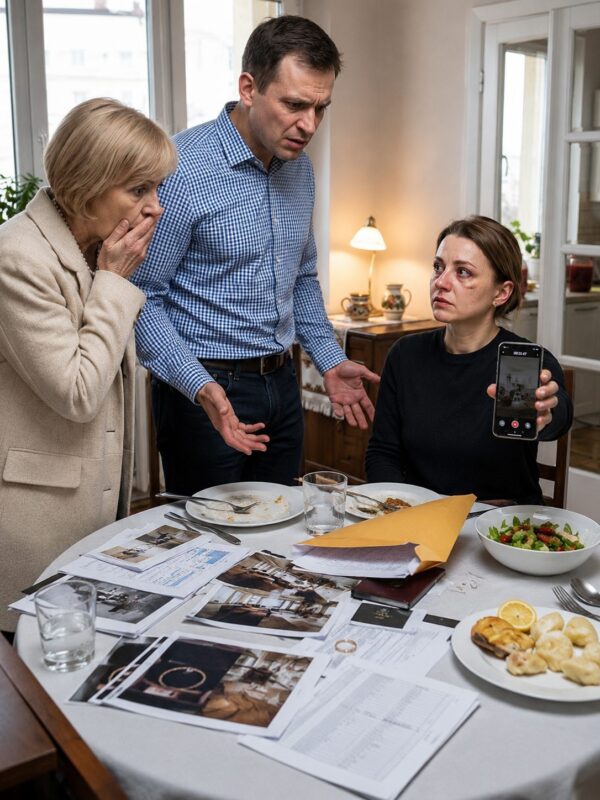
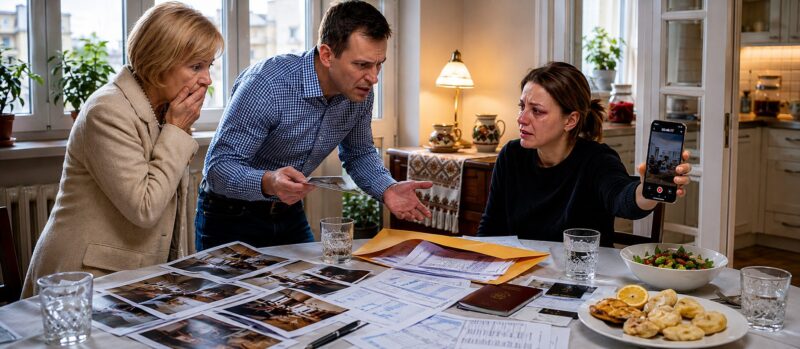
The first photograph slid out of the envelope.
In it, he stood in the parking garage with a box from my office, while his mother held the trunk open.
The second photo showed her hand on my box.
The third sheet was a bank statement.
The fourth was a copy of the concierge’s statement.
The fifth fell to the floor by Halyna Petrivna’s foot.
She looked down.
I knew exactly what she saw.
A list of things that had disappeared from my office.
Among the folders, the flash drive, the documents, and the old jewelry box, the first line read: *Father’s watch.*
Something in the room shifted.
It didn’t get louder.
It didn’t get more dramatic.
It was just that the silence stopped belonging to them.
Andriy raised his eyes to mine.
“What have you done?”
I leaned forward just enough for the phone under the sideboard to clearly catch my voice.
“I’ve finally stopped cleaning up the traces you left behind.”
Halyna Petrivna sat down heavily in her chair.
The glass near her plate wobbled and tipped.
Water spilled across the white tablecloth, crawled toward the envelope, and soaked the corner of one of the sheets.
Andriy didn’t move.
He stared at the phone in my hand, because now I was holding it out in the open.
The recording light was glowing on the screen.
And then a new message came in.
From the lawyer.
*“I’m at the entrance. Don’t open the door yourself.”*
Andriy read it along with me.
His face slowly drained of color.
Outside the apartment door, the bell rang.
This time, I didn’t get up right away.
I looked at Halyna Petrivna sitting over the wet tablecloth, at Andriy with the envelope in his hand, at the towel on the sideboard under which my truth was no longer hiding.
Then I said calmly: “Now we will talk without any hurt feelings.”
And only then did I walk to the door.