My daughter begged me not to go on my business trip and whispered, «Daddy, when you’re away, Grandma takes me somewhere and tells me I’m not allowed to tell you.»
I was supposed to leave before dawn, and everything in the house looked as if this morning had no right to become the most terrifying one of our lives.
My suitcase stood by the door, the folder with my documents lay on the console, my keys waited beside it, and coffee steamed in the kitchen, creating a soft, white dampness on the cold glass.
Solomiya sat at the table in her socks with yellow ducklings, staring at her plate as if she wasn’t sure if she was allowed to be a child today.
She was seven.
At seven, a child might be afraid of the dark, a stray dog, a school test, or the fact that Dad is going away for a few days and won’t hear her ask for water before bed.
But that wasn’t what was in her eyes.
There was something adult, heavy, and silent living there.
I slid the juice toward her and told her to eat at least a little bit.
She shook her head.
I asked if it was because of my trip.
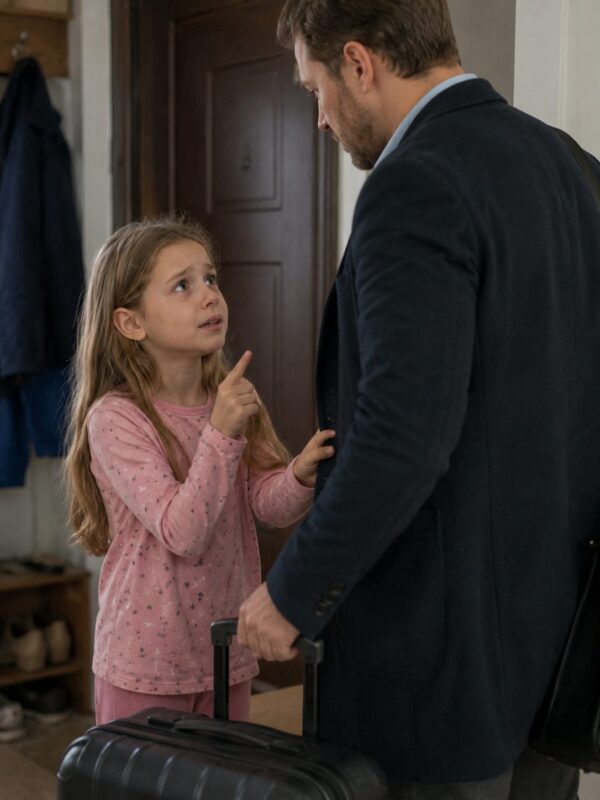
She nodded, but it was as if that were just a door behind which a different answer stood.
I sat down next to her, put my hand on the edge of the chair, and said I would be back in three days, and on Saturday, we would make blueberry pancakes.
Then Solomiya looked up.
«Daddy,» she said, almost voiceless, «when you’re away, Grandma takes me to a place.»
I didn’t move.
In seconds like these, the father in you wants to grab the child, shake all the answers out of the air, and immediately destroy everything that scared her.
But the adult in you has to sit quietly, because the child is still speaking.
«Where?» I asked.
Solomiya glanced toward the hallway.
Then she leaned closer.
«She says I’m not allowed to tell you. She says it’s our secret.»
I heard not words, but the clicking of a lock in my head.
My mother-in-law, Valentyna, had been living in a small guest house behind our home for six months.
After her husband passed away, Olena said it would be the right thing to do: Mom wouldn’t be alone, Solomiya would get more attention, and with my travels and Olena’s work, life would become easier for us.
And at first, it really did seem easier.
Valentyna brought over *borscht*, *varenyky*, clean towels, picked Solomiya up from school, and read to her at night when we were running late.
She looked like the kind of grandmother every neighbor loves because she knows whose back has been aching and always has a candy on hand for a child.
We let her in close.
Too close.
I asked Solomiya what happens in that place.
She said there’s a house with blue doors.
She said the lights inside are very bright.
She said sometimes there are other children there.
She said Grandma brings clothes in a bag, and the adults tell the children where to stand.
At the word «adults,» something in my chest turned to stone.
I asked if she liked it there.
«No,» she answered immediately.
That «no» was faster than fear.
I didn’t ask any more questions.
A child who has finally opened the door to their secret shouldn’t have to stand under the spotlight of adult horror right away.
I just hugged her.
She clung to me as if she were afraid I would disappear for three days again.
«You did the right thing,» I whispered into her hair. «You’re very brave.»
She whispered that Grandma said I shouldn’t make things difficult.
And in that very moment, I realized my business trip had ended before it even began.
Olena arrived home in less than half an hour.
She walked in wearing her coat, folder under her arm, with the face of someone ripped away from work by a sharp call, and she hadn’t said a word yet, but she already knew that a normal day had come to an end.
We sat in the living room.
Solomiya was watching cartoons in the next room.
An old *rushnyk* hung on the wall, and a cup of half-drunk tea sat on the table, and this simple domesticity made everything feel even more terrifying.
I told Olena what our daughter had said.
At first, her face wouldn’t accept what was said.
Then it accepted a part of it.
Then the whole truth, because children don’t invent blue doors, bright lights, clothes in a bag, and the command to stand where adults tell them.
«Did she definitely say ‘blue doors’?» Olena asked.
I nodded.
We opened the laptop and looked again at the drawings Solomiya had made with a child psychologist a few weeks ago.
Back then, we told ourselves it was just a phase following changes in the family.
Back then, the blue rectangle was just a rectangle.
Back then, the little figures were just children’s scribbles.
Back then, the thing on three legs was just a random shape.
Now, it could be a door.
Children.
A tripod.
Sometimes the truth doesn’t arrive as new information.
Sometimes it returns to an old thing and forces you to see it for the first time.
Olena said we needed to call someone immediately.
I said we would call, but first, I needed to know where Valentyna was taking her.
Olena looked at me as if she hated that she understood my logic.
I had spent years filming documentaries.
I had to work with topics that people hide behind tidy doors, nice titles, and papers that look legal.
I knew how not to spook someone who thinks they are smarter than everyone else.
I knew how to wait.
And I knew that sometimes one extra move toward the truth can close it off forever.
We decided to play out my departure.
I was supposed to pack a suitcase.
Olena was supposed to drive me so that Valentyna would see it.
Then Olena would go to work.
I would return to the neighborhood and watch.
In the evening, Valentyna messaged Olena to ask what time we were leaving.
The message looked ordinary.
That was exactly why it was terrifying.
Olena replied 6:30, because I always leave early.
After Solomiya fell asleep, my wife came into my office.
On the table lay batteries, memory cards, a camera, a spare phone, and a power bank.
«What if there’s a normal explanation?» she asked.
I looked at all of it.
«Then I will be grateful for it for the rest of my life.»
In the morning, we played the part of a family to whom nothing had happened.
Olena kissed me by the car.
I said I would call when I arrived.
Valentyna stood by the guest house in her grey cardigan, waving.
Solomiya watched from the window.
I had to look away, because I was afraid she would see the plan on my face and get even more scared.
At the station parking lot, Olena turned off the engine.
She was silent for a long time.
Then she said she hated this.
I said I knew.
She said what she hated most of all was that she wasn’t surprised enough.
That sentence hit me harder than I wanted to show.
Because sometimes a family feels small cracks for years and calls them personality quirks.
Valentyna always wanted to control everything.
When Solomiya ate, slept, what she wore, who her friends were, what activities she needed.
We called it caring.
We said that after losing her husband, she was just holding onto order.
But order that doesn’t ask for permission very quickly becomes power.
An hour later, I was back in our neighborhood.
I parked down the street behind a hedge.
The camera was on the passenger seat, my phone was plugged into a power bank, and in the cup holder sat a thermos of coffee I couldn’t bring myself to drink.
At 8:55 AM, Valentyna walked from the guest house to the main house.
At 9:00 AM, she came out with Solomiya.
My daughter was wearing a pale blue dress I had never seen before.
I remembered it not because of the color.
I remembered it because of the preparation.
Someone had decided how my child should look.
Someone had put this dress in a bag.
Someone had waited for the father to leave.
Valentyna put Solomiya in the car, buckled her in, and drove off.
I let two cars pass between us.
They went past the school, the gas station, a few old shops, and then into a part of the city with repurposed warehouses.
There, the buildings stood low, the brick was worn, the windows were narrow, and the signs looked as if no one had read them in years.
Valentyna parked by the door.
They were blue.
Not dark, not grey, not random.
Bright blue, almost cheerful, as if that alone was supposed to convince adults that nothing bad could be happening behind them.
I started recording.
Valentyna opened the back door.
Solomiya got out and pressed her hands to her sides.
Valentyna smoothed the hem of the dress and leaned in to say something.
I didn’t hear the words, but I saw my daughter stand even straighter.
Then Valentyna unlocked the door with a key and led her inside.
Seven minutes later, a man in a dark coat arrived.
Then a woman with a large bag.
Then another car arrived.
Then another.
I photographed license plates, faces, doors, the time on the screen.
I worked coldly, almost professionally, and that was exactly what scared me.
Inside, the father in me was screaming.
Outside, the camera was working.
First, I called Olena.
I told her Solomiya was there.
She asked only one thing:
«Blue doors?»
I said yes.
She gasped and said she was calling Detective Petrenko.
I knew Iryna Petrenko from my previous work.
She had helped me with a project about teenagers whom adults were pulling into dangerous schemes under the guise of «great opportunities.»
She once told me that if something seems wrong involving a child, it’s better to call sooner than to have to explain later why you stayed silent.
I dialed her myself.
She answered quickly.
I gave her the address.
The description of the doors.
The number of cars.
Solomiya’s clothing.
The other children I saw.
The words my daughter had said.
On the other end of the line, it became very quiet.
Then she told me not to go in.
Not to get close.
Not to reveal myself.
To keep the entrance in sight.
I said I wouldn’t leave my child.
She replied:
«I am not asking you to leave her. I am asking you not to make sure you get taken out before we can take the children out.»
Children.
That word was worse than anything I had heard yet.
Twenty minutes later, two unmarked cars rolled into the street.
Then a police cruiser.
Then another.
The movement was fast, but not flashy.
No shouting.
No movie theatrics.
People who know what they are doing don’t always look dramatic.
They just don’t let the doors close.
The man in the dark coat stepped out first.
When he saw the badge, he jerked backward.
He wasn’t allowed to retreat.
The woman with the bag appeared in the opening, and for one second, I saw light behind her shoulder.
White.
Harsh.
Not like office lighting.
It looked like the lamps they set up to make sure every face is visible.
I felt nauseous, though I couldn’t vomit.
Detective Petrenko walked to the door, but she didn’t come to my car.
She just held up two fingers.
*Stay.*
I stayed.
First, two children were led out.
Then a little girl.
Then a boy.
Then Solomiya.
I don’t remember opening the car door.
I think I was already on the sidewalk when I realized I was moving.
Petrenko caught my gaze and said:
«A second.»
«That’s my daughter.»
«I know. Give us a second.»
Solomiya stood on the threshold, pale, small, looking like a stranger in that dress no one had asked us about.
When she saw me, her mouth opened, but no sound came out.
Then she ran.
I grabbed her so hard I almost fell.
«Daddy,» she sobbed into my neck.
«I’m here,» I said. «I’m here. I’m sorry. I’m so sorry.»
I didn’t know exactly what I was apologizing for.
For the fact that these trips were part of my job?
For trusting a person who spoke with the voice of family?
For the fact that my child had to bring the word «secret» to the kitchen table all by herself?
Then Valentyna walked out of the door.
Two officers were walking beside her.
Her grey cardigan was buttoned perfectly.
Her hair was perfect.
And her face was innocent.
It was offended.
As if we had ruined her morning.
«Andriy,» she said sharply, «you have no idea what you’ve done.»
I looked at her over Solomiya’s shoulder.
For the first time in all the time I’d known her, she stopped looking like family.
She looked like a stranger we had let too close to our child.
«Where were you taking her?» I asked.
Valentyna pressed her lips together.
«It was a safe opportunity for a children’s modeling session. You made everything dirty.»
Detective Petrenko looked at her.
«No,» she said. «You did.»
The woman with the bag was led out behind her.

She was crying, saying she only kept the schedule.
The man in the dark coat kept glancing at the cameras, as if trying to understand which ones had already captured his face.
Solomiya pressed into me tighter.
«She said not to tell you,» my daughter whispered.
«I know, sweetie.»
«She said you would ruin everything.»
I closed my eyes.
«I certainly hope I did.»
At the precinct, Olena arrived looking like she was holding herself together with her own two hands.
Solomiya rushed to her and collapsed into her arms.
They didn’t let go of each other for a long time.
The child was interviewed by a specialist who works with minors.
Olena and I waited behind the glass and couldn’t do anything, and it was a level of helplessness you wouldn’t wish on your worst enemy.
Parents get used to thinking that love is an action.
To pick up.
To protect.
To take away.
To say no.
But sometimes, love is forced to sit on a chair in a hallway and not break procedure, because the procedure is what is now protecting your child.
Later, Detective Petrenko came out with a folder.
I understood more from her face than I wanted to.
«It wasn’t just your daughter,» she said.
Olena found my hand.
«How many children?» I asked.
«We are still establishing that.»
My knees buckled.
Petrenko spoke carefully.
On paper, the facility was registered as a children’s creative studio.
Supposedly classes, auditions, portfolios, a talent workshop.
But for several of the children, there were no proper permits.
No parental signatures.
There were indications that some of the children were brought there without the knowledge of their legal guardians.
Olena covered her mouth with her hand.
I asked about Valentyna.
Petrenko looked into the folder, then at us.
«Provisionally, she didn’t just bring Solomiya. She may have been recruiting others.»
Olena made a sound I had never heard from her before.
It wasn’t a cry.
Not a scream.
Something deeper.
As if an entire room inside her had collapsed.
I thought about all the times Valentyna stood in our kitchen with a pot of *borscht*, saying that a grandmother just wants to help.
About all the times she picked Solomiya up from school.
About all the times I thanked her.
The most terrifying doors are sometimes not opened by strangers.
Sometimes they are held open by someone you gave a spare key to.
Petrenko laid a few photographs on the table.
In one was Solomiya.
In the second were two children I didn’t know.
In the third was another child by those same blue doors.
«We found these in a locked cabinet,» the detective said. «There may be more.»
I looked at the photographs until they blurred.
My daughter had warned me.
A seven-year-old child had been carrying a secret that should never have touched any child.
And if I had gotten on that train, if I had gone to that conference, if I had decided it was just childhood anxiety before a separation—I might never have known where Grandma was taking my little girl.
We barely slept that night.
Solomiya fell asleep between us, clutching the hem of my T-shirt.
Olena lay with her eyes open.
I didn’t ask what she was thinking.
I was afraid I already knew.
Before dawn, my phone rang.
The number was unknown.
I almost declined it.
Then I answered.
The man’s voice was calm, business-like, so steady that I wanted to throw the phone against the wall.
«Andriy Kovalchuk? This is attorney Oleh Lytvyn. I represent Valentyna Kravchuk. Your mother-in-law wants to speak with you before she gives her statement.»
Olena sat up beside me.
I felt the same chill in my body that I had felt by the blue doors.
«Why?» I asked.
The lawyer paused.
The pause was short.
Just long enough for me to look at my wife.
«Because she claims,» he said, «that your wife knew more than she is saying right now.»
I turned slowly to Olena.
Her face had turned white.
Not surprised.
Not angry.
White.
And in that moment, the blue doors ceased to be the only place I had to demand answers from.
Because it is one thing to learn that your child was behind doors you couldn’t see.
And it is something else entirely to hear that the key to those doors might have been lying closer than you ever allowed yourself to imagine.