Sofia felt her heart skip a beat. She tried to keep her voice casual. «Oh, Taras, you’re up? I bought this for your uncle’s anniversary party. I wanted to look nice standing next to you.»
Taras set his coffee on the dresser and slowly walked toward her. He didn’t touch her. He simply examined the dress she was wearing as if it were a structural defect in a wall.
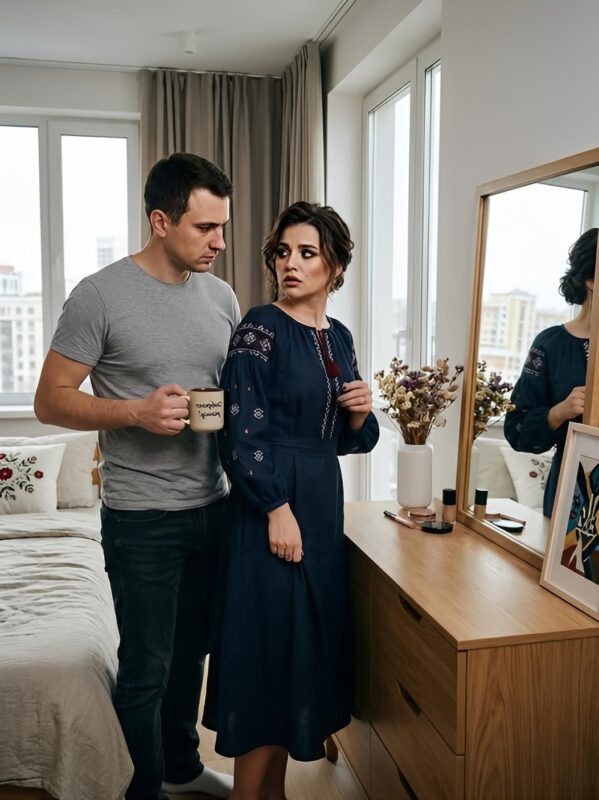
«How much, Sofia? I’m asking you: how much did you throw away on this scrap of fabric?»
«Taras, it was on clearance. It was only fifteen hundred hryvnias.»
«Fifteen hundred?» He raised an eyebrow ironically. «So, a hundred cans of food for the pantry? Or enough gas to fill the car? We’re saving for solar panels, Sofia. Every cent needs to be working, not hanging in a closet.»
«But I earned it myself!» she cried out, feeling a lump form in her throat. «I stayed up all night working on that logo for the bakery.»
«’Earned it yourself’?» Taras laughed, a sound colder than the mist over the canyon. «And whose internet were you using? Whose heated apartment were you sitting in? Whose coffee would you be drinking right now if I didn’t manage the budget? In this family, there is no ‘my’ money. There is a collective resource. And you just betrayed it for an emerald-colored rag.»
Sofia turned toward the mirror so he wouldn’t see her tears. She knew it was useless to argue. Taras was a master of numbers; he could logically prove that even buying an extra apple was a step toward a financial abyss.
«Take it off,» he tossed over his shoulder as he left the room. «Wear the grey one. It looks modest and decent. There’s no need to annoy the relatives with wealth we don’t have because of your frivolity.»
The anniversary dinner was in full swing. The whole family was there: distinguished uncles in blazers, aunts in heavy gold jewelry, and boisterous teenagers. Sofia sat next to Taras in the same grey dress he had «approved.» She felt like a grey mouse among tropical birds.
Taras was the life of the party. He told jokes, proposed toasts to the guest of honor, and everyone listened admiringly to the «successful IT guy» who knew the value of a dollar.
«You know, friends,» he said suddenly as the main course was served, «my Sofia almost showed up here looking like a queen tonight.»
The table went silent. Sofia froze, gripping her fork so hard her knuckles turned white.
«She bought a dress,» Taras continued with a sly grin. «Emerald! Silk, sequins—the works. She says, ‘It’s for the holiday!’ I asked her, ‘Sofia, did you calculate how many kilowatt-hours we could have bought with that money?'»
A ripple of laughter went around the table. Uncle Bohdan, the birthday man, patted Taras on the shoulder. «Well done, son! Teach your woman to be thrifty while she’s young. My Halyna wanted a fur coat once, and I told her: ‘Moths eat a coat in the closet, but new tile in the bathroom lasts forever!'»
Aunt Halyna gave a forced smile but stayed quiet.
«Exactly,» Taras added, hitting his stride. «She’s a creative soul, always has her head in the clouds. I think she believes money grows on the trees in our canyon. She says, ‘I earned it!’ and I just laugh. It’s one thing to earn it; it’s another to know how not to blow it. That’s how we live: I count it, she spends it. If it weren’t for my oversight, we’d be living under a bridge—though we’d be draped in silk!»
Sofia felt her face burning. Every word from her husband felt like a stone thrown at her. She stared at her plate, the edges of her steak blurring.
«Sofia, why are you so quiet?» Taras’s cousin, Lyudmila, asked with a slight smirk. «Was the dress really that expensive?»
«To some, it’s a dress; to others, it’s a month of tuition for a child,» Taras interjected before she could answer. «But it’s fine, I started a ledger. Now every Uber ride, every coffee in a paper cup—it’s all logged. Discipline, ladies and gentlemen, is everything!»
Sofia felt something inside her snap. This wasn’t just a joke. This was a methodical erasure of her interests and priorities. She looked up and saw that some guests were looking at her with pity, while others looked on with disdain.
«Excuse me,» she said softly, standing up. «I need to use the restroom.»
She walked through the restaurant, feeling their eyes on her back. In the bathroom, leaning against the tiled wall, she finally let the tears fall. Why? Why does he treat me like this? The question pulsed in her temples. She remembered how, at the beginning of their relationship, he brought her flowers and told her she was his inspiration. When did he turn into a cold-hearted accountant?
The next day, Sofia sat in a small café called «On the Edge,» which literally hung over the canyon. A cup of coffee sat before her—a small act of rebellion Taras would never know about. Across from her sat Katya, a childhood friend known for her sharp tongue and independence.
«He actually said that in front of everyone?» Katya nearly choked on her latte. «The thing about the canned food?»
«Exactly, Katya. I felt like a criminal on trial for embezzling state funds. He even started a ledger.»
«A ledger, you say?» Katya’s eyes flashed with a dangerous spark. «Listen, Soph, do you know that the best weapon against that kind of attitude is his own weapon?»
«What do you mean?»
«Your Taras is the ‘Ideologue of Economy,’ right? Fine. Become his star pupil. Only with one catch: start counting his money. Just as meticulously, just as cynically. Start your own ledger. Comment on every little thing he buys. He buys something expensive? Translate the cost into sacks of flour for him! He grabs a drink after work? That’s three bottles of dish soap!
Sofia was terrified by the mere thought. «He’ll be furious. He’s so persuasive.»
«Don’t give him the chance to be persuasive. Use his own arguments. ‘Shared budget,’ ‘every cent must work.’ Believe me, he won’t see this coming. To him, you’re a defenseless flower he can trample. It’s time to be a cactus.»
Sofia looked out at the Smotrych River flowing deep below. She was scared, but her resentment was stronger than her fear. She remembered her emerald silk, which had never seen the light of day.
«Okay,» she whispered. «I’ll try.»
That evening, Taras returned from work in a great mood. He tossed his car keys on the table along with a bag from the hardware store.
«Look, I picked up a new set of drill bits. German-made!» he announced proudly. «We’re going to get those living room shelves up.»
Sofia slowly walked to the table. She pulled a pre-prepared leather-bound notebook from the shelf. She began to write slowly, in neat calligraphy.
«German drill bits,» she narrated to herself. «How much, Taras?»
He raised his eyebrows in surprise. «Three hundred hryvnias. Why?»
«Three hundred hryvnias,» Sofia said, shaking her head. «Do you realize how many eggs we could have bought for that? Or a mountain of high-quality meat? You already have a set of drill bits, Taras. Why do we need another? This is an irrational use of our collective resources.»
«The old ones were getting a bit dull. And besides, I bought these with my own salary!»
«Oh, Taras,» Sofia smiled, mirroring the exact expression he’d worn at the restaurant the night before. «You said it yourself: in this family, there is no ‘my’ money. This is a shared budget. And whose electricity were you using when you picked those out at the store? Whose shoe leather were you wearing down while walking to the register? Let’s be consistent. Let’s write this down: ‘Unjustified expenditure on duplicate tools.'»
He opened his mouth to argue, but then closed it. His own logic, recited back to him in her soft voice, was like a snare.
«Is this some kind of joke?» he finally managed to squeeze out.
«No joke at all. I just realized how right you were. We have to be frugal. By the way, I saw you bought coffee at the gas station this morning. Eighty hryvnias? Think of how much fruit we could have bought instead! We could have used that money to buy enough dish soap to last two months instead of that expensive gel you like. I’m logging it: ‘Disposable coffee—a step toward bankruptcy.'»
Taras was unpleasantly quiet that evening. He didn’t turn on the TV (to save electricity, as Sofia reminded him) and went to bed early.
A week passed. Life in the apartment turned into a cold war of numbers. Sofia proved to be a gifted student; she didn’t miss a thing.
When Taras bought new socks—despite having three perfectly good pairs—she gave him a lecture on «textile surplus.» When he wanted to order pizza on Friday, she pulled out the notebook and calculated the cost of homemade pasta, proving that pizza was a «financial abyss.»
«Sofia, this is unbearable!» he shouted one day after she pointed out he’d held the refrigerator door open too long. «I can’t even eat in peace in my own home!»
«It’s our shared home, Taras,» she replied calmly, not looking up from her book (which she was reading by natural light to avoid using a lamp). «And every watt of electricity that escapes that fridge represents my time and your time spent working. Isn’t that what you said last week? I’m just learning. You wanted me to take things more seriously, didn’t you?»
He stormed out of the house, slamming the door behind him. Sofia closed her eyes. She didn’t feel like a winner; she felt exhausted. But it was too late to stop.
The real test came on Saturday. They were expecting guests—the very same relatives Taras had humiliated her in front of.
Saturday in Kamianets-Podilskyi was windy. The old fortress in the distance looked even gloomier under low-hanging clouds, and inside Taras and Sofia’s apartment, the silence was thick enough to cut with a knife. The relatives were due at six. Taras paced the room, nervously adjusting his collar. He was used to being the man in charge, but the last few days under his wife’s watchful eye had rattled him.
«Sofia, where are the appetizers? Where’s the charcuterie board?» he asked, peering into the fridge.
Sofia calmly set the table with bowls of sauerkraut, homemade pickles, and boiled potatoes drizzled with oil and dill.
«Taras, you said it yourself: ‘Why buy store-bought junk when the pantry is full of your Uncle Bohdan’s preserves?’ It’s rational. The cost of this dinner is zero hryvnias. Isn’t that perfect for our budget?»
Taras turned red. «But the guests! Uncle Bohdan, Aunt Halyna—they’re used to a proper spread! What are they going to say when they see nothing but potatoes?»

«They’ll say we’re a frugal young couple,» Sofia smiled. There was so much gentle venom in that smile that Taras instinctively stepped back. «You were so proud of my ‘new training.’ Now I’m showing you the results. Every hryvnia saved is a step toward our solar panels. Right?»
The doorbell cut off his response. The relatives crowded into the living room. Uncle Bohdan arrived with his usual boisterous laugh; Aunt Halyna brought a box of chocolates, which Sofia immediately set aside, saying, «Thank you, this will be an excellent strategic sugar reserve for the winter.»
As everyone sat down, an awkward silence fell. The guests stared at the potatoes and cabbage, waiting for the rest of the meal to appear.
«Well, Taras,» Uncle Bohdan began, pouring out some of the homemade liqueur he’d brought. «How are those solar panels coming along? Are you going to be energy-independent soon?»
Taras opened his mouth, but Sofia beat him to it. She pulled her leather notebook out and placed it on the table next to the bread.
«Oh, Uncle Bohdan, we’ve made so much progress!» she exclaimed with feigned enthusiasm. «Thanks to Taras’s lessons, I’ve realized we used to just throw money away. Look here: this week alone, we saved two thousand hryvnias just by Taras skipping gas station coffee and funding his new drill bits by giving up pizza.»
Aunt Halyna adjusted her glasses, peering at the entries. «Drill bits funded by pizza? How does that work?»
«It’s simple,» Sofia said, turning to Taras, who was looking for any place else to fix his eyes. «Taras wanted new German drill bits for eight hundred hryvnias. I calculated that’s the equivalent of eight small pizzas from the grocery store. So, we gave up food delivery for the next two months, and voila—Taras has his bits, and we have empty stomachs on Friday nights, but a pantry full of tools. Isn’t that just ‘manly wisdom’?»
Uncle Bohdan grunted, but this time his voice lacked its former approval. «Well, tools are sacred, but pizza… a woman should have a break from the kitchen once in a while, Taras.»
«Rest is an illusion of capitalism,» Sofia said, quoting her husband and savoring every word. «Taras says true rest is the knowledge that your capital is growing. By the way, Taras, I noticed your entry from yesterday in the ledger. Three thousand hryvnias for ‘unforeseen expenses.’ What was that? A new power supply or a contribution to our future fund?»
Taras nearly choked on his drink. «That was for work. Professional equipment.»
«Oh, how interesting!» Sofia clapped her hands. «Do you have the receipt? You said that any expense without a receipt is a crime against the family. I’d like to add the model number to our asset registry.»
«Sofia, enough,» Taras hissed, his voice finally cracking.
«Why enough, honey?» She looked at him with wide, «innocent» eyes. «You told everyone at the restaurant last Saturday that I ‘have my head in the clouds’ and can’t count. Well, I’m back on earth now. I’m counting every one of your kopecks. By the way, you’ve already eaten three rolls tonight. That’s minus six hryvnias and seventy kopecks. That would have been just enough to buy the matches we’re running low on in the kitchen.»
The room went dead silent. Aunt Halyna slowly set down her fork. Uncle Bohdan looked at his nephew with a strange expression—a mix of disappointment and shame. Now, they didn’t see a «successful provider.» They saw a petty micromanager who had walked right into his own trap.
The guests left early. Aunt Halyna gave a curt nod on her way out, and Uncle Bohdan, usually so talkative, simply patted Taras on the shoulder. «Don’t push it too far, son,» he said. «Even a stone cracks if you put too much pressure on it.»
As soon as the door clicked shut, Taras snapped. He grabbed the leather notebook from the table and hurled it into the corner.
«What the hell was that?! You humiliated me in front of the whole family! You made me look like some cheapskate counting matches!»
Sofia calmly began clearing the plates. She didn’t flinch at his shouting; her internal fortress was already built.
«I was only quoting you, Taras. Since when is the truth a humiliation? You said yourself that frugality is a virtue. Did you just not like the way your virtue looks from the outside?»
«That wasn’t frugality! That was a mockery!» he panted, his face erupting in red splotches.
«And what you did to me at the restaurant?» Sofia finally looked him in the eye. There was no anger in her gaze, only a deep, boundless exhaustion. «When you ridiculed my work, my dress, my right to a little bit of joy? You called that ‘teaching me a lesson.’ You wanted me to feel small, incapable of doing anything without your permission. Well, Taras? Do you feel big now?»
He opened his mouth to shout back, but the words caught in his throat. He looked at his wife and, for the first time in years, saw not an accessory to his life, but a woman with a will of her own.
«I’m going for a walk,» he muttered, grabbing his jacket.
«Don’t forget to turn off the hallway light,» she called after him. «Seven cents a minute, remember?»
She was alone. Sofia picked the notebook up from the floor and smoothed out the crumpled pages. She didn’t feel happy. This victory tasted like ash. She walked to the window, looking at the dark silhouette of the Old Castle. Kamianets had seen many sieges, but the most terrible siege is the one we lay against those closest to us, trying to conquer their souls with our rules.
A few days passed. Taras became quiet. He stopped making comments about coffee or lights. In fact, he barely spoke at all. Sofia stopped her «audits» too. The game was over, and the reality left behind felt hollow.
One day, while looking for an old internet contract, Sofia glanced into the bottom drawer of Taras’s desk. There, under a pile of papers, she found another notebook. It looked just like the one he showed everyone, but the entries were different.
She opened the first page. The dates went back to the beginning of their life together.
September 12th. Bought flowers for Sofia. She was so happy. Need to set aside more next month; I want to buy her that graphic tablet she’s been dreaming about.
November 15th. Sofia is upset because of a client. Bought her expensive chocolate and sparkling wine. Logged it as ‘car expenses’ so she wouldn’t scold me for being wasteful.
The entries went on, page after page. Sofia felt her head spin. Taras, the man she thought was a cold accountant, had been keeping «double books» for years. He played the role of the strict miser in front of his family and her, but secretly spent money to make her happy, masking it as boring household costs.
But something had changed six months ago. The tone of the entries shifted.
January 20th. Work was cut back. Projects closed. I can’t tell Sofia; she’s so proud of my success. I’ll save on everything so she doesn’t notice we’re in a financial hole.
March 10th. I’m scared. The money is melting away. I’ve become angry, snapping at her over every little thing. I want to protect her from poverty, but instead, I’m just destroying our love. She bought a dress. God, she looks so beautiful in it, but I screamed because we won’t have enough for rent next month.
The last page was dated yesterday.
I’ve lost her. I’ve become the man I always hated—a petty husband. Now she’s counting my bread rolls, and I deserve it. I wanted to be a wall for her, but I became a cage.
Sofia closed the notebook. Tears rolled down her cheeks, dripping onto the old wood of the desk. She understood everything now. His control hadn’t been a thirst for power. It was a twisted, ugly way of expressing his fear for their future. His humiliation at the restaurant had been the desperate cry of a man who felt his world collapsing and tried to assert himself in the only way he knew how.
That evening, when Taras returned, he saw a strange sight in the living room. The emerald dress was laid out on the table, shimmering in the rays of the evening sun. Sofia stood beside it.
«Why did you bring that out?» he asked softly, not meeting her eyes.
«I found your notebook, Taras. The second one.»
He froze. His shoulders slumped. «I’m sorry. I didn’t want you to know I was a failure. I wanted to be your protector.»
Sofia walked over and took his large, calloused hands in hers. «A protector is someone who shares their fear, not someone who turns it into a weapon against their family. We are a team, Taras. We’re in Kamianets—the fortresses here were built together, by the whole city. No wall can stand if there is no trust inside.»
«We have almost nothing left, Soph,» he whispered. «I failed at everything.»
«We have this dress,» she smiled through her tears. «And we’re going to sell it. I have other things I barely wear, too. I’ve already posted the ads. That money will cover the rent and give us a cushion for a few weeks. And then, I’ll take on more projects. I saw how hard you tried to save us. Now it’s my turn.»
Taras pulled her close, burying his face in her hair. In that moment, the Old Castle outside the window didn’t look like a gloomy prison, but a true, reliable defense.
A year passed. There were no more «control ledgers» in Sofia and Taras’s home. On the roof of the small house they had finally managed to buy on credit, the first solar panels appeared. But they weren’t the main source of light.
For their anniversary, Taras gave her a package. Sofia opened it and gasped. It was the emerald dress.
«You found it? How?» She couldn’t believe her eyes.
«I bought it back from the woman you sold it to. I had to work a lot of freelance hours over the last six months to make it happen,» he smiled, and it was that same warm smile she had fallen in love with long ago. «But I did the math, Sofia. Seeing you smile in this dress is worth exactly one million kilowatt-hours. And I’m happy to pay for them.»
They stood on the balcony, looking at the lights of night-time Kamianets. The city stood on stone, and their life now stood on forgiveness and truth. It was the most reliable foundation in the world.