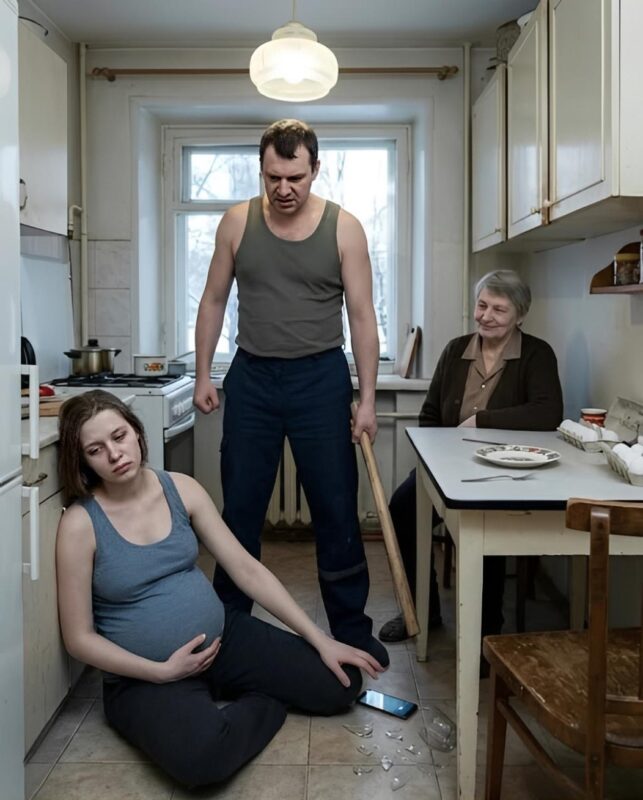
The shard of the broken phone flickered so briefly I thought I’d imagined it. But Vitya saw it too.
At first, he stared at the piece of glass with irritation, as if it were just trash under his feet. Then, his expression shifted. It wasn’t a dramatic change, but the smug confidence he’d carried all morning—the look of a man who believed every scream in this house belonged to him—suddenly vanished.
A single word flashed on the shard:
«Coming.»
He looked up at me. I was lying on the tile, clutching my stomach. For the first time that morning, the terror in my chest was replaced by a strange, heavy silence. He finally understood. The message hadn’t disappeared just because the phone was shattered.
«Who is it?» he snapped.
I didn’t answer. My lips were trembling and the metallic taste of blood filled my mouth, but I stayed silent. My mother-in-law still hadn’t grasped what was happening. She sat at the table, smoothing out her robe as if she were more annoyed by the disruption to her routine than the violence in the room.
«What are you standing there for?» she barked at her son. «End this circus already.»
But the circus ended at that exact second. The doorbell rang—not long or hesitant, but short and sharp. It wasn’t the ring of a guest. It was the ring of someone who had already made up their mind.
My sister-in-law flinched first. She lowered her phone quickly, as if only just realizing she was still holding it. My father-in-law looked up from the table, scowling.
«Who the hell is it at this hour?»
Vitya didn’t answer. He kept looking from the shard on the floor to me, then back to the door. It was the truest moment of the morning: the split second he realized that control is a fragile thing.
The doorbell rang again, longer this time, followed immediately by a heavy fist pounding on the wood. The force of it made the glass in the kitchen cabinet rattle.
«Vika!» a voice shouted from the hallway. «Open the door!»
It was Aleksey. My brother never raised his voice without reason. There was something in his tone now that made even my mother-in-law sit up straight.
«Don’t open it,» she whispered urgently to her son.
«And what do you suggest I do?» Vitya snapped, his voice cracking.
«Tell him she’s not home.»
I would have laughed if I could. I was lying on their kitchen floor, six months pregnant, with a split lip and a bruise forming where he’d held the club. And they still thought they could just lock the door and make the problem go away.
Aleksey hit the door again. Then again. On the third strike, the old lock gave way. I couldn’t see the hallway, but I heard the door slam against the wall and the gasp of a neighbor out on the landing. Then came the footsteps—heavy, fast, and without a hint of hesitation.
A second later, my brother was standing in the kitchen doorway. He took it all in at once: me on the floor, the club in Vitya’s hand, the mother-in-law at the table, the sister-in-law clutching her phone, and the grease smoking in the pan. Sometimes, a situation doesn’t need an explanation. Sometimes, one look is enough to turn a man’s heart to stone.
That’s what happened to Aleksey. He didn’t scream. He didn’t charge in swinging. And that made it even more terrifying—though not for me.
«Get away from her,» he told Vitya. His voice was low, almost flat.
Vitya reflexively gripped the club tighter. «This is family business. Stay out of it.»
«You lost the right to call this a family the moment you did this.»
Aleksey stepped forward. The mother-in-law jumped up. «She fell! She’s having a breakdown! she’s always like this!»
He didn’t even look at her. He just muttered, «Shut up.»
There was no hysteria in his voice—only a hard, final limit. It worked better than any shout. The sister-in-law began frantically tapping at her screen, trying to delete something. Aleksey saw it out of the corner of his eye.
«Phone on the table. Now.»
«It’s mine—» she stammered.
«On the table. Do it now.»
She didn’t move fast enough. Aleksey pulled out his own phone and hit record. He filmed me. He filmed the club. He filmed the shattered phone and the dark drops of blood on the tile. He filmed Vitya’s face. Then, and only then, he called for an ambulance. Immediately after, he called the police.
That was when Vitya finally lost it. Not when he was hitting me. Not when I was begging him to watch out for the baby. He snapped the moment he realized this was leaving the kitchen and going out into the world.
«What do you think you’re doing?!» he yelled, lunging toward my brother. «Put that phone away!»
Aleksey met him with a single, precise movement. The club flew out of Vitya’s hand and clattered against a table leg. A chair flipped over. My father-in-law started to get up but froze. He was the kind of man who only loved power when it wasn’t turned against him.
«Nobody is leaving,» Aleksey said, his voice still steady. «The ambulance is on the way.»
I don’t remember exactly how he got to my side. I just remember his hand behind my head—incredibly gentle. He kept his other hand steady, holding the phone, knowing he couldn’t leave a single detail unrecorded.
«Vika, can you hear me?» he asked.
I nodded.
«Is the baby moving?»
I tried to focus past the pain. Almost immediately, I felt a faint, soft kick. It was so quiet it brought tears to my eyes.
«Yes,» I whispered.
Aleksey closed his eyes for one brief, shaky second.
It was as if he had finally taken a breath himself.
The ambulance arrived quickly—likely because Aleksey had used the few words you can’t ignore: pregnant, beaten, fetal distress. The police arrived with them.
That was when I witnessed something I would later remember with a sharp, stinging clarity. My mother-in-law’s tone shifted instantly. Only five minutes ago, she had been laughing. Now, she was sobbing, clutching her chest, telling them I was a «nervous girl,» that I had «just fallen,» and that this was all just a «typical family spat.»
People like her always bank on other people’s exhaustion. They count on the authorities wanting to close the call quickly, sign the paperwork, and leave. But that day, their luck ran out.
The young paramedic who knelt beside me saw the bruise on my thigh, my split lip, and the way I kept shielding my stomach with my hands—a reflex I didn’t even realize I had. He didn’t say a word. He just turned to his partner and said one word:
«Stretcher.»
As they lifted me, I heard one of the officers tell everyone in the room to stay put. Then, the second officer asked:
«Who was filming this on their phone?»
The kitchen went dead silent. My sister-in-law turned pale. She was still clutching her phone as if it could protect her, but technology has a way of betraying those who are too confident in their own impunity. She hadn’t managed to delete everything. Or rather, she hadn’t been fast enough.
When they checked her phone later, a short video remained. It didn’t show the beginning. It didn’t show everything. But it showed enough.
It was enough to hear the mother-in-law laughing. Enough to see me lying on the floor, shielding my belly. Enough so that no one could ever call this a «typical family spat» again.
In the ambulance, I wasn’t shaking from the cold. Aleksey sat beside me in silence. Sometimes, the silence of someone who loves you is more supportive than any words could be.
Only once did he ask: «Why didn’t you tell me sooner?»

I turned toward the window. There is no short, honest answer to that question. At first, you’re ashamed. Then, you’re terrified. Then, it feels like it’s too late. You start living from one quiet week to the next, learning to be grateful just for the absence of a fight. And then, one day, you’re lying on a kitchen floor and you realize that «too late» is about to become a permanent reality.
The ER was hot and smelled like medicine and damp coats. They rushed me in for an exam immediately. The overhead lights were blinding. The doctor asked questions in a fast, clinical tone:
How many weeks? Where were you hit? Did you lose consciousness? Do you feel movement?
I answered, but my own voice sounded like it was coming from a long way off. When she applied the transducer, I stopped breathing. For a second, the room was so quiet I could hear a metal cart rolling in the hallway behind the wall.
Then, a sound filled the room.
Rapid. Rhythmic. Alive.
The baby’s heartbeat.
I covered my face with my hands and, for the first time all day, I cried—not out of pain, but out of relief. The doctor didn’t offer any empty platitudes. She just turned down the volume and said, more gently than before:
«The heartbeat is strong. But there is a threat of miscarriage. You need absolute rest and observation.»
The word «threat» sounded scarier than any scream. A scream eventually ends, but a threat lingers in your body.
They admitted me to the ward. Aleksey sat in the hallway on a hard plastic chair with two cups of tea from a vending machine. One cup went cold in his hand. When the police officer came to take my statement, I initially asked, «Can we do this later?»
It wasn’t because I wanted to protect Vitya. It was because I didn’t even have the strength to say my own last name.
Aleksey stood up and walked over. He didn’t rush me. He didn’t pressure me. He simply placed a clear plastic bag on the nightstand containing the shard of my broken phone.
«One text was enough to bring me here,» he said. «Now, only you can decide if you have the strength to stop being silent.»
It wasn’t about revenge. It wasn’t about some grand sense of justice. It was about a boundary—the one I had spent months pushing further and further away just so I wouldn’t have to admit what my marriage had become.
I gave my statement. At first, it was messy. Then, it became steadier. Finally, it became detailed.
I told him about the first slap before I was even pregnant.
The screaming in the middle of the night.
The way he took my money.
The mother-in-law telling me «not to shame my husband with my tears.»
The way I eventually stopped telling my mother the truth because I didn’t want to scare her.
The officer wrote in silence, occasionally asking for a date or a specific quote. When I got to the part about the club, my hands started shaking again. Aleksey silently handed me some water.
And I finished.
By evening, Vitya started texting me from unknown numbers—his own had been taken as evidence.
First came the threats.
Then the begging.
Then the threats again.
«You ruined everything.»
«You’re going to leave our child without a father.»
«Tell them you fell.»
«Mom is distraught; her blood pressure is through the roof.»
Every message was so familiar that it made me feel cold to my core.
Even now, with doctors, hospital walls, and legal protocols between us, he still tried to make it my fault.
I stopped responding. I simply forwarded everything to the investigator.
Two days later, Aleksey brought me my things. Not everything—just the essentials. My ID, my prenatal records, a warm sweater, and a charger that my broken phone no longer needed. Tucked at the top of the bag were a pair of tiny knitted booties I’d bought in secret a month ago. They were so small I couldn’t bring myself to touch them for a long time.
«Did you go get them yourself?» I asked.
He nodded, sitting on the edge of the visitor’s chair. «With the police.»
The way he said it made me realize there was no going back, even for the sake of appearances. He filled me in on the details. When they arrived to collect my things, my mother-in-law went right back to playing the victim, clutching her heart. My father-in-law kept muttering about how I’d «set everyone up.» Vitya demanded to see me, but the restraining order was already in effect.
The same oilcloth was still on the kitchen table. The kettle was still by the wall. Only the club was gone—taken into evidence.
But they found something else. It turned out there wasn’t just one video on my sister-in-law’s phone. There were several. Short clips from different days: me scrubbing the floor; people screaming at me from the other room; my mother-in-law making comments about my pregnancy as if the baby were just another chore I was failing at.
She hadn’t recorded them for evidence. She’d done it for humiliation—for the family group chat, for a bit of internal entertainment. Sometimes, evil is arrogant enough to keep its own archives. That was the turning point where their defense began to crumble. It’s one thing to deny words; it’s another thing entirely when your own voice, your own laughter, and your own cruelty are part of a criminal file.
A week later, the investigator visited me. She was a woman in her forties, tired, with incredibly observant eyes. She didn’t act shocked. I’m sure she’d seen too many kitchens just like mine over the years. Her calm was sobering.
«They’re going to ask you to settle,» she said. «They’ll use relatives, pity, and threats. But the decision is yours.»
I nodded. In that moment, for the first time, I didn’t feel fear. I felt the weight of my own choice. It’s a strange feeling—when you’re in pain, ashamed, and terrified for your baby, but deep down, a thin, unfamiliar thread of self-respect begins to form. Not strength—strength was still a long way off. Just self-respect. The quietest kind of inner foundation.
I was discharged under a gray sky. Old, dirty snow lined the hospital courtyard. Aleksey helped me into my coat without asking unnecessary questions. We didn’t go back to my house. That place wasn’t a home anymore. We went to his.
He had a small two-bedroom apartment that always smelled like tea and laundry detergent. A pot of dried-up basil sat on the windowsill; he’d been promising to throw it out for months but never got around to it. I sat by the window and, for the first time in months, I didn’t hold my breath every time I heard the front door open.
That turned out to be its own kind of silence. Very expensive. Very rare.
After that, everything moved slowly. The paperwork, the depositions, the medical exams, the restraining orders. His mother tried to get to mine, leaving long, sobbing voice messages. Then came the anger. Then more tears. They still acted as if this were just a «family misunderstanding» rather than a crime.
But there is a point where the words «we just lost our tempers» lose all meaning. For me, that point wasn’t the pain or the blood. It was my mother-in-law’s laughter while I lay on the floor protecting my child. Some things you can’t unsee.
My daughter was born six weeks later, a little ahead of schedule. She was tiny, with a fierce, wrinkled face and a surprisingly loud voice. When they placed her on my chest, I didn’t cry at first. I just stared at her forehead, her microscopic fingers, and the way she scowled in her sleep as if she already had a very firm opinion on the world.
And then, suddenly, I remembered that kitchen. The tile. The broken phone. The word «Coming.»
The realization hit me so hard the nurse thought I was having a medical emergency. I wasn’t. It was just the first time I realized exactly how close I had come to the edge.
Aleksey came to the maternity ward that evening. He brought a bag with some snacks and a new phone—a basic one. «We’ll get you a better one later,» he said.
I smiled. That one sentence held our entire childhood. The imperfection of it. The awkward care. Love without the need for big words. As he was leaving, I called out to him.
«Aleksey.»
He turned around.
«Thank you for coming right away.»
He was quiet for a moment, then spoke softly. «You’re the one who finally sent the text.»
That was the truth of it. It wasn’t just that I was saved. It was that, at the very last second, I chose not to be silent. It was late—almost too late—but I made the choice.
Sometimes, life doesn’t start over with a grand gesture. There’s no music, no cinematic promises. It starts with a hospital nightstand, bitter tea, a folder full of paperwork, and a baby sleeping soundly nearby.
That night, the room was dim. My daughter slept in her clear bassinet against the wall. My tea sat cold on the table. Outside, a gray dawn was breaking. And for the first time in a very long time, I wasn’t waiting for the door to be kicked open.