A forty-year-old billionaire had spent more than three million dollars trying to figure out why his twin sons kept losing their strength, yet every specialist walked out of his mansion with a brand-new theory and zero answers. Then I stepped in as their new nanny, got brushed off by his arrogant private doctor, and caught something right outside the boys’ bedrooms that made me wonder if the truth had been hiding inside that luxurious house all along.
My name is Claire Morgan.
At thirty-four, I walked up to Vincent Moretti’s Connecticut estate hauling a single suitcase and enough nervous energy to freeze my hands.
The security gates swung open to reveal a property that looked more like a five-star resort than a family home.
Marble. Glass. Endless manicured lawns. Security cameras watching every move.
Suddenly, my thrift-store cardigan felt painfully out of place.
Everyone knew Vincent Moretti’s name. Publicly, he was a forty-year-old billionaire investor with a portfolio of restaurants and high-end real estate stretching across the Northeast.
Privately, people muttered that his influence reached into boardrooms and industries most folks never even thought about.
The nanny agency had called me less than twenty-four hours earlier.
A live-in gig. Twin seven-year-old boys. Unexplained health issues. A jaw-dropping salary.
The head housekeeper, Mrs. Harper, led me straight into Vincent’s study.
Medical files and charts littered his desk.
Vincent himself looked nothing like the polished, magazine-ready photos I’d seen online. He looked completely worn out.
“Have you cared for children with complex medical needs before?” he asked.
“For eight years.”
“What makes you different from the other nannies?”
“I pay attention to the little things.”
An eyebrow arched upward.
“Explain.”
“Meals. Sleep schedules. Cleaning products. Daily routines. What changes when their symptoms flare up or fade away. Specialists only see children during scheduled appointments. A real caregiver sees their entire day.”
For the first time, Vincent looked genuinely intrigued.
He slid a thick folder across the desk toward me.
“My sons, Lucas and Leo, have been losing their strength for almost eighteen months.”
The medical notes listed chronic fatigue, recurring discomfort, brain fog, sudden shifts in appetite, and noticeable weight loss.
“They used to race each other down these halls,” Vincent said quietly. “Now, some mornings, just making it down the stairs completely exhausts them.”
“How many specialists have you seen?”
“More than I can count. New York, Boston, Philadelphia. Over three million dollars down the drain.”
“And no clear diagnosis?”
“None.”
I quickly flipped through the pages.
“What about their mother?”
His expression instantly turned to stone.
“Isabella passed away in a car crash four years ago.”
“I’m so sorry.”
“The boys started getting sick shortly after that.”
Before I could ask anything else, the office door swung open.
A silver-haired man walked right in without bothering to knock.
Dr. Harrison Blake.
His eyes locked onto me.
“Who’s this?”
“Claire Morgan,” Vincent replied. “Potential nanny.”
Dr. Blake let out a sharp, dismissive laugh.
“You’re hiring another babysitter?”
“Nanny,” I corrected, keeping my voice level.
His smile turned condescending.
“These boys need high-level medical expertise, not household help trying to play detective.”
“I agree.”
That seemed to catch him off guard.
“Then I guess we understand each other.”
“Not entirely. How long have you been treating them?”
His eyes narrowed.
“Eleven months.”
“And have you figured out the root cause?”
Dead silence.
Vincent leaned back in his leather chair.
Dr. Blake’s jaw tightened.
“You really ought to stay in your lane.”
“I plan to. My lane is noticing what happens when the doctors aren’t around.”
Vincent looked back and forth between the two of us, then slowly stood up.
“She’s hired.”
Dr. Blake stared at him in disbelief.
“Vincent, that is completely absurd.”
“That wasn’t a request for your sign-off.”
Scowling, the doctor gathered his paperwork and stormed out of the room, fuming.
Vincent turned his gaze back to me.
“Do you actually enjoy ruffling feathers?”
“No. I just don’t mistake arrogance for expertise.”
That earned him the ghost of a smile.
He led me upstairs to the second floor. Lucas and Leo had adjoining bedrooms tucked away at the very end of a sprawling hallway.
Just as Vincent reached for the first door handle, I froze.
I smelled something.
Faint.
Sweet.
Almost floral, but with a weird, chemical edge underneath.
“Do you smell that?” I asked, pausing.
Vincent frowned.
“Smell what?”
“The scent in the air.”
He took a deep breath through his nose.
“I don’t smell a thing.”
I walked over to a decorative brass air vent set low in the wall between the boys’ rooms.
The scent was much stronger right here.
“When was this HVAC system last serviced?”
Vincent’s expression shifted, uncertainty creeping in.
“I honestly don’t know.”
“Who has access to it?”
“The house automation system handles climate control.”
“That wasn’t my question.”
He stared at me, processing the shift in tone.
Just then, behind us, Mrs. Harper dropped a fresh stack of towels with a sharp thud.
I spun around.
She was staring wide-eyed at the vent.
And the sheer terror frozen on her face told me someone in this mansion knew exactly why I was asking.
—
The moment I pointed out the strange floral smell drifting from the vent, Mrs. Harper’s face drained of color.
Then seven-year-old Leo piped up in a whisper, saying he had smelled that exact scent before—right before he and his brother always crashed and fell ill.
Vincent immediately demanded answers, but the terrified housekeeper was too scared of the truth to explain anything out in the open hallway.
Once we pulled her into a private room, the full story came out: mysterious maintenance workers had been tampering with the boys’ ventilation system late at night.
And one specific name kept popping up behind those unauthorized visits: Dr. Harrison Blake.
However, what we ultimately uncovered hidden deep inside those air ducts revealed a chilling truth—the twins might not have been the first targets.
“She said fake flowers smelled like headaches.”
Vincent stared at his sons.
There was something almost frightening about the stillness that washed over him.
“Boys,” I said gently, “does that smell happen all the time?”
Lucas shook his head.
“Mostly at night.”
“Every night?”
“No.”
“Only when you’re sick?”
Leo looked across at his brother. The twins exchanged one of those silent conversations that only siblings seem capable of pulling off.
Then Lucas answered, “Before.”
“Before you feel sick?”
He nodded.
A cold shiver raced down my arms.
“Do you remember when?”
“Tuesday,” Leo whispered.
Mrs. Harper closed her eyes tightly.
Vincent caught it instantly.
“Margaret.”
She backed away a step.
“Sir—”
“What happened on Tuesday?”
“Nothing.”
“Don’t lie to me in front of my children.”
“I’m not lying.”
“You are terrified.”
“I’m just tired.”
“You are terrified,” Vincent repeated, his voice flat and unyielding.
Mrs. Harper’s face crumpled for half a second before she managed to lock it down.
“I need to go finish prepping the guest room.”
She turned to leave.
Vincent stepped into her path. Not aggressively—he didn’t need to. There was a sudden, chilling shift in him, the kind that made it clear nobody was walking away until he got answers.
“Margaret, you’ve worked in this house for thirteen years.”
“Yes.”
“My sons are sick.”
Her eyes welled up.
“I know.”
“You watched Claire touch that vent, and you looked like you’d just seen a ghost.”
Mrs. Harper pressed her lips into a hard, thin line.
“Tell me why.”
“I can’t.”
Vincent’s voice dropped to a low register.
“That is not an answer.”
“I can’t.”
“Why?”
Her eyes flicked upward toward the corner of the ceiling.
That was it. One quick glance. Less than a second.
But I caught it.
I followed her gaze up. A black security dome was mounted near the ceiling.
“Who watches the cameras?” I asked.
Vincent looked over at me.
“My security team.”
“All of them?”
“They record continuously.”
“Who has direct access?”
“My head of security, Keller. And me.”
Mrs. Harper whispered, “Please.”
I stood up straight.
“We shouldn’t talk out here.”
Vincent picked up on it immediately. He took the twins downstairs himself.
Twenty minutes later, the four of us were sitting inside a small, wood-paneled library on the west side of the mansion.
No cameras. Vincent had already checked.
Mrs. Harper sat near the fireplace, clutching her hands so tightly her knuckles were stark white. I remained standing by the door.
Vincent shut it firmly.
“Speak.”
She stared down at the floorboards.
“I found something six months ago.”
Vincent kept his eyes on her.
“What did you find?”
“A maintenance worker upstairs. It was well past midnight.”
“What worker?”
“I didn’t recognize him.”
“And you didn’t report it?”
“He had official identification.”
“Issued by whom?”
“Keller.”
Vincent’s jaw tightened.
“What was he doing?”
“Right outside the boys’ rooms.”
My pulse quickened.
“Was he messing with the ventilation system?”
“I think so.”
“You think?”
“I saw his toolbox open. The wall grille was off.”
“And you just let it go?”
She looked up, her fear suddenly flaring into defensive anger.
“I asked him what he was doing!”
“What did he say?”
“He told me there had been a humidity complaint.”
“There was no humidity complaint.”
“I know.”
Silence hung heavily in the room. Vincent walked over to the tall window, staring out at a lawn so immaculate it looked almost artificial.
“When did you tell Keller about this?”
“That very morning.”
“And?”
“He told me the contractor was fully authorized.”
“Did you ask why?”
“Yes.”
“What did he say?”
Mrs. Harper hesitated, her throat tightening.
“He said the boys’ specialist had requested specific environmental adjustments.”
Vincent spun back around.
“Which specialist?”
She looked right at him.
“Dr. Blake.”
Nobody said a word.
I instantly remembered Blake’s face back in the study—his impatience, his condescension, his immediate need to put me in my place.
“What exactly did Keller tell you?” I asked.
“He said Dr. Blake believed the indoor air quality might be contributing to the boys’ decline. He claimed specialized medical filters had been installed.”
“Filters,” I repeated.
Mrs. Harper nodded.
“After that, I started noticing more maintenance visits late at night.”
“How often?”
“Maybe once or twice a month.”
Vincent’s face hardened into stone.
“For six months?”
She shook her head.
“Longer.”
“How much longer?”
“I don’t know for sure.”
“Guess.”
“Possibly a year.”
He stared at her, disbelief bleeding into his voice.
“You watched strangers open up the ventilation system right outside my sons’ rooms for a whole year?”
Mrs. Harper surged to her feet.
“I was scared!”
“Of what?”
“Daniel knew things.”
Vincent’s expression faltered slightly.
“What kind of things?”
“My daughter had racked up serious gambling debts years ago. My brother had immigration issues in the past. Private things nobody in this house had any business knowing.”
“Did he threaten you?”
“Not out loud.”
“Then what did he say?”
Tears spilled over Mrs. Harper’s lashes.
“He told me wealthy families survive because the staff understands the difference between what they see and what they’re allowed to see.”
Vincent stepped back as if physical force had hit him.
I’d spent enough time working around ultra-wealthy families to know one absolute truth: money doesn’t chase away fear; it just gives fear more rooms to hide in.
“Vincent,” I said, stepping forward. “I want the boys out of this house tonight.”
He looked at me sharply.
“You actually think the ventilation is making them sick?”
“I think there’s more than enough reason not to gamble with their lives.”
“What about testing?”
“Test everything. Just not while they’re sleeping upstairs.”
He whipped out his phone.
“Done.”
Mrs. Harper shook her head frantically.
“No.”
Vincent paused, glaring at her.
“What do you mean, no?”
“You can’t move them out openly.”
“Why not?”
“Because if Daniel is involved, he’ll know right away.”
Vincent’s eyes narrowed to slits.
“You think Keller would actually harm my children?”
Mrs. Harper whispered, “I think someone already has.”
The heavy weight of those words settled over us like lead.
Without hesitation, Vincent made three quick phone calls. The first was to a private pediatric facility. The second went to a security consultant who didn’t answer to his regular team. The third was to someone named Marco—a conversation that lasted less than thirty seconds.
“I need Daniel Keller located. Quietly.”
He hung up.
“What happens now?” I asked.
“We find out who’s been entering this house.”
“No,” I said. “First, we find out what’s actually inside that vent.”
Vincent gave me a long, unreadable look.
“You claimed you weren’t a detective.”
“I’m not.”
“You’re doing a remarkably convincing impression.”
“I’m just a nanny who prefers the children in her care to stay alive.”
That shut him up.
By five o’clock that afternoon, Lucas and Leo were gone from the estate. Vincent told the household staff he was taking them into Manhattan for an intensive round of specialist testing. In reality, they were tucked away in a secure guesthouse owned by one of Vincent’s business partners thirty miles away.
I went with them.
For the first time since I’d met the twins, they slept with the windows cracked open to the fresh night air.
The next morning brought something miraculous.
Leo ate breakfast. Every last bite of it—eggs, toast, half a banana. Then he asked for more.
Lucas immediately teased him about being a bottomless pit, and Leo fired a loose grape right at his head.
For ten glorious seconds, they looked like completely normal seven-year-olds.
Vincent was standing in the doorway, watching them quietly. He turned away before they could catch him wiping his eyes.
I followed him out into the hall.
“They seem better,” he murmured.
“One good morning isn’t concrete proof.”
“You don’t sound surprised.”
“I’m trying not to jump to conclusions.”
“But you have a working theory.”
“Yes.”
He waited.
“Something in that house is poisoning their environment.”
“Poison?” The word sounded brutal spoken out loud.
“I don’t know what else to call it.”
“Chemical exposure?”
“Maybe.”
“Intentional?”
“I honestly don’t know.”
He glanced back toward the kitchen, where the sound of the boys laughing drifted down the hall.
“Someone deliberately hurting children sounds completely impossible.”
“No,” I corrected softly. “It sounds unbearable. That’s a very different thing.”
His phone buzzed in his hand. He answered it, and his expression darkened instantly.
“Where?” A pause. “When?” Another pause. “I’m on my way.”
He ended the call.
“They found Keller.”
“Where?”
“At his home.”
That should have brought a sense of relief. It didn’t.
Vincent looked grim.
“He’s dead.”
Daniel Keller had apparently suffered a massive heart attack overnight. At least, that was the initial medical conclusion. Forty-six years old, no known history of heart trouble, found completely alone in his house.
The timing was way too convenient. Vincent thought so too.
“You stay here with the boys,” he ordered.
“No.”
He stared at me, dumbfounded.
“I am not dragging you into a dead man’s house.”
“I didn’t ask you to.”
“Then what are you playing at?”
“I’m going back to the mansion.”
His face flashed dark.
“Absolute hell no.”
“You moved the boys. Whoever is behind this knows the game might be up.”
“Exactly.”
“Which means they’re going to sweep in and clean out whatever is hidden in that ventilation system.”
“My security team is already securing the estate.”
“The exact same security team that failed to notice midnight contractors for a full year?”
That hit home. Vincent rubbed the back of his jaw, swearing under his breath.
“You have a deeply irritating habit of making entirely valid points.”
“So I’ve been told.”
Twenty-five minutes later, we pulled back up to the estate.
His security detail had the upper floor locked down tight. Nobody had touched the vents since yesterday.
An independent environmental specialist arrived shortly after us. Dr. Emily Chen was in her early fifties—practical, quiet, and completely unimpressed by opulence. I liked her right away.
Pulling on heavy-duty gloves, she unscrewed the brass grille. Behind it sat a standard filtration insert—until she pulled it free.
Tucked neatly behind the filter was a small, unmarked plastic cartridge. No brand names. No serial numbers.
Vincent stared at it, horrified.
“What is that?”
Dr. Chen didn’t answer right away. She carefully slipped it into a heavy-duty evidence bag and sealed it.
“I won’t speculate until it’s run through a lab.”
“Could it release something into the room?”
“Yes.”
“How?”
“Forced airflow.”
“Could it make kids sick?”
She looked him dead in the eye.
“Depending entirely on what chemical compound it’s packing.”
We checked the vent outside Leo’s room. Another cartridge.
Lucas’s room. Another one.
My stomach plummeted. Three devices, cleverly hidden behind ordinary wall grilles, pumping something toxic right into their breathing space.
Vincent looked like he’d forgotten how to breathe.
“When can you have the contents identified?”
“I’ll have preliminary lab screenings by tonight.”
Vincent turned sharply to his chief of security.
“I want a complete log of every single person who stepped foot on this floor in the last two years.”
“Yes, sir.”
“Every employee, contractor, guest, and doctor.”
The man nodded and rushed off.
I walked back down the hallway, staring at the walls.
“Why three?”
Vincent glanced back at me, distracted.
“What?”
“There are three cartridges. One between the rooms, and one in each bedroom.”
“Right.”
“If someone just wanted to dose the boys directly, the bedroom vents would have been plenty.”
“You think the hallway device served a different purpose?”
“I don’t know.”
I turned toward the opposite wall. A large, framed photograph hung right there. Vincent and Isabella, back when the twins were toddlers. Isabella was laughing, her dark hair falling across her face as Lucas sat proudly on her shoulders.
I stared at the exact placement of the frame. It was hung directly opposite the hallway vent.
“What was this room right here before?” I asked.
Vincent followed my gaze.
“What room?”
I pointed to a narrow, unassuming door right beside the photo.
He frowned.
“That’s just an old storage closet.”
“Has it always been?”
“No.”
“Then what was it?”
His expression shifted, a shadow crossing his features.
“It was Isabella’s private sitting room.”
A cold chill crawled up my spine.
“Before she died?”
“Yes.”
“Did she spend a lot of time in there?”
“Every single day.” Vincent’s voice dropped into a distant, hollow tone. “She loved to paint.”
I looked from the old sitting room door back to the hallway vent.
“How long has that specific grille been there?”
“I have no idea.”
He stepped up to the door and tried the knob. It was locked. He stared at it for a second, looking genuinely surprised.
“Why is this locked?”
“You tell me.”
He pulled a master key ring from his pocket and tried a key. Nothing.
The security chief stepped up, offering to force it. Vincent shook his head.
“Do it.”
The heavy wooden door gave way after two hard kicks.
Dust billowed out into the shafts of golden afternoon light. The room had been preserved like a time capsule, exactly as Isabella had left it. An easel stood by the window with unfinished canvases leaning against the wall. Books covered a small reading table. A knitted shawl still draped over the back of a velvet chair.
Vincent stopped dead in the threshold, seemingly paralyzed.
“I haven’t stepped foot in here since the funeral.”
“Who locked it?”
“I always assumed Margaret did.”
Mrs. Harper was called back upstairs. When she saw the splintered door frame, her face went blank with confusion.
“I never locked this room.”
Vincent turned back.
“Then who did?”
“I don’t know, sir.”
I stepped inside. The air tasted stale and heavy with dust, but underneath it caught something else—that faint, sweet, chemical tang.
The exact same smell.
“Vincent.”
He heard the urgency in my voice.
I tracked the scent toward the shared wall dividing the room from the boys’ hallway. There was no visible vent on this side—only a heavy, built-in wooden bookcase.
“Help me move this.”
Two of the security guards rushed in, shoving the heavy bookcase aside.
Behind it sat another grille. It was older, coated in layers of old wall paint.
Dr. Chen stepped forward and unscrewed it. She clicked on a penlight and poked it into the dark ductwork.
“Well, that’s interesting.”
“What is it?” Vincent demanded.
“This branch ties directly into the main hallway duct.”
She reached inside the dark opening. When her hand pulled back out, she was holding a small, weathered metal object.
Not a plastic cartridge.
An old-fashioned metal key.
Vincent stared at it in disbelief.
“What the hell is that?”
It was a heavy, brass skeleton key. Attached to it was a small paper tag, yellowed with age, bearing two faded handwritten letters in black ink:
*V.M.*
Vincent Moretti.
He reached out and took it slowly from Dr. Chen’s palm.
“I know this key.”
“Where from?”
He didn’t answer. Instead, he walked past the easel straight to Isabella’s old mahogany desk. The surface was clear. He pulled open the drawers, one by one. Empty.
Except for the bottom drawer, which featured a small, archaic keyhole.
With shaking hands, he slid the brass key inside and turned it.
*Click.*
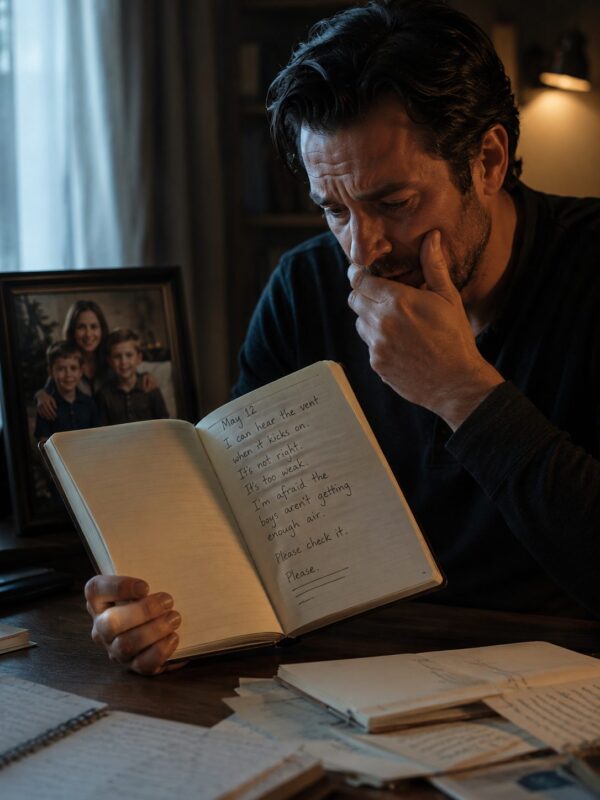
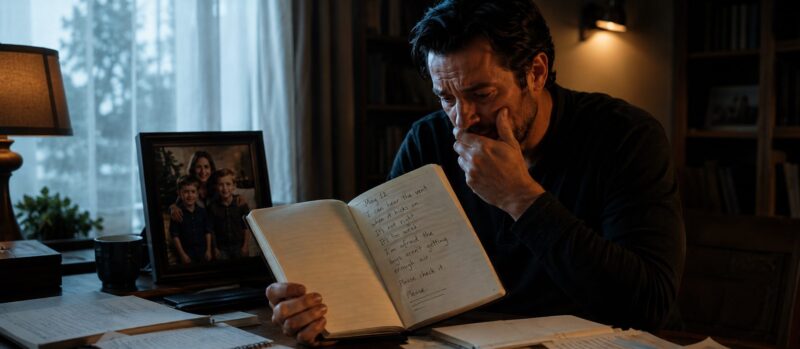
Inside sat a worn leather-bound notebook.
Vincent froze.
“It’s Isabella’s.”
He sank down into the chair, simply holding the book against his chest for a long, quiet moment. Then, with a trembling breath, he flipped open the cover.
Dates. Notes. Frantic fragments of handwriting. Long lists of names.
The final entries were scrawled during the harrowing months leading up to Isabella’s fatal car crash.
Vincent read in absolute silence. The color drained from his face until he looked practically ghost-white.
“What does it say, Vincent?” I asked gently.
He didn’t reply.
“Vincent?”
He slowly extended his hand and passed the open notebook to me.
One entry near the back had been aggressively underlined three times:
**June 14**
*The boys complained about the smell again today. Daniel insists it’s just the new filtration system acting up, but Blake flew into a rage when I started asking questions. I’m having the vents inspected independently.*
The next line made my throat constrict.
*Nothing about this house’s ventilation is standard.*
I flipped the page.
**June 18**
*Vincent thinks I’m losing my mind and giving into grief. I don’t even blame him anymore—he trusts Daniel implicitly. He trusts Harrison. That is precisely why I’m terrified to my core.*
Vincent was staring blankly at the floorboards.
“I told her she was drowning in her grief,” he whispered, his voice barely audible. “She grew intensely anxious after the twins were born. Sometimes she convinced herself people were watching our every move.” He looked up at me, eyes haunted. “I told her Blake was just trying to help keep them healthy.”
I kept reading down the page.
**June 21**
*The independent lab called back. The sample contains a synthetic compound that has no business circulating through an infant’s or child’s bedroom.*
Below that, Isabella had jotted down a single phone number, followed by one chilling sentence:
*If anything ever happens to me, the answer isn’t hidden in the medicine cabinet. It’s buried deep inside Vincent’s past.*
I looked up sharply.
“What past?”
Vincent’s jaw locked.
“I don’t know.”
“That’s a lie.”
His eyes locked onto mine. For the first time since I stepped foot in this mansion, I saw something far deeper than exhaustion or anger pooling in his gaze.
Pure, unadulterated terror.
Before I could press him further, Dr. Chen hurried back into the room from the hallway.
“I’ve got the preliminary lab telemetry back.”
Vincent stood up fast.
“What is it?”
“I won’t name the exact compound until the secondary tests clear, but—”
“Give me the bottom line, Doctor.”
“The cartridges contain a sophisticated airborne neurotoxin engineered for slow, continuous release.”
My stomach hit the floor.
“Would that explain the boys’ progressive weakness?”
“It explains every single symptom down to the letter.”
Vincent gripped the edge of the mahogany desk so hard his knuckles turned white.
“So someone was intentionally poisoning my sons.”
Dr. Chen’s expression remained grim and professional.
“Someone systematically injected a slow-acting chemical agent directly into their private air supply.”
Silence choked the room.
Then my mind flashed back to Isabella’s journal entry.
“The old hallway cartridge,” I said aloud.
Dr. Chen turned to me.
“What about it?”
“Could that housing have been installed four years ago?”
She frowned, considering it.
“The hardware is considerably older than the bedroom units.”
“How old?”
“I’d have to pull it apart in a lab to be certain, but…”
“Could it date back five years?”
“Yes, easily.”
Vincent caught on before I could even finish the sentence.
“No.”
I looked right at him.
“If Isabella’s old sitting room was piped into that exact same duct branch—”
“No!”
“Vincent—”
“I said no.” He grabbed the leather journal and started flipping through the pages in a blind panic.
Dr. Chen watched him, completely bewildered. “Someone want to explain what’s happening here?”
Before anyone could answer, the security chief burst into the room holding a tablet.
“Mr. Moretti. You need to see this feed right now.”
“Not now—”
“Sir, look at the timestamp.”
He thrust the screen forward. It was a security playback from eleven months earlier.
Timestamp: 2:13 AM.
A figure wearing standard maintenance coveralls walked casually down the upstairs hallway carrying a heavy toolbox. He stopped right outside the twins’ doors, pulled the wall grille, and slipped a device inside.
Vincent leaned in close, his breathing ragged.
“Zoom in on his face.”
The digital image sharpened and cropped in on the man’s profile as he glanced up toward the dome camera.
My breath caught in my throat.
It wasn’t Keller. It wasn’t an outside contractor.
It was Dr. Harrison Blake.
Vincent stared at the screen, paralyzed by betrayal.
Suddenly, his cell phone started vibrating in his pocket. An unknown, restricted caller ID.
He answered on speakerphone.
“Hello?”
Dead silence on the other end for a second. Then, a heavily distorted voice echoed through the room.
“You really should have left those vents alone, Vincent.”
Vincent’s grip on the phone turned white-hot.
“Who the hell is this?”
“You wasted three million dollars trying to diagnose your sons.” A cold, synthetic laugh rattled through the speaker. “You should have spent that money trying to remember your own past.”
*Click.* The line went dead.
Nobody in the room dared to breathe.
Then the security chief’s radio crackled to life on his hip.
“Sir?”
“Report,” the chief barked.
“Dr. Blake’s vehicle just breached the estate perimeter.”
Vincent’s eyes went completely black with rage.
“Lock the front gates down!”
“He didn’t come through the main gates, sir.”
“What are you talking about?”
The security chief stared down at his tablet terminal.
“There’s an old legacy service road hidden behind the north woods. He just came right through it.”
Vincent frowned, his mind racing. “That access road was sealed off over two decades ago.”
“Apparently not.”
I looked back down at Isabella’s open journal resting on the desk.
Something didn’t add up. It felt too clean, too straightforward. Blake running scared, Keller dead, hidden cartridges in the vents. It all pointed straight to Blake.
And yet…
I flipped the notebook back to the very final page. There, scrawled beneath Isabella’s warning about Vincent’s buried past, was another line. It was written smaller, jammed tightly into the margin like an afterthought.
I read it once. Then read it again.
The blood in my veins turned to ice water.
“Vincent.”
He looked up, distracted.
“What?”
I held the journal out toward him.
“Blake wasn’t the person Isabella was actually afraid of.”
His face hardened into a dangerous mask.
“What on earth are you talking about?”
I pointed a trembling finger at the final sentence.
Isabella had written:
*Harrison thinks he controls Daniel.*
*Daniel thinks he controls Harrison.*
*Neither of them realizes they are just taking orders from the top.*
Vincent stared down at the handwriting, reading the words over and over again.
Then his gaze drifted slowly away from the page, moving across the room to the locked sitting room door, and finally landing on the old family photograph of Isabella.
His lips parted. For several seconds, absolute silence swallowed the room.
When he finally spoke, the sound barely cleared his throat:
“That’s impossible.”
“Why?”
His answer came out as a hollow, terrified whisper:
“Because I buried him twenty-two years ago.”
And somewhere down in the cavernous, shadowy depths beneath the mansion, a heavy iron door slowly slammed shut.