## A Bitter Harvest on the Montana Frontier
My daughter-in-law announced that her parents were moving into the guest house on my nine-acre Montana property because, according to her, «At your age, you don’t need this much land anyway.»
She never asked.
She simply informed me.
Worse, my son had apparently already given her parents permission without discussing it with me.
I didn’t argue.
Instead, I bought three heavy-duty padlocks, changed a couple of financial arrangements, and made one very inconvenient adjustment to the only road leading to the pasture where they intended to park their RV.
It started one quiet morning while I was drinking coffee on the porch of my Montana cabin.
Clare casually said, «My parents are arriving on the fifteenth. They’ll use the guest house.»
I slowly lowered my mug.
«Who invited them to live here?»
She sighed as though I were the unreasonable one.
«Evelyn, please. You’re making this unnecessarily difficult.»
I looked across the property I had purchased after thirty-seven years as a surgical nurse: nine acres of pine trees, open pasture, and mountain views; a workshop I had built; a guest cottage I had restored; and the peaceful retirement I had worked nearly four decades to afford.
Two days later, my son Caleb called.
«Mom, it’s only temporary. Six months at most.»
«Did you tell Clare her parents could move onto my property before anyone asked me?»
Silence. That told me everything.
«We’ll come Saturday and get the guest house ready,» he finally said.
«Fine.»
—
### Drawing the Line
The next morning, I drove into town and purchased three industrial padlocks, heavy steel chain, and a new deadbolt. Then I secured the guest house. I locked the workshop, too. Apparently, Clare had confused my kindness with permission.
On Friday, a delivery truck pulled into my driveway. The driver checked his paperwork.
«Queen mattress for Clare Harper. I’m supposed to put it in the guest house.»
«You can take it back.»
He looked confused. «Wrong address?»
«No. Wrong permission.»
The mattress left on the same truck. Clare called less than thirty minutes later.
«That mattress was for my parents!»
«Then send it to the house where they’ll actually be living.»
She hung up.
Saturday morning, Clare and Caleb arrived. Clare marched straight toward the guest cottage before stopping at the sight of the chain across its door. She tried the handle anyway.
«Where’s the key?»
«With me.»
«Give it to me.»
«No.»
Her expression hardened. «My parents are coming next week.»
«You told me they were coming. You never asked whether they could stay.»
She turned toward my son. «Caleb, tell your mother to unlock this.»
He looked uncomfortable. «Mom, maybe we can just—»
«No.»
That single word finally made something clear. My property wasn’t a family committee decision. They left furious. But I wasn’t finished.
—
### Financial Independence
That evening, I began reviewing some of the other ways I had been «helping» my thirty-four-year-old son. I still paid his phone bill. His truck remained on my insurance. Whenever his business struggled, I quietly transferred money. I had considered it parental support. Clare and Caleb had apparently begun considering it an obligation.
So I stopped.
I transferred Caleb’s phone account into his name and removed his truck from my insurance policy. No angry lecture. No threats. I simply decided that a grown man could start paying his own bills.
Two days later, Caleb called.
«Mom, something happened to my phone.»
«I transferred the account to you.»
«And my truck insurance?»
«You’ll need your own policy.»
Before he could respond, Clare grabbed the phone. «Fine! Keep your stupid guest house. Dad bought an RV.»
I said nothing.
«They’re bringing it Friday,» she continued. «We’ll park it in the lower pasture.»
«No, you won’t.»
She laughed. «You own nine acres, Evelyn. You’re seriously going to complain about one RV sitting on empty grass?»
Then she hung up.
I walked to the window and looked toward the pasture. Clare had forgotten one important detail: there was only one road wide enough for a vehicle to reach the lower field.
—
### The Trench
The following morning, I called Marcus, a contractor who had worked on my property several times.
«I need a drainage trench across the pasture access road.»
«How large?»
«Three feet deep and four feet wide.»
He paused. «Evelyn, a vehicle won’t be able to cross that.»
«Perfect.»
By that afternoon, the road ended at a deep trench.
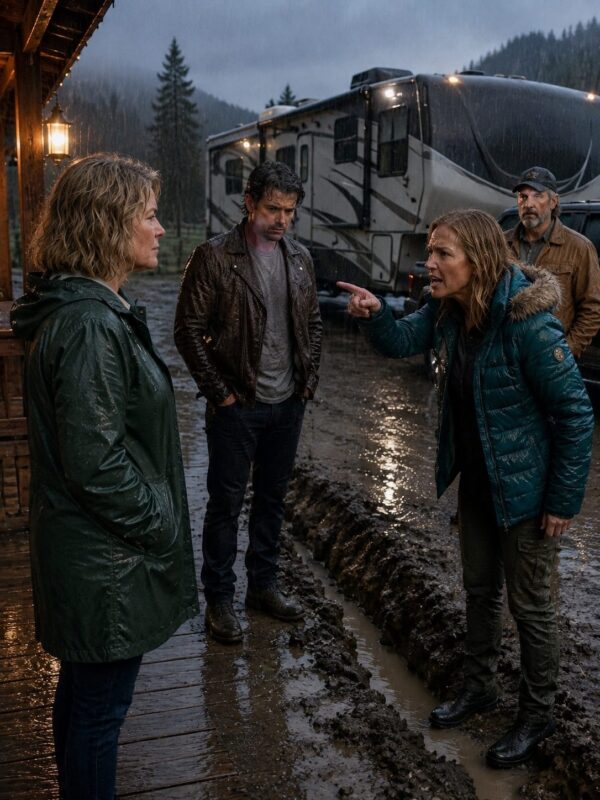
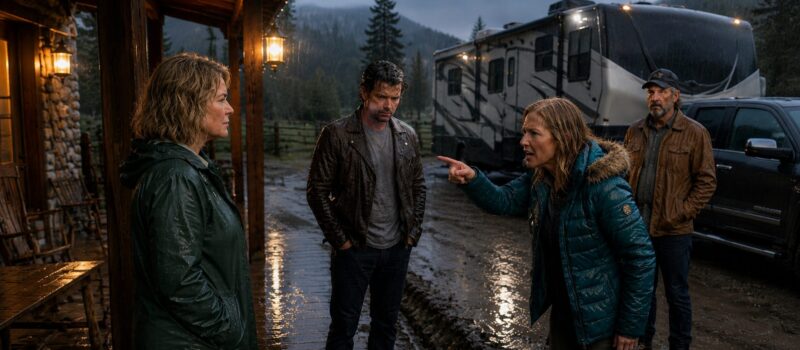
Friday arrived with cold Montana rain. Just before sunset, headlights appeared at the entrance to my property. A pickup came first, followed by another truck towing a thirty-foot travel trailer, and then Caleb and Clare’s SUV. They had actually done it.
Clare’s father turned toward the pasture and guided the enormous RV down the dirt road. Then his brake lights came on. The truck stopped. He climbed out, walked several feet forward, and stared into the trench. Then he looked at the RV, and then at my cabin.
I remained on the porch. Seconds later, Clare came storming through the rain.
«What did you do?»
«I improved the drainage.»
«You deliberately dug that because you knew we were bringing the trailer!»
«I told you not to bring it.»
«Fill it in.»
«No.»
Her face went red. «You can’t do this!»
«On my property?»
She opened her mouth but couldn’t seem to find an answer.
Then Caleb approached. For once, he wasn’t looking at me as though I were the problem. He studied the trench, the enormous RV, and his furious wife.
Clare pointed toward me. «Well? Tell her!»
Caleb remained silent. Then something unexpected happened. He looked directly at Clare.
«Actually, Mom told us not to bring the RV.»
She froze. «Whose side are you on?»
«This isn’t about sides.»
Then Caleb glanced toward Clare’s parents. His expression changed. «There’s something I should’ve told you before any of this started.»
Clare stared at him. «Told me what?»
Caleb took a long breath. Then he revealed something about her parents’ six-month plan, the RV, and—most importantly—who Clare had secretly expected to finance their new life on my property.
The anger disappeared from her face almost instantly. Because apparently, I wasn’t only supposed to provide the land.
**I was supposed to pay for something else, too—and Caleb had finally discovered exactly what Clare had arranged behind both our backs.**
He shook his head.
«I kept pretending it wasn’t that. But it was.»
Clare stared at him.
«Your parents needing somewhere to live is real,» he continued. «But this isn’t ours to give them.»
After a long silence, Clare said, «You could’ve told me this two weeks ago.»
«Yes.»
There was no defensiveness in his answer.
«I should have. I didn’t because it was easier not to. You were excited and I didn’t want to be the person who stopped it.»
He looked directly at her. «That was wrong.»
Something changed in Clare’s expression. She finally looked at me.
«I wasn’t trying to be cruel.»
«I know.»
And I did know. Clare wasn’t evil. She loved her parents and wanted somewhere convenient for them to live. She had seen one older woman occupying nine acres and had decided the obvious solution was to redistribute part of what I had.
Her mistake was not malice. It was believing that wanting something strongly enough gave her a claim to it.
Gary finally approached the porch.
«Mrs. Hartwell,» he said, «I owe you an apology.»
I looked at him.
«My wife and I were told everything had been arranged. But I should’ve spoken to you myself before agreeing to come here. We had no business arriving without your permission.»
His apology was direct and uncomplicated.
«I appreciate that.»
«We’ll take the trailer to the county RV park tonight. It isn’t a permanent solution, but we’ll figure something out.»
Then he turned toward his daughter. «Clare, we’re leaving.»
She lowered her eyes. «Okay, Dad.»
—
### Clearing the Air
It took nearly twenty minutes to turn the vehicles around in the rain. I watched from the porch. When the last taillights disappeared, Caleb returned. He stood below the porch steps, soaked.
«I’m going with them to the RV park,» he said. «Just to make sure they get settled.»
«That’s the right thing to do.»
He nodded, then stopped. «Mom.»
«Yes?»
«I’m sorry.»
I waited.
«For all of it. Agreeing without asking you. Telling you instead of asking. Standing outside the guest house and acting like you were being unreasonable.»
I looked at my son—thirty-four years old, finally speaking plainly.
«I know.»
He almost smiled. «That’s all?»
«What else do you want?»
«I don’t know. Something more.»
«You made a bad decision,» I said. «Then you corrected it in the rain, in front of your wife and her parents. That took more than I expected. It’s enough.»
He nodded, then hesitated. «The phone and insurance?»
«Yours now.»
«Fair.»
«It always was.»
He left.
—
### A New Chapter
The following Monday, I called Marcus. On Tuesday, he returned and filled in the trench. The irrigation need, as far as I was concerned, had been satisfied.
Over the following months, several things changed. Gary and his wife, Patricia, found a rental about forty minutes away. It had a small yard, and Patricia quickly became involved with a nearby community garden. They visited my property once that winter. Gary walked the fence line with me and asked questions about the workshop, the drainage, and the repairs I had made. I discovered he had built a small manufacturing company in his fifties.
«It required more stubbornness than talent,» he admitted.
«Stubbornness is underrated,» I said.
He laughed.
Clare and I did not suddenly become close. Life is usually less sentimental than stories, but something more useful developed between us: we understood each other’s boundaries. She understood that my generosity was voluntary. I understood that beneath her entitlement was a capable woman who had rarely been forced to examine what she assumed she deserved. She never mentioned her parents living in the guest house again.
The following spring, I mentioned the building myself. Caleb and Clare were visiting for a weekend. After dinner, I told them the guest house had been closed for months and needed regular use.
«If you want to stay there when you visit, you can,» I said.
Clare looked surprised.
«Not permanently,» I added. «Not as anyone’s residence. But when you’re here for a weekend, I’d rather you sleep there than drive home late.»
«That would be nice,» Clare said carefully.
There was no expectation in her voice this time—only appreciation. The next morning, Caleb moved gardening equipment from the guest house into my workshop. Clare asked permission to replace an old lamp and add curtains to the west-facing window.
«Go ahead.»
The new lamp was better than mine.
—
### The Surgical Mindset
We never had a long conversation about the previous October. We didn’t need one. The consequences of that conflict had become part of the way we interacted.
Months later, my friend Marion visited. She had worked at the same hospital as I had and retired around the same time. One evening, after I told her what had happened, she asked me something other people had also wondered: «Weren’t you angry?»
I thought about it. «No.»
The silence stretched. Marion looked skeptical, and I understood why. People expect anger in stories like this—someone crosses a boundary, the injured person becomes furious, and anger drives revenge. That wasn’t what happened.
Thirty-seven years as a surgical nurse had taught me that anger could wait. In an operating room, you deal with reality first. You don’t scream because something went wrong; you assess, you respond, you stabilize, and you feel whatever you need to feel later.
When Clare announced that her parents were moving onto my property, I didn’t feel rage. I felt clarity. I knew exactly what would happen if I allowed it: the RV would become permanent, then perhaps a shed would appear, followed by another vehicle and changes to the guest house. Soon, the land I had purchased for a quiet retirement would become a shared family compound I had never agreed to create.
Not because anyone was deliberately trying to steal it, but because boundaries usually disappear gradually—one small accommodation at a time. Clare had assumed each individual request would be too small for me to resist: the mattress, the guest house, the RV, the pasture. She misunderstood something important: small steps still cross property lines.
«So you weren’t worried about Caleb?» Marion asked.
«I was.»
«About losing him?»
«Not exactly.» I looked toward the guest house. «I was worried about whether I would leave him enough room to do the right thing.»
She waited.
«If I had screamed at Clare or insulted her parents, Caleb would’ve spent all his energy trying to calm everyone down. He would’ve stayed in the middle. That would’ve allowed him to avoid deciding anything.»
Marion nodded. «So you removed the middle.»
«Exactly.»
The chained guest house left no ambiguity. The phone and insurance transfers removed the assumption that I would always absorb the consequences of his choices. The trench made the final decision impossible to postpone.
«When he arrived Friday,» I said, «there was a trailer on one side of a hole and my property on the other. He had to decide whether he believed his wife was entitled to something that wasn’t hers.»
«And he chose you.»
«No,» I said. «He chose what was right.»
That distinction mattered to me. I had no interest in winning against Clare. I wanted my son to stop living as though avoiding conflict was the same thing as being kind.
—
### Perspective and Peace
By summer, Clare’s attitude toward the land had changed. One July morning, I was putting on my boots to walk the fence line when she appeared on the porch with coffee.
«If you don’t mind,» she said, «can I come?»
I nodded.
We walked the perimeter together. For the first time, she asked about things she had never seemed interested in before: the water table, drainage, why the northern corner stayed colder, how I had planned the electrical capacity in the workshop, and why the guest house had taken two summers to finish. She listened—really listened.
At the northwest corner, she stopped beside a stand of old pine trees and looked back toward the cabin. From there, you could see the entire property at once: the cabin, workshop, guest house, pasture, and fence.
«It’s a complete thing,» she said.
«Yes.»
«You planned all of it.»
«Over several years.»
She was quiet for a moment, then said something I respected her for: «I thought it was excessive. For one person. Nine acres, a workshop, a guest house that mostly sat empty. My parents needed somewhere to go, and I looked at all this and thought the math worked.»
«The math didn’t include the person who owned it.»
«No,» she said, looking across the land again. «It didn’t.»
That was as close to an apology as I needed.
Later that year, Gary and Patricia joined us for Christmas at Caleb and Clare’s home. Patricia and I spent nearly two hours talking about soil, frost dates, perennial beds, and Montana growing conditions. Before I left, Gary pulled me aside.
«I should’ve called you myself before that whole RV disaster.»
«Yes.»
He laughed. «You really dug a trench.»
«Marcus dug it.»
«You ordered it.»
«That’s true.»
«Clare’s still embarrassed.»
«She’ll survive.»
Gary grinned. «I’ve told that story to half the people I know.»
«I hope you describe the irrigation accurately.»
He laughed so loudly Patricia looked across the room.
—
### The Value of Clarity
On the four-hour drive home, I thought about how strange it was that something so unpleasant had ultimately improved several relationships—not because conflict is good, but because clarity is.
My son paid his own phone bill now. His truck had its own insurance. Gary and Patricia had their own home. Clare asked before using anything on my property, and when they stayed in the guest house, they treated it as what it was: a gift, not a right.
The following May, Caleb and I were drinking coffee on the porch while Clare slept inside the guest house.
«The morning light in there is good,» he said.
«East-facing window.»
«You planned that?»
«Yes.»
He smiled. «You planned everything.»
«Most things.»
«And the trench?»
«That I improvised.»
He laughed. «Marcus told me it was the best irrigation project he ever built.»
«Marcus is generous.»
Caleb took another sip of coffee, his expression growing thoughtful. «You know what I keep thinking about?»
«What?»
«You paid my phone bill for years. Insurance, too. Helped when the business was struggling. But you never complained.»
«I offered.»
«Most parents would’ve reminded me every few months.»
«Why?»
«To make sure I appreciated it.»
I looked toward the mountains. «Arguments rarely make people appreciate things. Usually, they just make people defend themselves.»
«So you just waited?»
«I waited until the arrangement stopped making sense.»
«And then you ended it.»
«Yes.»
He shook his head. «I really was an idiot.»
«No. You were comfortable.»
«That sounds worse.»
«It’s more accurate.»
He laughed again.
A few minutes later, Clare came onto the porch holding her coffee. She leaned against the railing and stared at the mountains.
«It really is beautiful here,» she said.
«Yes.»
We stood quietly before she added, «I understand now why you didn’t want to share it.»
I considered the sentence. It wasn’t exactly right. I had never been unwilling to share—I had shared meals, holidays, weekends, the guest house, money, time, help, and countless other things. What I refused to share was ownership over decisions that belonged to me. Still, I understood what she meant.
«The mountains help,» I said.
She smiled faintly. «Yes. They do.»
### Standing Guard
The three of us stood there as sunlight moved across the property. The guest house was clean and occupied by people I had invited. The workshop remained locked unless I chose to open it. The lower pasture was green and flat again, with no visible sign remaining of the trench.
That temporary ditch had done permanent work.
People sometimes call what I did punishment. I don’t. A punishment exists to make someone suffer because they did something wrong. The locks were not punishment; the phone transfer, the insurance change, and even the trench were not punishment. They were clarifications.
* The locks clarified who controlled the buildings.
* The bills clarified who was responsible for Caleb’s adult life.
* The trench clarified whether Clare’s announcement could override my answer.
Once everyone understood the situation, none of those measures were necessary anymore. That is why the trench was filled, why the guest house eventually reopened, and why Clare was welcome on the property after she learned how to enter it properly.
There is a difference between defending a boundary and building a wall around yourself forever. I had no interest in the second.
I am sixty-one years old. I spent thirty-seven years caring for people during some of the most frightening moments of their lives. That work taught me to look at a situation as it actually exists instead of how everyone wishes it existed:
* My daughter-in-law wished my nine acres were unused family resources. They weren’t.
* My son wished he could avoid choosing between keeping his wife happy and respecting his mother. He couldn’t.
* Gary and Patricia wished their housing problem had already been solved. It hadn’t.
* And I wished, perhaps, that I could continue being generous without anyone confusing generosity with obligation.
That had stopped being possible, so reality had to be clarified with a chain, a transferred account, a canceled insurance policy, and a three-foot-deep trench. Sometimes important truths arrive through very ordinary tools.
### The Boundaries of Respect
I still walk my property lines several times each year—not because I expect someone to challenge them, but because knowing the boundaries of what belongs to you is part of taking care of it. You cannot defend something you have never bothered to understand, and you cannot maintain what you refuse to measure.
That applies to land. It applies to money. It applies to relationships. It applies to respect.
My nine acres remain exactly what I bought them to be: pine trees, mountains, a workshop, a guest house, a cabin, and quiet. Caleb visits, Clare visits, and Gary and Patricia occasionally visit, too. They are welcome because they understand that welcome is something given, not taken.
Sometimes, early in the morning, I sit on the porch with my coffee and remember that rainy Friday: the RV lights glowing beyond the fence, Gary staring into the trench, Clare standing in the rain, furious, and my son walking toward us.
For four years, Caleb had tried to live between two positions. That night, he stopped. I have thought many times about what changed him. It wasn’t my lecture—I never gave one. It wasn’t anger—I never shouted. It was simply a situation that had finally become too clear to reinterpret: his mother owned the land, his wife had no permission to use it, and a thirty-foot trailer was sitting on the wrong side of a four-foot-wide hole.
Sometimes people find themselves when there is nowhere left to hide from the truth. Caleb found himself in the rain on a Friday evening. Clare found something, too: not humiliation, but perspective.
And I discovered that defending what I had built did not destroy my family. It made our relationships more honest. The land was still mine, and the silence was still mine. But now the people I loved could enjoy both with me because they finally understood the difference between being invited into someone’s life and believing they had a claim over it.
That difference had always existed. The only question was whether everyone understood it.
Now they did. And that was enough.