“Denis! Get over here, drop everything. I think we’ve got our first one!”
He stepped onto the porch in just his sweatpants, still damp from the shower, holding a cup of coffee. His work shirt was drying right there on the railing—it smelled of diesel and the road, just like he did after a haul.
“The first what?”
“A cucumber, you dummy!”
I pushed the leaves aside. It was small, a little crooked, and covered in little bumps—but it was ours. Denis crouched down, prodding it with his finger as if checking it for defects.
“So… this is what we sold the car and your room for? And lived three years without a single day off?”
“For this, my love.”
He laughed and hugged me from behind.
The garden hose was trickling in the grass across the path. We still didn’t have baseboards in every room of the house, the spare room was filled with boxes stacked to the ceiling, and the living room still had temporary curtains. But this was our yard. Our land.
The phone rang on the table under the canopy. The screen flashed: *Raisa Nikolaevna*.
“Your mom,” I said, handing him the phone.
“Yeah, Mom… We’re just watering… What?” Denis straightened up. “When did he get in? With Karina and Misha? …I see.”
He paused, listening. “Tomorrow? Mom, could you at least call in the morning? We’ll be coming off a shift… Fine. We’ll be waiting.”
He laid the phone on the table face down.
“Oleg’s back. From the south, with his family. He went completely broke down there. They’re staying at Mom’s, resting after the trip.” Denis looked at me. “All four of them are coming over tomorrow.”
“Coming over, huh,” I said, turning the spigot. The water gurgled and stopped. “And he didn’t even bother to call you himself to say he was back? His own brother.”
“Well, you know him,” Denis said with a shrug. “He’s always in his own little world.”
“I do know him,” I said. “That’s exactly why it bothers me.”
Three years ago, this place was nothing but a dirt road and a vacant lot. The land had belonged to Denis’s father, Viktor Sergeyevich. He’d always wanted to build a house here, but he never got the chance.
When he passed away, his mother and two sons divided the land. At the notary’s office, Raisa Nikolaevna had signed over her share to the boys. She was well-established in the city and didn’t even want to look at the suburbs, which were too tied to her late husband.
Back then, Oleg was already living out of his suitcase. A partner had invited him to the coast to open a spot near the sea—shish kebabs, lounge chairs, a wild influx of tourists in the summer.
Oleg sold his share to Denis. He was in a rush: “Take it, or someone else will.” He set the price himself and signed the papers at the notary.
Later, the contract ended up in my folder with all the other house documents—I keep everything organized, a habit from my old job.
To pay Oleg the full amount, we sold our car. To start construction, I sold the room in a communal apartment I’d inherited from my mother. The money from that room covered the foundation and the walls. For the roof, windows, heating, and finishes, Denis took out a loan—one we’re still paying off.
For three years, we squeezed into a rented one-bedroom apartment on the edge of town. I worked as a manager at a shoe store, and Denis worked as a delivery driver, crisscrossing the region. While we were building, he’d stop by the site between routes, unload lumber and bags of cement by himself, and return home after midnight.
Raisa Nikolaevna didn’t help. She only called to sigh, “Why do you need that house? You had that room; you could have lived in peace.”
And Oleg kept sending photos of the sea: a tanned arm, a cocktail, and a caption: “I’ll be big soon, I’ll take you all out for the season.”
He never made it big. The beach spot had offered hope at first, but then it started: rent, debts, a bad partner who skimmed the register, and the empty winter season when there wasn’t a single tourist, but the overhead still had to be paid in full.
In three years, it ate every penny he had. And now he’s returned to the home port—though it’s not clear yet what he’s bringing back with him.
Over the last year, he’d called only a couple of times—just to say happy birthday, nothing more.
Denis pulled out a pack of cigarettes, lit one, and exhaled the smoke.
“Well, they’re coming. For a visit. He’s my brother, after all. We’ll have some tea, sit and talk.”
“We’ll have some tea,” I agreed. “But Denis, when a brother doesn’t think about you for a year, and then suddenly shows up after a long trip in the middle of a heatwave—that’s not just for tea.”
“Then what is it for?”
“I guess we’ll find out tomorrow.”
“Oh, let it go. They’ll look at the house, have something to eat, sit for a while, and head back to Mom’s.”
“Sure,” I said. “Back to Mom’s…”
The next day, a taxi pulled up just after two. I’d asked for time off in the middle of my shift, managed to boil some potatoes, and set the table.
Denis happened to have the day off, and he met his brother at the gate.
They all spilled out of the car at once—Raisa Nikolaevna in the lead, followed by Karina and Misha, and Oleg last.
He was tanned, loud, and confident—you’d never guess he’d come back with nothing. Misha immediately ran into the yard to examine everything in sight.
“Denis! Brother!” Oleg hugged him and slapped him on the back. “Man, you really went all out! Look at you move up in the world! I thought this would be some shack, but you’ve got yourself a palace here.”
“Hardly a palace,” Denis said with an embarrassed smile. “It’s just a house.”
“Don’t be modest!” Oleg gestured around the yard like a realtor on a tour. “Hey, Anya, great to see you! You’re living large, I’ll give you that.”
“Hello, Oleg. Come on in; why stand out in the heat?”
Karina hugged me with one arm. “Oh, Anya, what a house…” She looked up, appraising the second floor. “How many rooms are in here? Misha, look how much space Uncle and Aunt have. And here we are, suffering in Grandma’s sweatbox.”
“Hello, Karina. We put our heart into it—we were building it for ourselves, after all.”
Raisa Nikolaevna pecked me on the cheek, pulled back, and walked along the garden beds with her hands behind her back, like a property inspector.
“How everything has changed, huh? And it used to be nothing but weeds waist-high,” she stopped, squinting. “Though, Anya, you shouldn’t have planted the cucumbers on this side. They need sun, and here, the fence casts a shadow after noon. And the tomatoes are too crowded; they should have been thinned out long ago. Who plants like this?”
“They grow fine,” I said.
“That’s the thing—they just ‘grow.’ For you, everything just grows on its own.”
While we were poking around the garden, Oleg walked into the house first. When I followed, he was already wandering through the rooms: touching the walls, pulling on door handles, peering into corners as if conducting an audit.
“Did you build this yourselves or hire someone?”
“Mostly ourselves,” Denis replied. “I’d work after my hauls, and Anya after her shifts. Three years of that.”
“It shows,” Oleg tapped a partition wall with his knuckle and picked at a wallpaper seam with his nail. “Your drywall is going to crack at the seams after a couple of winters. Mark my words. You should have built this properly, with brick. I would have told you, if I’d been around—I know this business inside and out.”
What exactly he knew about the business, I had never figured out in all these years. He had never worked a single day on the construction, and this was the first time he’d even seen the house. But he nodded with the air of an expert.
“It’s standing, so that’s good enough,” Denis shrugged. “What could possibly go wrong?”
We sat down to lunch. Potatoes, salad, and Denis’s signature meat with mustard.
Karina barely touched her plate—she moved to the window and stood there, picturesquely tilting her face into the draft.
“God, the air in here is so fresh,” she closed her eyes. “It’s hell at Mom’s apartment. The windows face the sun, and there’s no AC. Misha doesn’t sleep at night; he just tosses and turns and cries.”
“The child is completely exhausted,” Raisa Nikolaevna chimed in. “And I can’t have an AC; the draft would make me sick. We’re all suffering together in that concrete box. It’s a blessing here—the house is so cool. I’m almost tempted to move in here myself,” she dabbed her lips with a napkin, looking like a person who had just had that thought by complete accident.
“Listen, Denis,” Oleg pushed his plate away and stretched. “Do you happen to have any job openings at work? I need something to hold me over until I figure things out. You know how it is—I came back from the south with empty pockets.”
“No, brother. The guys have been there forever; they hold onto those spots. The pay is good, so nobody leaves,” Denis spread his hands. “Where would a vacancy come from?”
“That’s a shame,” Oleg drummed his fingers on the table. “Well, nothing to be done. I’ll find something.”
Karina returned to the table and sat opposite me. “And living in a house like this in the summer is a dream. For the kid—the yard, the fresh air, the quiet. Instead of a cot in Grandma’s cramped place.” She sighed. “I told Oleg… let’s buy a house while the business was going well and we had the money. We could have managed a mortgage. But he wouldn’t hear of it—he kept expanding, putting every penny back into the business. And now, we’re left with nothing. How does that happen? You guys are much luckier.”
I almost choked. “Luckier?” I set my fork down. “We poured every ounce of our strength into this place, and a chunk of our lives on top of that. We sold the car, we sold my room, we’re still paying off the loan. Luck had nothing to do with it, Karina.”
Karina nodded—politely, but clearly not understanding a word I said.
Raisa Nikolaevna put her silverware down and looked at Denis—long and heavy, the way someone looks when a decision has already been made and they’re just waiting for formal consent.
“Denis. You have an entire room upstairs sitting empty. And Oleg, Karina, and Misha aren’t strangers. Let them stay until they get back on their feet. Surely you don’t grudge your own brother a little corner?”
Denis looked nervous, glancing at me, then at his mother. “Mom, you don’t decide things like this on the spot, over dinner.”
“And when should we decide, son? When we end up taking the child to the hospital from that heat?”
“Raisa Nikolaevna,” I sat up straight and looked her right in the eyes. “In our home, you ask the owners first. And *then* you decide on rooms for guests who have only been here for two hours.”
A silence fell over the table. Oleg scoffed and stared out the window. Karina looked down at her plate. Raisa Nikolaevna pressed her lips together.
“Owners, is it…” she finally turned her gaze to me. “And here I thought, simply enough, that you were both the owners. Turns out, the final word is yours, Anya. Refusing to let your husband’s own brother in the door—that’s your call?”
“Mom, come on,” Denis muttered.
“It’s not ‘come on,’ son. You only have one brother. And I’d hate to see a situation where you have a house, but no brother.”
Nothing more was said about the room. We finished our tea, Karina complimented the pie, and Oleg told a few stories about the south—how he’d almost made it big, but his partner had let him down.
Around six, they called a cab. We said our goodbyes; Raisa Nikolaevna kissed Denis, but only gave me a stiff nod.
Denis shut the gate behind them, walked back to the house, and sat across from me, looking quite pleased with himself. “There, that wasn’t so bad. See? You didn’t believe they were just here for a visit.”
“What visit, Denis?” I started stacking the plates. “That was a reconnaissance mission. They came to see which room they could take.”
“Oh, stop it. We made it clear that it wouldn’t work.”
“‘Wouldn’t work’?” I turned around. “Denis, you were squirming the whole lunch. ‘We don’t decide over dinner,’ ‘we don’t decide on the spot.’ You should have just said: *No. Period.* You left them a crack in the door, and they’re going to climb right through it.”
“I’m not going to be rude for no reason. Maybe it’ll really work out—they’ll find other housing and get settled.”
“For no reason?” I slammed the plates onto the table. “Your mother straight-up asked for the room for Oleg. And added, ‘Maybe I’ll move in myself.’ That’s not a hint; that’s a demand. I don’t intend to squeeze into my own house. We didn’t build it for three years just so your brother could set up a camp here.”
Denis was out of sorts for three days after that. I didn’t pressure him—I saw he was hurting: it was his brother, his mother.
On the third day, in the peak of the heat, I was coming home from my shift. My shirt was sticking to my back, the bus was a sauna, and my head felt like a lead weight.
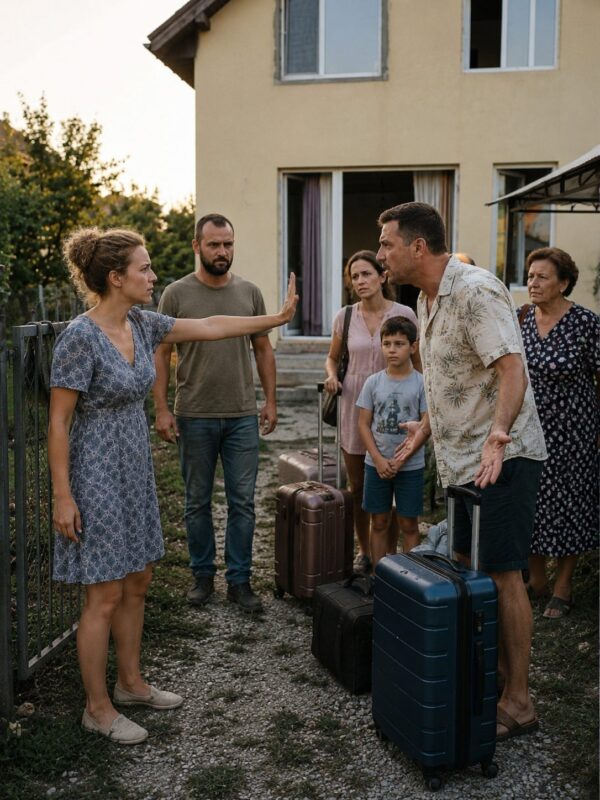
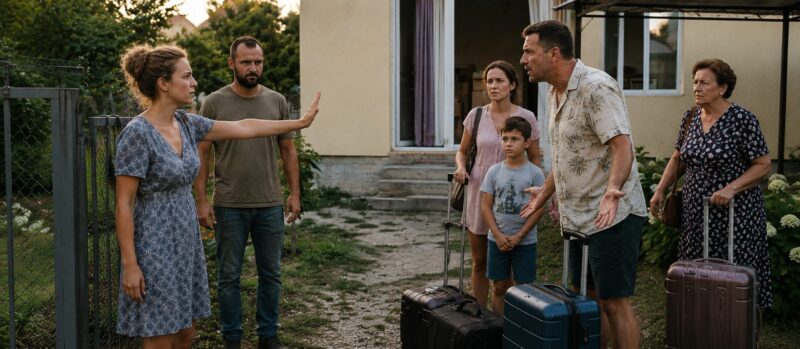
I turned onto our street and saw a taxi by our gate with its trunk open. Oleg was pulling out large plaid bags, Karina was holding a rolled-up blanket and a bag, and Misha was standing next to a box of toys.
Raisa Nikolaevna was standing in the shade, giving orders: “Don’t put them in the sun, carry them inside the house immediately!”
Denis had already stepped out onto the porch with some tools in his hands. He was looking at the bags, clearly bewildered.
“What is going on here?” I asked, stopping at the gate.
“Oh, Anya!” Oleg broke into a smile. “We’re here! We decided to leave our things here for a while—there’s no room at Mom’s, you know how cramped it is. We’ll just crash here until I find a job.”
“Stop. Nobody is taking these things into the house,” I stood in the doorway, blocking his path.
“Come on, now,” Oleg dropped his suitcase on the ground. “We aren’t here forever. We won’t be in anyone’s way—just a corner, a room upstairs. It’s a steam bath at Mom’s day and night; you can’t breathe, the child is suffering, not sleeping.”
“We already discussed this, Oleg. At dinner,” Denis said, coming down from the porch. “I thought I made it pretty clear.”
“What is there to discuss?” he suddenly raised his voice. “I basically gave you this land for free. For pennies! As a family! And now look what it’s worth—they put in a road, and everything’s quadrupled in price. I looked at listings online yesterday—it made me break into a cold sweat. I could have sold it to a stranger for a fortune! But I gave it to my brother. So, stop turning your nose up at me.”
Raisa Nikolaevna walked over and stood next to her son. “Oleg is right. I gave up my share—signed everything over to you, out of kindness. I thought you’d live as one family. But you’re ready to choke each other over a room.”
I stepped forward, blocking the gate completely. “Let’s get this straight. Oleg, you didn’t *give* us your share. You sold it. You set the price, and you pressured us because you needed the money immediately for your spot by the sea. We sold our car to pay you off. You took the money and left.”
“So I sold it. So what?”
“So you don’t get to ask for it back. The land is worth more now, but it isn’t *your* land anymore. You got rid of it three years ago, of your own free will. And we built this house ourselves: my room, the loan, three years in a cramped rental. You didn’t put a single penny into this construction. None of you helped—you didn’t even offer a word of advice. Raisa Nikolaevna actively tried to stop us: ‘Why do you need this house? You won’t make it, you’ll just bury your money in the dirt.’ You didn’t even believe we’d build anything.”
Denis walked over and stood shoulder-to-shoulder with me. “Oleg, no hard feelings. But the renovation isn’t finished; half the house is full of boxes. We aren’t going to turn this place into a dorm for the whole family,” he took a breath. “If you want, we can help with rent. We’ll cover the deposit, help out for the first month. But into the house—no.”
Oleg turned red and kicked his bag. “He’ll help me with the rent… what a philanthropist! I’ll figure it out myself, I’m not a child,” he glared at our yard. “You guys have gotten arrogant with this house, I see. Got your noses in the air. Mom, let’s go. We aren’t welcome here.”
Raisa Nikolaevna turned slowly toward Denis. She stared at him for a long time, with reproach. “So that’s how it is now, son… your own flesh and blood don’t matter anymore,” her lips trembled with offense. “Just watch that you don’t regret it later. You only have one brother, you won’t have another. Today you’re turning him away from your gate, but who will you go to tomorrow?”
“Tomorrow, I’ll go to my wife, Mom,” Denis said, quietly but firmly. “She won’t turn me away from the gate.”
They loaded back into the taxi in silence. Misha kept asking why they weren’t staying, and Karina tugged his sleeve, irritated. The door shut, the car took off, kicking up dust on our new road.
We stood by the gate. Denis slid the bolt home—slowly, all the way.
“You know,” he said, looking at the empty road, “at first, I really did think: the room is sitting empty, it’s a shame to waste it on family… maybe they could stay for a bit.”
“And now?”
“Now I think: it’s not ‘spare.’ It’s empty because we haven’t finished it yet. With our own hands, just us.” He paused for a moment. “Oleg already gave up this house once—when he took the money and left. It’s too late to ask for it back.”
I walked over to the garden beds. The cucumber had grown noticeably in the last few days—no longer a crooked little thing, but firm and straight.
I picked it, rinsed it off under the hose, broke it in half, and gave Denis his share.
He took a bite with a crunch and nodded.
“Finally, our own,” he said. Denis looked out over the yard, the house, the fence. “And the house is ours. Only ours.”