The Empress Banquet Hall
The air in the restaurant was thick with the scent of roast goose, expensive perfume, and a lingering stench of stale alcohol that seemed to emanate even from the velvet curtains. The jubilee for Uncle Boris—the father of Eduard’s father—was being held with that specific brand of «mercantile grandeur» often called «generosity of soul,» though in reality, it was nothing more than a vanity fair. Crystal chandeliers vibrated from the bass of the chanson music, and the tables were overflowing with delicacies that the guests couldn’t possibly eat but continued to greedily pile onto their plates.
Irina sat perfectly upright, feeling the corset of her dress digging into her ribs. She worked in the immigration service; she was accustomed to order, quiet, and precise procedures, but here, chaos reigned. Her husband, Eduard, had already undone his top button and was flushed. His face—usually focused and intelligent, the face of an experienced criminal investigator—was now twisted into a mocking smirk. Alcohol had loosened his tongue, and Eduard felt like the king of the evening.
When Uncle Boris handed his nephew the microphone for a toast, Eduard stood up, swaying. The room wasn’t truly silent—forks clinked and people whispered—but every eye was fixed on him.
«Dear Uncle Borya!» Eduard bellowed, causing the microphone to emit a piercing feedback screech. «I wish you… everything! But most of all, freedom! You know, I look at my own life…» He paused for dramatic effect and gestured around the room, his gaze settling on Irina. «Boredom! My wife is a walking manual. No fire, just instructions.»
A ripple of snickers went through the room. That was all the encouragement Eduard needed.
«You know, I’ve been thinking, maybe I should refresh things for the anniversary too?» He winked at his uncle. «Yesterday, I was thinking about buying a new car, but today, I’m thinking: why not get a divorce? Who’s with me?»
The room exploded in laughter. Eduard’s relatives—aunts in sequins, cousins with greasy faces—began to applaud. To them, it was the height of wit. Eduard beamed, basking in the attention. He felt like a stand-up comedian.
Irina didn’t move. She slowly picked up her glass of water, took a sip, and in her eyes—usually warm and grey—appeared an icy glint that Eduard had never seen in eight years of marriage. But he wasn’t looking at her; he was looking at the audience.
Only one person wasn’t laughing. Galina Petrovna, Eduard’s mother, who was sitting next to her daughter-in-law, had turned pale. She gripped Irina’s hand under the table, her fingers trembling.
«Edik, sit down, you’re drunk,» she hissed, though her voice was drowned out by the approving roar of the crowd. «Stop playing the clown; this won’t end well.»
«Mom, don’t start!» Eduard brushed her off into the microphone. «It’s a joke! Humor! Ira just doesn’t understand humor; she has the Administrative Code instead of a sense of humor!»
Another burst of laughter. Irina stood up slowly. She didn’t cry or scream. She simply picked up her purse, neatly adjusted the napkin on the table, and without saying a word, headed for the exit. Her back was straight as a taut wire.
«Well, look at that, she’s offended!» Eduard shouted after her to the jeers of the guests in the back. «Do you have money for a taxi? Or do I need to issue you a permit?»
Irina stepped out into the cool night. The noise of the party was instantly cut off by the heavy door. There was no hysteria inside her, only a cold, crystal-clear rage that, mixing with her professional habit of planning, turned into a battle strategy. She took out her phone, called a taxi, and while she waited for the car, she typed a short message to her mother: *»Everything is fine. I’ll be there soon. Don’t ask.»* But she wasn’t heading to her mother’s; she was heading home. To the apartment that belonged to her mother, but where Eduard had acted like he owned the world.
The Apartment on Builders’ Street
The next morning was overcast. Rain drummed against the eaves, washing away the remnants of yesterday’s dust. Eduard woke up at his parents’ house with a splitting headache. Galina Petrovna had been in a foul mood since dawn, clattering dishes in the kitchen and taking her heart medication.
«Let’s go,» she said dryly to her son when he tried to drink some coffee. «You need to apologize. You crossed every line yesterday. Wives leave over words like those.»
«Oh, Mom, come on,» Eduard winced, putting on his wrinkled shirt from the night before. «She’ll pout and get over it. She loves me. And besides, where would she go? She’s thirty-five, no kids, who else would want her?»
On the way home, Eduard even prepared a joke about «the return of the prodigal wife.» He was certain he would find Irina in tears, perhaps with breakfast waiting, expecting his majestic forgiveness.
The door opened with Galina Petrovna’s key. They stepped into the hallway and froze.
The corridor was piled high with black plastic trash bags. They were stacked on top of each other, forming barricades that reached the mirror. A sleeve of Eduard’s expensive coat poked out of one bag; his fishing rod stuck out of another.
«What is this?» Eduard stared blankly at the pile. «Are the neighbors renovating? Why are they cluttering up our hallway?»
Irina appeared in the doorway of the living room. She was wearing loungewear, calm and refreshed, with a cup of coffee in her hand. There were no traces of tears, no shadows of suffering.
«The neighbors have nothing to do with this,» she said in a steady voice. «It’s you who are moving out.»
Eduard scoffed, trying to put on his usual mask of condescension. «Ira, stop the theatrics. I had too much to drink yesterday; it happens. So, the joke was a bit much. Go ahead and clear this mess; I have work tomorrow, and I need a shirt ironed.»
That was when Irina delivered the line:
«Yesterday, you announced we were getting a divorce in front of everyone, they all applauded, and you just laughed. So, have you changed your mind today?»
«It was a joke!» Eduard roared, feeling his irritation pierce through his hangover. «Are you stupid? Can’t you tell the difference between a toast and reality?»
«I know the difference between a husband and a clown,» Irina cut him off. «Leave the keys on the side table. You don’t live here anymore.»
Eduard turned purple. His ego, inflated by yesterday’s applause, had received a painful puncture. The situation was spiraling out of control, and instead of backing down, he decided to attack. It was an old tactic that had always worked: intimidate, lean on his authority, make her feel guilty.
«Oh, so *I’m* moving out?» He stepped toward her, kicking one of the bags. «You should be thanking your lucky stars for me! You barren woman! We’ve been married for eight years, and you can’t even have a child! I’m only with you out of pity! If it weren’t for me, you’d be rotting in your immigration office among your papers! Who are you without me? Nothing!»
Galina Petrovna gasped and grabbed her son by the elbow: «Edik, shut up! What are you saying?!»
But Eduard was already on a roll. He started spewing filth: he brought up every gift he had ever bought her, every time she had been sick and he—the «hero»—had gone to the pharmacy. He blamed her for his failures at work, for the fact that she didn’t smile enough, for the fact that her mother was a «witch.»
Irina stood motionless. Her calm acted like a red flag to a bull. She wasn’t looking at him like a husband, but like an object of study, like a cockroach under a magnifying glass. That contempt in her eyes snapped his fuse.
«Why are you so quiet?!» he screamed, and, swinging his arm, he delivered a loud slap to her face.
The sound of the impact echoed off the walls. Galina Petrovna covered her mouth with her hand, sinking onto the ottoman. Eduard froze, expecting tears, hysterics, submission.
But Irina slowly turned her head back. There was no fear in her eyes. Only cold, calculated logic. She placed her cup on the shelf.
«Mistake,» she said quietly.
In the next second, the idyll of family life ended. Irina, the daughter of a retired colonel, hadn’t taken dance lessons in her youth—she had trained in kickboxing, a fact Eduard had conveniently forgotten or dismissed as an unimportant «girly hobby.»
Her kick to the groin was lightning-fast and brutal. Eduard made a sound like a deflating balloon and folded in half, gasping for air.
The Stairwell
Pain blinded Eduard. As a criminal investigator who had seen hundreds of fights in police reports, he was completely unprepared to find himself the victim. He backed away, tripping over his own trash bags, and stumbled out into the hallway as the door remained open.
Irina followed. Now, she was the one on the offensive.
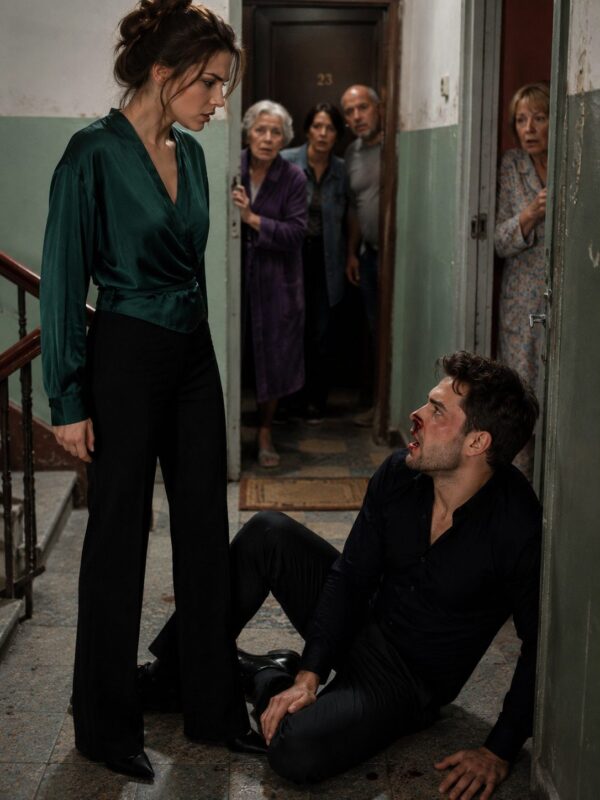
«You thought I would cry?» she asked, grabbing him by the ear and jerking him down with force. The cartilage crunched; Eduard howled. «You thought you could humiliate me in front of a hundred people and then come back for clean shirts?»
«You’re sick!» he wheezed, trying to strike out blindly, but his coordination was shattered by the pain in his abdomen.
Irina caught his arm and twisted it sharply. With her other hand, she grabbed the thick head of hair he was so proud of and yanked with all her might. Eduard felt the skin on his scalp tear, and a clump of hair remained in his wife’s hand.
«This is for yesterday’s applause,» she hissed, and delivered a short, precise punch to his nose.
Blood sprayed out, flowing in a hot stream onto his wrinkled shirt and the landing floor. Eduard instinctively covered his face with his hands, leaving himself open. Irina’s next move—a knee to the face as he tried to crouch—split his eyebrow open. Blood flooded his eye.
He lost his orientation. The grandeur had evaporated. Only primal fear and pain remained. He tried to crawl toward the elevator but got tangled in his own limbs and fell.
At that moment, the neighbors’ door opened. Uncle Misha, a retiree, looked out, along with a young couple with a child who were heading down from the upper floor.
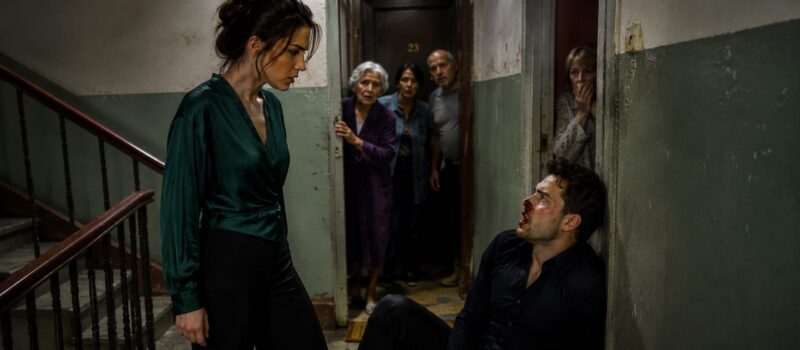
They saw a scene worthy of an action movie: the respected Eduard Viktorovich, always so important, crawling on all fours, smearing blood across the tile, while his quiet wife stood over him like a Valkyrie of retribution.
«Ira, he’s going to get killed!» shouted Galina Petrovna, who had run out, trying to get between them—though more to save her son from further mutilation.
Eduard, sensing his mother’s presence, tried to stand to preserve some shred of dignity, but Irina didn’t care about the audience. She stepped up close. Her face was contorted not by anger, but by the physical exertion.
«You’re a pathetic excuse for a man, Edik,» she said loudly enough for all the neighbors to hear. «A greedy, narcissistic nothing.»
He growled in frustration and pain, then tried to shout something back, but instead of words, a strange, barking sound escaped his broken lips. He literally barked like a chained dog whose tail had been stepped on, choking on his own blood and saliva.
«Woof-woof!» the neighbor’s little boy mocked.
That was rock bottom. Publicly humiliated, beaten by a woman, in shredded clothing, with a broken nose, a split eyebrow, and a black eye already bruising into a hideous shade of blue, Eduard whimpered on the dirty floor of the hallway.
«Take him away, Galina Petrovna,» Irina said, dusting off her hands as if she had touched something contagious. «And don’t forget his things. The elevator is working.»
She turned, entered the apartment, and slammed the iron door with a deafening clang.
The City Hospital Emergency Room
The smell of bleach and medicine brought Eduard somewhat back to his senses, but it did nothing to diminish his rage. He sat on a cot, shirtless, while a nurse treated his split eyebrow and stitched up his lip. The swelling on his face was so bad that his left eye was completely shut. A front tooth was loose and aching, a reminder of his encounter with his wife’s knee.
Galina Petrovna sat in the hallway, weeping into her phone, complaining to her sister about her «crazy daughter-in-law.»
«It’s fine,» Eduard lisped, spitting blood into a tray. Despite his concussion, a plan for revenge was already brewing. «She’ll be sorry. I’ll document these injuries. I’ll sue. I’ll take the apartment as jointly acquired property. I’ll take the car. She’ll be left with nothing! I’ll make her life a living hell! I’m a criminal investigator; I know all the moves!»
He imagined Irina crawling at his feet, begging for him to forgive his debts, imagine her being fired from her job for assault. Anger mingled with greed. He knew they had savings—in accounts they had opened together. He knew the documents were in the glove compartment of the car.
«Doctor, write everything down!» he demanded. «Soft tissue contusion, suspected nasal fracture, concussion!»
When the procedures were finished, he walked out into the corridor looking like a battered pirate.
«Mom, give me your phone. Mine stayed there, in that cursed apartment.»
He accessed the banking app on his mother’s smartphone. His fingers were trembling. He needed to lock the cards immediately and transfer all the money to his mother’s account. There was a substantial amount—they had been saving for an apartment upgrade for five years.
Enter password. Error. Try again. It went through.
Balance: $0.00.
Eduard felt his blood run cold. He checked the savings account. $0.00.
He looked at the transaction history. Ten minutes ago. A transfer to… his mother-in-law’s account. Reason for payment: «Repayment of debt per promissory note dated 2018.»
«What debt?! What note?!» he screeched so loudly that the nurse at the station jumped.
He remembered. Four years ago, when they were buying the car, they were short on cash. Irina’s mother had given them a large sum. Eduard, tipsy and overjoyed at the time, had signed some piece of paper Irina had handed him: «A formality, just to put Mom’s mind at ease.» He hadn’t even read it.
«That bitch!» he rasped. «Well, that’s fine—the car is in my name! The Toyota is worth two million!»
He ran out of the emergency room, forgetting about his mother. He needed to get to the garage.
«Sever» Garage Cooperative
The rain had intensified. Eduard, in a torn jacket with his head bandaged, reached the garage via a taxi paid for by his terrified mother. He ripped the garage door open.
The car was gone.
Instead of the shiny SUV, a solitary stool stood in the middle of the empty garage. On the stool lay a thick A4 envelope and a set of garage keys.
Eduard, limping (the kick to the groin still sent dull pain through him with every step), approached the stool. His hands were shaking so hard he struggled to rip the paper open.
Inside were photocopies.
The first page: A vehicle bill of sale. Dated last night. Buyer: Irina’s brother. Sale price: 10,000 rubles.
Eduard remembered. A general power of attorney. He had issued it to Irina himself three years ago when he thought he might lose his license for «speeding» and wanted to protect his assets. A power of attorney with the right to sell. He had forgotten to revoke it. It was valid for five years.
«That’s impossible…» he whispered, collapsing onto the cold garage floor.
But that wasn’t all. In the envelope was another document. A medical report.
Dated five years ago. A reproductive medicine clinic.
Patient: Eduard Viktorovich.
Diagnosis: Azoospermia. Absolute infertility. Irreversible.
Attached to the bottom was a note written in Irina’s clear, elegant handwriting:
*»I didn’t tell you so as not to wound your fragile male ego. I went through the treatments myself, took the hormones, endured the procedures, and pretended the problem was mine so you could feel like a man. You spent five years taunting me about infertility. Today, your entire family, who laughed at me yesterday, received a copy of this report in the family group chat. Along with pictures of your beaten face. Live with that.»*
Eduard’s world collapsed. Not because of the lost money or the lost car. It was the realization of the total, annihilating shame he had brought upon himself.
For so many years, he had played the role of the alpha male, humiliated his wife, and considered her defective—when she was the one who knew the truth. She had pitied him. And now, in one second, she had destroyed his reputation before the entire clan.
His mother’s phone in his pocket began to blow up with notifications from relatives. Uncle Borya, Aunt Lyuba, cousins.
Eduard looked at the screen. A message from Uncle Borya: *»You’re a real piece of work, Edik. Don’t ever call me again.»*
Eduard slid down the wall onto the concrete floor. Everything hurt: his broken tooth, his torn scalp, his crushed groin. But the pain in his shattered ego was worse. He imagined them all laughing—not at his joke, but at him. At his infertility, at the fact that his wife had beaten him, at the fact that he was now a pauper.
He opened his mouth to scream, but instead of a shout, a pathetic, despairing wail echoed through the empty garage, trailing off into a sub-human whimpering. In the corner of the garage, a rat squeaked, frightened by the strange, unearthly sound.
He was cornered. Punished. Destroyed. And the worst part—he knew he had done it all to himself, with his own tongue and his own arrogance, by underestimating the woman who had kept his secrets for years.