I was weeding when the phone rang. The screen flashed “Val. Petrovna,” and her voice had that tone people usually reserve for reporting a house fire.
“Nina, honey, are you at the dacha?”
“I am. What happened?”
“Nothing happened. I just… I wanted to tell you. A woman came to your place. About eleven o’clock. I saw her through the peephole standing at your door. Then Slava opened it and let her in.”
My hand dropped, phone and all. My vision blurred. The bed of dill, a bumblebee hovering over a yellow squash blossom, my dirt-covered fingers. All of that had existed a second before the call. Now, the world had shifted.
“Nina? Can you hear me?”
“I hear you. What kind of woman?”
“Dark hair. Thin. Wearing this trench coat, beige. I’ve never seen her before. She just stood there, rang the bell, and Slava opened it. Opened it so quickly, like he’d been waiting for her.”
*Like he’d been waiting.* Those words hit me right in the gut. I squeezed the phone, and clumps of dirt from my fingers showered the screen.
“Thank you, Valentina Petrovna.”
“I’m not looking to stir up trouble, Nina. I just thought you ought to know. You never know.”
I hung up. I sat right there on the path between the garden beds. The earth was warm, baked by the July sun, and I could feel that heat right through my jeans. It was strange that my body could still feel anything at all. Because inside, everything had gone deathly still, like the air before a thunderstorm.
Slava is working a side job today. That’s what he said. For the last six months, he’s been picking up extra shifts at the plant on Saturdays. Or maybe not at the plant. I cycled through those Saturdays in my mind, and they lined up like falling dominoes.
Every Saturday, I would head to the dacha. Seedlings, watering, weeding. Sixteen hundred square meters of land passed down from my parents. I loved being there alone. The silence, the air, my hands in the dirt. Slava hadn’t gone with me for two years. He said it was his back. He said it was the overtime. He didn’t say much else.
And now, a dark-haired woman in a beige trench coat had stood at our door. And he’d opened it fast. Like he’d been waiting.
I stood up. My knees were stained with dirt. My hands were shaking—not from the cold, but from something else. Something heavy and hot was rising from my stomach to my throat. I walked into the house and rinsed my hands under the tap. The water from the well was freezing. My fingers went numb, but I stood there, holding them under the stream until my bones ached.
Then, I packed my bag. Closed the greenhouse. Checked if the pump was off. Everything was automatic, like a robot. There was only one thought in my head: *Who.* Who was she? Who is this woman?
Eighteen years of marriage. Eighteen. I’m forty-one, he’s forty-four. Our daughter, Liza, is a freshman in St. Petersburg. We didn’t fight. Not really. But we didn’t talk, either. Not truly. For the last year, we’d lived like two people in a train compartment: polite, quiet, strictly on schedule.
I started the car. The old Logan sputtered and groaned to life. The steering wheel was scorching from the sun, so I grabbed a rag from the glove box to grip it. I pulled out onto the dirt road. Eighty kilometers to the city. An hour or so.
Enough time to lose my mind.
Trees blurred past the window. Birches, pines, more birches. The radio was droning on about traffic jams on the Ring Road. I turned it off. The silence was worse. My thoughts started creeping in like weeds in fertile soil: one after another, non-stop.
The last few months. What had changed? I started counting them off like prayer beads.
In March, Slava bought a new shirt. Just because, not for any holiday. Light blue, with thin stripes. I was surprised at the time, because he usually wore the same things until they frayed. He also started shaving every day. He used to go around with stubble on the weekends. But now, every single morning, even on Saturdays before his “side job.”
The phone. He started placing it face down. A small thing. Many people do that. But he never used to.
And one more thing. In May, I found a receipt in his jacket pocket from a coffee shop on Pokrovka. Two cappuccinos, a cheesecake. I don’t drink cappuccino. He knows that. I crumpled the receipt and threw it away back then. I told myself, *A colleague. From work.* But the receipt didn’t leave my head. It stayed there, flattened out, the numbers perfectly clear.
Two hundred and forty rubles for two cappuccinos and a cheesecake. That’s what the beginning of the end looks like.
Or maybe not the beginning. Maybe the end had been happening for a long time, and I just hadn’t noticed. Because I was busy with the garden, reports, getting Liza into college. Because it was easier not to notice.
I had sensed it in my gut back in May. But I choked the feeling down. I buried it under the mundane, like smothering embers with ash. But the embers hadn’t gone out.
The road wound through a village. A speed bump jolted the car. In the rearview mirror, I saw my reflection: flushed, hair plastered to my forehead, eyes wild. A stranger’s face. I didn’t know I was capable of looking like this.
On the back seat lay a basket of dill and radishes. I’d picked them that morning, thinking I’d make a salad that night. That we’d have dinner. That it would be just a normal Saturday. God, how far away that felt. A whole lifetime ago.
Around the forty-kilometer mark, I remembered our wedding photo. A big one, in a frame, that used to hang in the hallway before the last renovation. Later, Slava took it down, saying the frame was old. I didn’t argue. But in that photo, in the corner, there was a woman. Dark hair, thin, sharp cheekbones. I asked him back in the first year:
“Who is that?”
“My sister. Don’t worry about it.”
And I didn’t. In eighteen years, Slava said maybe ten words about his sister. That she existed. That she was older. That they didn’t talk. Period. I didn’t pry. Everyone has their own closets, their own skeletons. His mother, Zoya Grigoryevna, lived in Tula, and we visited her once a year, in May. She didn’t talk about her daughter either. A family of people who mastered the art of silence.
But now, on the road, with my back damp and my head pounding, I wasn’t thinking about a sister. I was thinking about the dark-haired woman in the beige trench coat. About the two cappuccinos. About the striped shirt.
The city began with a traffic jam at the entrance. I sat behind a semi-truck, tapping my fingers on the wheel and biting my lip. A habit since childhood. Mom used to say, “Stop it, your whole lip is going to be covered in sores.” I never did stop. Even now, when I’m stressed, my lower lip is the first casualty.
Stuck in traffic, I called Slava. It rang. Once, twice, three, four times. He didn’t pick up. My vision blurred. He always answered before. Even from meetings, he’d step out if I called. But now, four rings and silence.
I called again. Voicemail. He’d turned it off. Or declined the call. There was a difference, but at this point, it didn’t matter. There was only one thought left: get there, go in, see.
See what? I didn’t know. Maybe nothing. Maybe a clean apartment and a note saying, “Back by seven.” But something inside, some ancient mechanism, was driving me home. Just as a wolf is driven by the scent of a stranger in her den.
I was shaking. My hands, my voice, my thoughts. Everything was shaking. And I was furious with myself for it, because I didn’t know anything yet. No-thing. Just the neighbor’s words. Dark-haired. A trench coat. That’s all.
But that was enough to make me speed through the city, cutting off a van at a turn and nearly running a red light.
I pulled up to the house at four o’clock. The courtyard was empty, save for some kids on the playground and a cat on a bench. I looked up: our windows on the fourth floor. The curtains were drawn. When I left this morning, they were open. Slava never closes the curtains. He doesn’t even notice curtains. Someone had closed them.
My fingers were clumsy as I typed the door code. I messed it up twice. Three, seven, one, nine. The door beeped and opened. The elevator was broken, as usual. I climbed to the fourth floor on foot. I was nearly running, my footsteps echoing against the walls.
The third-floor landing smelled of cabbage soup—Valentina Petrovna’s place. Her door was closed, but I could feel her standing behind it, watching through the peephole. Listening. I didn’t stop.
Fourth floor. Our door. I took out the key. The lock turned smoothly, and I walked in.
The entryway was quiet. Slava’s shoes: his work boots, sneakers, slippers. Everything familiar. Nothing foreign. I kicked off my shoes and walked into the hallway. I sniffed the air.
And there it was.
The scent. Alien. Not mine. Sweetish, with a heavy, floral note. Perfume. Women’s perfume. It hung in the air like dust in a sunbeam: invisible, but everywhere. In the hallway, in the living room, and strongest of all, in the kitchen.
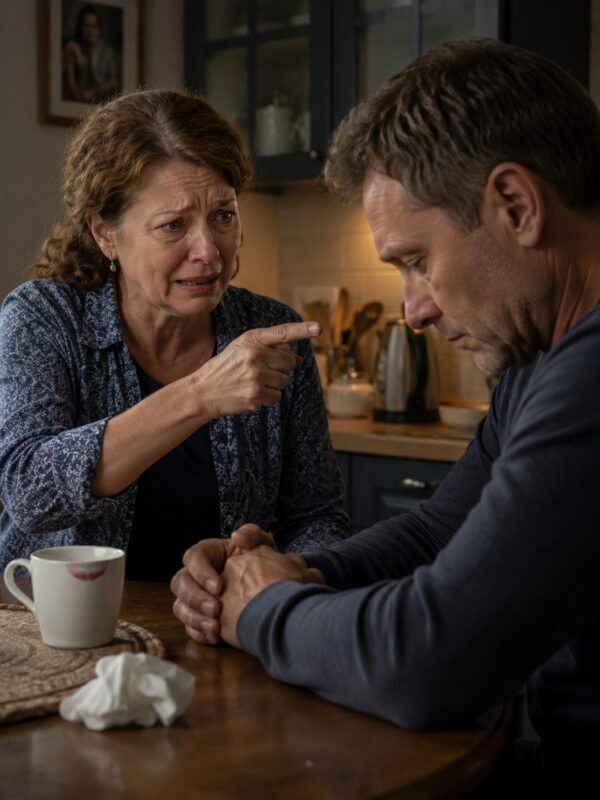
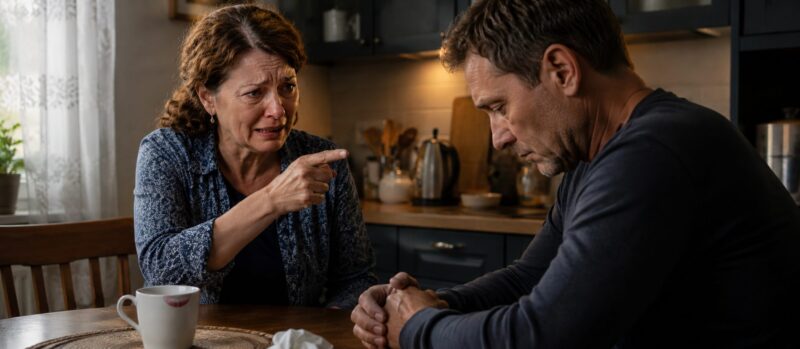
I stood in the middle of the kitchen, breathing it in. My arms hung limp. On the table, on my daisy-patterned oilcloth, sat a cup. White, with a blue rim. I recognized it. My mother-in-law, Zoya Grigoryevna, had given it to us when we used to visit her more often. We never used it. It sat in the back of the cupboard behind the other mugs. Someone had taken it out, poured tea, and drank. A brown puddle remained at the bottom. And on the rim, against the white porcelain, was a lipstick stain. Dark pink, almost magenta.
I don’t wear dark lipstick. Never have.
My legs gave out, and I sat on the stool. The same stool where we’d spent eighteen years eating breakfast. Slava on the left, me on the right. Coffee for him, tea for me. And here, on this stool, in this kitchen that smelled of a strange woman, I first thought the words “formal separation.”
Not a “fight.” Not a “talk.” A dissolution of marriage.
Then I stood up. And I began to search the apartment. Step by step, room by room. Like in a movie, but without the music. In a silence that rang in my ears.
The bedroom. The bed was made. That was strange: Slava never makes the bed. I ran my hand over the spread. Smooth, cold. The pillows were in place. I leaned over to his pillow and inhaled.
The strange perfume. The same scent. Sweet, heavy.
Then I saw a hair. Dark, long, against the light-colored pillowcase. My hair is light brown. Slava wears his hair short. This hair was black, maybe twenty centimeters long. I took it between two fingers and held it up to the light. It shimmered.
I felt nauseous. Physically, truly sick. I barely made it to the bathroom in time. I splashed cold water on my face. The mirror showed the same face I’d seen in the car, only worse. Pale, with red blotches on my cheekbones. My lip was bitten until it cracked.
I went back to the room. Sat on the bed. My mind felt empty and hollow, like a dry well. Just facts, one after another, like pebbles hitting the bottom.
The woman came at eleven. Slava opened the door fast. They were here, in our apartment, while I was digging in the dirt. Drinking tea from his mother’s cup. She lay on his pillow. And then she left, and he drew the curtains, and went to his “side job,” and didn’t pick up my call.
It all added up. The picture was so clear that it was unbearable to look at, like the sun at noon.
I sat there for maybe an hour. Maybe more. The sun shifted, and the strip of light on the floor crept from the door to the wardrobe. I watched it creep. I thought. I didn’t think. I just sat.
I remembered. How we met at Lesha Gorin’s birthday. I was twenty-three, he was twenty-six. He was the quiet one. He stood by the wall all evening with a beer. Then he followed me out to the balcony and said:
“You’re shivering.”
And he took off his jacket. That was it. That was enough. Two words, and I was lost. Because he didn’t ask, “Are you cold?” He said, “You’re shivering.” There’s a huge difference. He noticed, he didn’t just ask.
And now this man. This silent, reliable, boring, dear man. Brought someone else here. To my pillow. To my daisy-patterned oilcloth.
I heard the key in the lock at five minutes to seven. Later than usual. The door opened; boots hit the floor. Footsteps in the hallway. Heavy, slow, post-shift steps. Then he stopped. He probably saw my shoes.
“Nina?”
I didn’t answer. I sat on the bed in the bedroom. I didn’t move.
The steps grew closer. The bedroom door opened a crack. Slava stood on the threshold. Tall, in his work jacket, bag over his shoulder. His face was tired. The same face I’d seen a thousand times.
“Why are you home early? Did something happen?”
I looked up at him. He smiled. The familiar one—just one corner of his mouth. It had been that way his whole life. Not a smile, but a hint of one. I used to like it. Now, I wanted to throw a cup at him. The one with the blue rim.
“Who was here?”
The smile died. Not all at once. It froze, then slowly slid off his face like wet paint. He set his bag on the floor.
“What do you mean?”
“I mean exactly what I said. Who. Was. Here. Today.”
He stood and looked at me. Silent. His arms hung at his sides—big, with wide hands. I knew those hands by heart. Every scar, every callus. They fixed the kitchen faucet, put together Liza’s bike, kneaded dough for Easter. And now, those same hands might have been holding someone else.
“Nina, let me—”
“Valentina Petrovna saw. A woman in a beige trench coat. You opened the door for her. At eleven in the morning. While I was out digging in the dirt.”
He went pale. I watched the blood drain from his face, and it was terrifying, because Slava never pales. He’s the type who turns red when he’s angry. But now he was as white as the wall behind him.
“Nina, it’s not what you think.”
I scoffed. There it was. That phrase. From every bad movie, every girlfriend’s kitchen-table story, every internet post. “It’s not what you think.” A classic.
“And what do I think?”
“I don’t know what you think. But it’s not that.”
“Then what is it? Tell me. I’m listening.”
And he fell silent. He lowered his head. He stood there like a schoolboy in trouble. A big man, forty-four years old, nearly two meters tall, just standing and silent, unable to look me in the eye.
That silence was the worst part. Worse than the smell, worse than the hair on the pillow. Because if he could have explained it, he would have. Slava isn’t the type to stall. He stays silent only when he has nothing to say. Or when it hurts too much to speak.
“Perfume in the apartment. A cup on the table. Lipstick on it. And a hair on the pillow. Black. Long. Do you want to see? I kept it.”
He looked up. There was something in his eyes I didn’t expect. Not guilt. Not shame. Pain. Deep, old pain, like a crack in a wall that’s been patched over a dozen times, only to keep reappearing.
“Nina, sit down. Please.”
“I’m already sitting.”
“Okay. Fine.”
He leaned against the doorframe. He rubbed his face with his palms. I waited. My heart was pounding so hard I could hear it in my ears. A pulse in my throat, my temples, my fingertips.
“It’s Rita.”
I blinked.
“Who?”
“Rita. My sister. Margarita.”
Silence. Somewhere behind the wall, a neighbor’s television was playing. Mumbling, laughter, music. But here, silence.
“You don’t have a sister.”
“I do. I told you. A long time ago, you probably don’t remember.”
I remembered. I remembered the wedding photo, the dark figure in the corner. “My sister. Don’t worry about it.” That was twenty years ago, and I hadn’t worried about it.
“You said three words to me. In twenty years. Three words about a sister who comes to our apartment.”
“We haven’t spoken in twelve years. Since Father’s funeral. We fought then, and that was it. I changed my number, she didn’t know it. She found our address and came without calling.”
“Why?”
He fell silent again. But now, the silence felt different. Not empty, but full. Like a glass filled to the very brim. One move, and it would spill over.
“Mom is sick.”
Three words. Just like back then, with the wedding photo. Only these three words carried a different weight.
“Zoya Grigoryevna?”
“Yes. Cancer. Rita said they found out in June. Mom didn’t want to call me. She kept saying, why worry me? But Rita came. To tell me.”
I sat on the bed and looked at him. He stood by the door, staring at the floor. And between us hung everything: eighteen years, twelve years of silence with his sister, Mom’s illness, the cup with the blue rim, my fear, his shame.
“Why didn’t you tell me?”
“I couldn’t.”
“You couldn’t pick up the phone? To say, ‘Nina, Mom is sick, my sister came by’?”
“I couldn’t. I… after Rita left, I sat in the kitchen and couldn’t move. Then I went to work. Automatically. Like I’d just shut down.”
I understood. I didn’t want to, but I did. Because I knew Slava. He isn’t the type to call and spill his heart out. He’s the type who sits in the silence and processes things. For hours. And then pretends everything is fine.
But understanding didn’t erase the anger. I was furious. At him, at Valentina Petrovna, at Rita, at myself. At the fact that I’d spent the last three hours living in hell. At the fact that I’d searched my own home like a cop. Sniffing pillows. Examining hair in the light.
“The perfume. Why was there strange perfume in the apartment?”
“It’s Rita’s. She always wore it. Even back in childhood. Mom’s perfume, ‘Krasnaya Moskva’ (Red Moscow). Mom used to give it to her every year.”
*Krasnaya Moskva.* A sweet, heavy scent. I remembered: when we visited Zoya Grigoryevna in Tula, the hallway always smelled like that. That scent. I just hadn’t recognized it because I didn’t expect to find it here.
“The cup. Mom’s cup, from the cupboard. Did she take it out?”
“She recognized it. Said, ‘This is Mom’s.’ I gave it to Mom when she visited us, and Mom brought it back. Rita saw it and cried. She asked to have tea in that one.”
I closed my eyes. It was dark and hot behind my lids. The lipstick on the cup. Dark pink, almost magenta. Not a mistress’s lipstick. A sister’s. Who came to tell her brother that their mother was dying.
“The hair on the pillow.”
Slava looked at me. A long, heavy look.
“She was crying. Hard. I didn’t know what to do. I sat her on the bed. She lay down, covered her face with her hands. She lay there for twenty minutes. Then she calmed down, washed up, had tea, and left.”
I bit my lip. Really bit it, until it bled. It tasted salty.
“Why didn’t you tell me sooner? Not about today. In general. About Mom. Did you know before Rita came?”
A long pause. I counted my heartbeats. Seven, eight, nine.
“I knew. Since May. Mom called me herself. Once. She asked me not to tell you or Liza. She said everything was under control. I… I listened.”
May. Since May. I did the math. Two months he’d been living with this. Going to work, having dinner with me, watching TV. Two months he’d carried this stone inside and stayed silent.
“The side jobs?”
“Not side jobs. In May, yes, there was overtime. I wanted to set some money aside. For treatment. Just in case. And later, I started driving to Tula. On Saturdays. When you were at the dacha. So you wouldn’t ask.”
Saturdays. Every Saturday I thought he was at the plant. He was driving to Tula to see his mother. And staying silent. And coming back in the evening with a tired face, and I thought it was from the machinery. But it was from the road. From his mother’s illness. From the silence in the old Tula apartment.
“The receipt from the coffee shop. Two cappuccinos, cheesecake. In May. In your jacket pocket.”
He furrowed his brow. Then remembered.
“That was with Marina Sergeyevna. Mom’s doctor. She was in Moscow for a conference; I asked for a meeting. To discuss the treatment.”
I looked at him in silence. Every “clue,” every detail I’d collected like a detective, turned around and proved to be something else. The striped shirt. The phone placed face down so I wouldn’t see calls from Tula. Shaving on Saturdays because he was going to see his mother and didn’t want her to see him looking run-down.
Everything I’d interpreted as betrayal was, in fact, care. Awkward, silent, masculine, foolish care. He wasn’t hiding a mistress. He was hiding grief.
The landline rang. The old, wired one we hadn’t disconnected because Zoya Grigoryevna didn’t believe in cell phones. It rang loudly, demandingly, and we both jumped.
Slava picked up the receiver.
“Yes. Rita. No, it’s fine. Yes, she’s here. Hang on.”
He turned to me and held out the receiver. His hand wasn’t shaking. Mine would have been.
“She wants to talk to you.”
I took the receiver. Pressed it to my ear. A strange voice, low, slightly husky, with a soft Tula accent.
“Nina, hello. This is Rita, Slava’s sister. I’m sorry for how this turned out. I didn’t know your number, only the address from Mom. I came without warning.”
“Hello.”
“Slava just called me. He said you were upset. I want to explain. Mom is ill. I came so he would know. So we could decide what to do. Together. We haven’t spoken in twelve years, and it wasn’t easy for me to come. But Mom asked me to.”
“I understand.”
“Nina, it’s not his fault. Except that he stays silent. But he’s always been like that. Ever since he was a boy. He’d scrape his knee and just sit there silently until the blood dried.”
I listened and felt something inside, pulled tight in a knot, begin to slowly unspool. It hurt, like a limb waking up after being asleep, but it was unspooling.
“Thank you, Rita.”
“Thank *you*. For taking care of Slava. Mom says you’re a good person. Come see us with him. Together.”
I hung up. Slava was standing by the window. Back to me. A big back in a work jacket. His shoulders rose and fell. Once. Twice. He was breathing deeply and slowly, like a man trying not to cry.
I got off the bed. Walked over to him. Placed my palm between his shoulder blades. It was hot and hard under the jacket. He tensed for a second, then relaxed.
“Why did you stay silent?”
Quietly. Almost a whisper.
“I didn’t want to burden you. I thought I’d handle it myself.”
“You’re not by yourself. You’re with me. For eighteen years.”
He turned around. His eyes were red. He wasn’t crying, but he was on the edge. I could tell by the way he squinted, by the crease between his brows. In eighteen years, I’d seen him like this twice: when his father died and when Liza was in the hospital with pneumonia in fifth grade.
“I’m scared, Nina.”
Four words. For Slava, that’s an entire speech. I hugged him. Buried my face in his jacket. It smelled of machine oil, sweat, something sour. His scent. Dear, familiar, like the smell of home. And through that scent, I caught the smell of the strange perfume. *Krasnaya Moskva.* Mom’s scent. Rita’s scent. The scent of the family Slava had kept behind a closed door for twelve years.
We stood like that for a long time. It was getting dark outside. A July evening—warm and long. In the courtyard, one of the kids was shouting, “My turn!” The cuckoo clock in the kitchen ticked—the one that was a gift from his mother. The cuckoo had broken ages ago, but the clock kept running.
Then I pulled away. Wiped my eyes. Looked at him.
“When are we going to Tula?”
“Tomorrow. If you want to.”
“I do.”
He nodded. Sat on the bed and pulled off his boots. A habitual, daily gesture. I watched him untying his shoelaces and thought: here are the hands. Here are the boots. Here is the man I almost lost. Not because he left. But because I’d already decided he had. In my head, during those two hours on the road, I’d lived through the divorce, the division of property, the call to Liza. I’d invented it all, built it, furnished it. And all the while, he was driving home from work. To his wife.
That evening, we sat in the kitchen. I took the cup with the blue rim, washed it, and put it in a prominent place. Not in the back of the cupboard, but on the shelf next to our mugs. It stood there—small, old-fashioned, with a lipstick stain I didn’t wipe away.
Slava ate the salad made from the dill and radishes I’d brought from the dacha. In silence. I drank my tea in silence. But it was a different silence. Not empty, but warm. Like a blanket covering two people.
“Slava.”
“Hm?”
“Don’t stay silent anymore. Okay? You can tell me things. Even the bad stuff. Especially the bad stuff.”
He looked at me. Put down his fork. Reached across the table and covered my hand with his. Big, warm, rough. A callus on his index finger, a scratch on his thumb.
“Okay.”
One word. But I believed him. Because he didn’t make a promise. He just said “Okay.” And that was more honest than any vow.
At night, I lay there and listened to him breathe. Evenly, deeply, like people who have stopped carrying the load alone sleep. I didn’t sleep. I thought about Valentina Petrovna. About her call, about her “you never know.” Tomorrow, I’ll have to stop by her place. Not to argue. To thank her. Because if she hadn’t called, I wouldn’t have come. And Slava would have kept on staying silent. For a week, a month, until the very end.
Sometimes, you need a stranger’s peephole to see your own life.
I also thought about Zoya Grigoryevna. Small, frail, with a voice like a bell. The cup with the blue rim, *Krasnaya Moskva* in the hallway, the cuckoo clock. She’s sick. And we didn’t even know. Because in this family, everyone stays silent. Silent, silent, silent, until it cracks.
I turned on my side. Put my hand on Slava’s shoulder. He didn’t wake up, but he shifted closer. In his sleep. The body remembers, even when the mind shuts down.
In the morning, we’ll drive to Tula. And I’ll see Rita and realize she looks like that woman in the wedding photo, only older. And I’ll see his mother and hug her and not let go. And Slava will stand nearby, silent, with that half-smile of his. And maybe, for the first time in twelve years, he’ll hug his sister. Or maybe not. He doesn’t know how to do things right away. He needs time.
But we have time. I truly hope we do.
And I’ll leave the cup with the blue rim on the shelf. Let it stay. Let it remind me. Not of the dark-haired woman in the beige trench coat. Not of my fear and my anger. But of the fact that silence can have a high price. And that sometimes, the hardest thing isn’t forgiving. The hardest thing is asking.