That day, the personal hell of Daniil Romanovich Severov, head chef of the restaurant «Garnet,» hit rock bottom and smashed right through it with the deafening sound of a plate shattering against the hardwood floor. Standing in the middle of the cold prep area, surrounded by stainless steel and tile, he felt like the captain of a sinking ship, pulled down by the ballast of other people’s mistakes.
«This is impossible to eat!» he slammed his fist onto the stainless steel table, sending a small cloud of flour into the air. «You wouldn’t feed this to hogs in the sticks, let alone serve it here! Did you even taste this slop? I’m talking to you, Rinat!»
Standing at attention was the line cook, a forty-year-old man with a bloated face and red spider veins across his nose. He reeked of last night’s bender mixed with stale, cheap tobacco.
«Daniil Romanovich, don’t blow a gasket. The meat is fine, just a little tough. It happens, right?» Rinat lazily wiped his hands on a greasy apron and smirked. «You’re going to give yourself a stroke, and then I’ll be the one dealing with the fallout.»
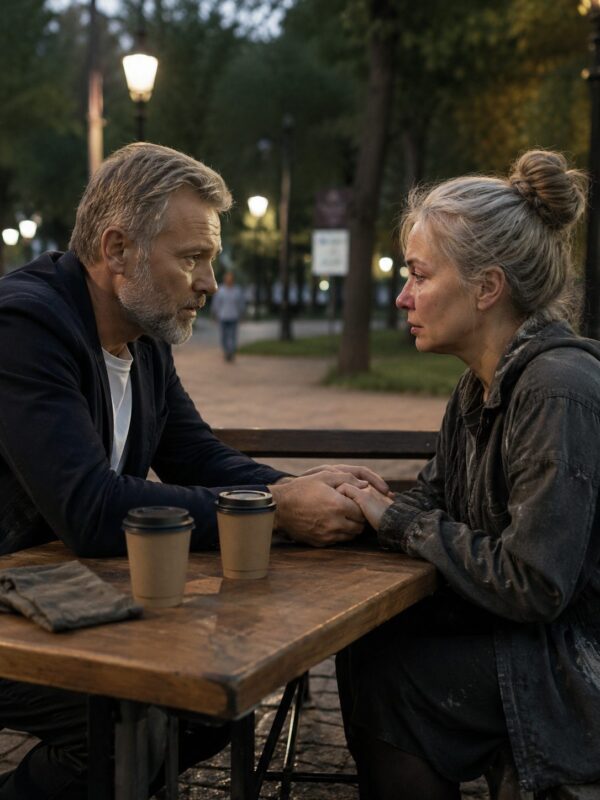
«You’re dealing with the fallout *now*! For the ‘New Zealand Tenderloin’ that turned out to be tough as a boot! For the sauce that broke because you likely dipped a dirty spoon into it!»
«You know what, Chef?» Rinat suddenly straightened up, a challenge glinting in his eyes. «How about you bring my salary up to big-city standards before you start making demands? If you want to pay pennies, hire some fresh culinary school grads from the boonies. I don’t give away my secrets for free.»
Daniil’s eye began to twitch. It wasn’t about the money. Rinat was paid well—even getting extra under the table just to keep him sober and working. But he still drank. And his culinary talent, once as brilliant as a comet, now looked like that same comet had crashed into a sewer.
«Secrets?» Severov whispered, barely audible. He suddenly realized he couldn’t take it anymore. The fear of losing his staff had held him hostage for years. He had been terrified of being left alone at the stove, afraid of losing the restaurant he’d poured his soul into. But now, the fear vanished, replaced by an icy calm. «Get out, Rinat. Right now. Take off the apron and hit the road. You’re free.»
Silence fell over the kitchen. The waitresses, huddled in the doorway, stopped breathing. Rinat opened his mouth, expecting the chef to back down as he always did—to negotiate or promise a bonus. But Daniil just stared coldly at the bridge of his nose, his gaze promising nothing.
«You… you’ll call me,» Rinat wheezed, crumpling his dirty chef’s hat in his hands. «You’ll come crawling back on your knees. And when you do, Daniil Romanovich, the conversation will be very different. I’ll set terms that will make you tear your precious ‘Garnet’ apart brick by brick out of pure spite!»
He threw the hat on the floor, kicked the door open, and stomped out. The slam echoed through the empty kitchen. A kitchen assistant, an elderly woman named Marya Sergeyevna, silently walked over, picked up the hat, and with two fingers, dropped it into the trash can with visible disgust.
«It’s about time, Daniil,» she said softly but firmly. «You don’t treat a rotten tooth—you pull it. Don’t beat yourself up. God willing, we’ll find someone capable.»
Daniil didn’t answer. He turned and walked into his office—a tiny, cramped room overflowing with papers and old menus. He collapsed into his chair and covered his face with his hands. Tomorrow was Saturday. The dining room would be packed. And there was no one to cook. Close down? Announce a «technical malfunction»? That would be a blow to his reputation that had taken years to build. Daniil had started «Garnet» from scratch, naming it after his late mother’s favorite stone. He couldn’t let it become a laughingstock.
His cell phone cut through the silence. The screen read: «Kiryukha.»
«Hey, Dad!» his son’s voice was bright and energetic. «You’re probably buried in your pots and pans again, right? Just reminding you—it’s Wednesday, and you know the tradition: the park and hot pastries. I’m almost at the ‘Old Oak’ tree.»
Daniil smiled. Kirill, his twenty-two-year-old son, was his greatest pride and his anchor. Years ago, during his college days, life had played a cruel joke: his young wife had run off, leaving the birthday-boy-turned-father with a bundle in his arms and a note: *I wasn’t born for a life like this.* Daniil never tried to find her, and he didn’t curse her. He just gritted his teeth and raised his son alone. Now, looking at the tall, sharp-witted, slightly ironic young man, he knew it was the best decision of his life.
He walked outside. The May evening enveloped the town in a warm, slightly humid haze. The air smelled of blooming poplars and fresh asphalt. Kirill was already standing by the pastry stand, impatiently tapping his toe.
«Dad, you look like someone just read you your death sentence,» Kirill noted, biting into a hot, greasy *chebureki*. «Something happen?»
«Fired Rinat,» Daniil grumbled, grabbing a coffee. «Or rather, he quit, but I pushed him out the door.»
«Oh! It happened! The dam finally broke!» Kirill stopped chewing. «I thought you were going to put up with him until he retired. So, who’s at the helm now? Or should I drop my engineering degree and join you in the kitchen?»
«Very funny. There’s no one. And more importantly, I can’t find anyone. The labor market is as empty as my head right now.»
They strolled slowly through the shaded alley of the Gromov Park. The sun danced in the leaves, scattering golden coins across the path. Kirill ate his third pastry with gusto, talking about his fiancée, Lera, and how they were picking out wallpaper.
«It’s all fluff, Dad. You’ll figure it out. You’re a Severov…»
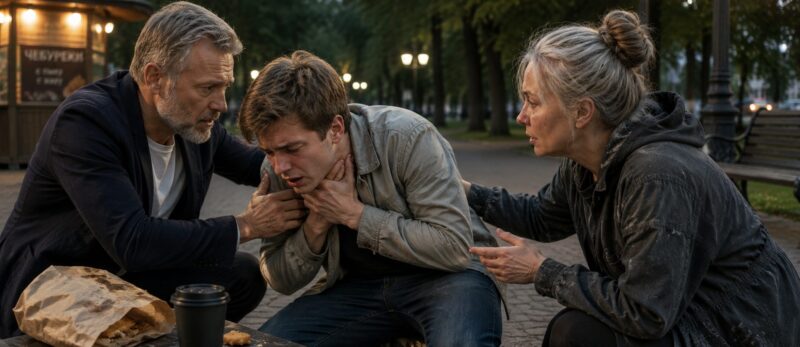
He didn’t finish the sentence. The young man’s face suddenly contorted, his eyes bulging. He dropped the bag, grabbed his throat, and let out a terrifying, gurgling wheeze. His skin began to turn from pink to a sickly blue.
«Kirill! Kir!» Daniil panicked, lunging at his son and pounding his back. «Spit it out! Come on!»
The boy was gasping, mouth wide open like a fish tossed onto the shore, but no air was getting through. A piece of the tough, rubbery meat from the cheap pastry was stuck in his trachea, cutting off his oxygen. Daniil knew he had mere seconds, but his movements were frantic and useless. Panic flooded his mind; all he could see were his son’s fading eyes.
Suddenly, a sharp, surprisingly strong shove sent him flying to the side. A figure in a shapeless, dust-covered coat grabbed Kirill from behind. A woman? A homeless person? She locked her hands under the boy’s chest and pulled back and upward with animalistic precision. There was a sudden *pop*, and the piece of dough and meat flew out of Kirill’s throat, landing in the dust.
Kirill doubled over, coughing, greedily and whistle-shrilly pulling in life-giving air. Daniil, not believing his eyes, rushed to his son, frantically checking his face.
«You’re alive… God, you’re alive…» he whispered with trembling lips. He turned toward the savior.
It was the same homeless woman who had been sitting on the steps of the old cathedral for the past few months with a cardboard sign. No one knew where she had come from. She didn’t beg loudly; she just sat there, looking through the passersby. Her face was haggard, yet not ruined—as if it had been sculpted from fine clay that had been weathered by wind and rain but never broken. In her deep-set, grey eyes, one could read both intelligence and an otherworldly exhaustion.
«You shouldn’t hit someone on the back,» she said in a quiet, surprisingly clear voice, devoid of the raspy quality typical of a heavy drinker. «The obstruction could have been pushed deeper. It’s the Heimlich maneuver. Sir, didn’t you learn that in school?»
«Thank you,» Daniil said, ready to fall to his knees right there in the dust of the alley. «You saved my son… I recognize you. You sit by the church.»
«I do,» the woman agreed, smoothing out her matted, once-blonde hair. «I suppose I was waiting for this moment. And now it’s happened.»
Kirill, catching his breath, stared at his savior with a mix of awe and curiosity. Meanwhile, Daniil frantically pulled out his wallet, scooped up all the cash he had, crumpled it, and held it out to her. It was a substantial amount.
«Please, take this. I know you can’t buy a life, but…»
The woman pushed his hand away with such natural dignity that Daniil was flustered.
«Put your wallet away,» she said wearily. «If I saved lives for money, I’d have opened an agency by now. I don’t want it.»
She turned to leave, but Kirill suddenly grabbed the sleeve of her dirty coat. His mind, still reeling from the shock, was fixated on a strange detail from before he had started choking.
«I’m sorry,» he said hoarsely. «I accidentally overheard… you said ‘Heimlich maneuver.’ And something about school… I don’t mean to pry, but the way you said it—it was as if you’d been teaching people for a lifetime. Or am I wrong?»
The woman gave a sad, thin smile.
«I didn’t teach, young man. I commanded. Once, in a past life. In the kitchen, you can’t get by without knowing the Heimlich, honestly. Someone was always choking on a bite during a tasting, rushing to please the boss.»
She waved her hand as if to dismiss the conversation and started to walk away, but both Severovs blocked her path. Daniil looked at her dirty yet elegant fingers and her sharp, defined cheekbones, and within him, alongside gratitude, a strange, crazy spark of hope ignited.
«Wait!» he blurted out. «Let’s… let’s just go to a café. Not out here on the street. Just coffee. You drink coffee, right? Real, fresh-ground coffee.»
For the first time, a glimmer of lively, almost childlike interest flickered in her eyes. She licked her cracked lips.
«With milk foam and cinnamon?» she asked, and a commanding tone suddenly cut through her voice—the very tone she had just described. «Only if you promise they won’t skimp on the cinnamon. And the milk must be frothed to stiff peaks, not just smeared in as a warm puddle.»
Daniil and Kirill exchanged a look. The café they stepped into, «Agatha’s,» was quiet. They sat at a corner table, hidden from prying eyes by a large potted ficus. The woman, who called herself Vera, tackled the coffee with a restrained passion that was a pleasure to watch. She didn’t just drink it; she analyzed it. She inhaled the aroma, eyes closed, then used a spoon to collect a bit of foam before taking a microscopic sip.
«Well?» Daniil asked, heart in his throat.
«The machine hasn’t been cleaned in three days,» Vera stated quietly. «And the beans are over-roasted. But, as they say, half a loaf is better than none.»
Next, they ordered a salad and a steak. And here, Vera completely transformed. She squared her shoulders and took up her knife and fork with such elegance that one might have thought she was sitting in a Michelin-starred dining room rather than a cheap diner. After cutting a piece of meat, she didn’t even taste it; she just touched it with her finger, pressing down.
«That’s enough,» she said, pushing the plate away. «It’s medium-rare, but the meat wasn’t brought to room temperature before grilling. That’s why there’s a ‘boot’ at the bottom while the top is raw. The coarse-ground pepper was pressed into the pores; that’s sloppy. The onions in the salad were sliced with a dull knife, bleeding juice into the dressing and ruining the aroma of the fresh cucumber.»
Daniil listened, spellbound. This wasn’t just product knowledge. It was instinct. An innate, absolute pitch for flavor that money couldn’t buy.
«Who were you?» Kirill asked point-blank, pushing aside his half-eaten dessert. «And be honest.»
Vera leaned back in her chair, and it was obvious that her energy was draining away again. The shine in her eyes faded, and her posture slumped.
«A head chef,» she replied, without a hint of pretension, but with a funereal finality. «But that was in another country and another era. Now, I don’t even have the documents to get hired as a dishwasher. I lost them. Or burned them—I don’t remember anymore. Life can bring storms that wash everything away: titles, home, family.»
«What kind of storm?» Daniil asked softly.
«Betrayal,» Vera snapped, making it clear the subject was closed. «The man I built my business and life with decided his young wife didn’t care for my culinary refinements. She wanted quick cash, not fine dining. I was kicked out of a restaurant that I had essentially created, and they smeared my name so badly that no respectable employer in the industry would touch me. I broke. I was in the hospital for a long time, and then… the streets. The streets accept everyone, you know.»
Silence hung in the café. Daniil looked at her and saw not a homeless woman, but a person whom fate had crushed like a bug, yet had failed to destroy the core within her. And that same core had just saved his son’s life.
A decision formed in his mind instantly. It was insane, absurd, and yet completely logical in the chaos his business was currently facing.
«Vera,» he said, leaning forward and looking directly into her eyes. «Don’t say no immediately. Hear me out. You won’t be on the street anymore. I have a restaurant. Today, it was left without a chef, and quite frankly, it’s on the verge of collapse. I need you. ‘Garnet’ needs you. Say yes.»
Vera didn’t answer right away. She looked out the window for a long time at the passersby, who went about their business unaware that a destiny was being decided at that very moment.
«Daniil,» she finally said—he noted she had remembered his name—»you have to understand, this is impossible. It would be a scandal. I’m homeless. I don’t have a health card. I could be sick. You’d be risking your restaurant.»
«I was risking it every day I kept an alcoholic in that kitchen,» Daniil retorted sharply. «And you are as sober as a judge. And your hands—even now, even dirty—they hold a fork with a grace my cook never possessed. We’ll take care of the rest. My lawyer will get you new documents in a week. You’ll get your health check done tomorrow. For now, you’ll stay at my place. In the guest bedroom. Don’t argue; it’s not up for discussion. It’s a condition of the job.»
Kirill watched his father, holding his breath. He hadn’t seen this version of Daniil Severov in a long time. In his eyes burned the same adventurous fire that had created «Garnet» in the first place.
Vera suddenly let out a sob. A single, solitary tear rolled down her unshaven cheek and fell into her cup of leftover coffee.
«I accept,» she whispered.