Autumn twilight thickened outside, drenching Matvey Serebryakov’s yard in liquid gold and crimson. He stood leaning on his shovel, scowling at the windowless, dark-red brick wall that had risen on the other side of the picket fence. The barrier was monstrous—ten feet tall, topped with wrought-iron spikes, like the prison of some local warlord. Since his neighbor, a certain German Voldemarovich von Lange, had erected this fortress, Matvey’s yard had been plunged into eternal shadow, and the neighbor’s very presence felt like a splinter in his heart.
The locals of Zaozyorye—a village lost among pine forests and peat bogs—called the man «the city baron» behind his back. Rumor had it he held a high-ranking position in the administration of the regional capital, Svyatogorsk, visiting his estate only on weekends to rest from his «righteous labors.» The local girls would swoon at the mere mention of his name, imagining a fairytale life, but Matvey saw only a demonic obsession.
Fragments of a conversation drifted to his ears from behind the brick wall. A woman’s voice—high, cracked, and choked with tears—was pleading, begging, appealing to a conscience that wasn’t there. The man’s baritone, by contrast, sounded cold and disdainful, as if he were shooing away an annoying fly.
«But you promised…» the wind carried a plaintive sob.
«I promised nothing. You made it all up. Get out before I call security,» von Lange snapped. Heavy footsteps crunched on the gravel, retreating into the depths of the property.
Matvey sighed and drove his shovel deep into the packed snow. It was November—slushy, damp, and stubbornly refusing to give way to winter. He had to clear the yard, or he wouldn’t be able to get his car out tomorrow. *Some people play out romantic dramas,* he thought bitterly, *and others have to shovel the snow for them.*
A quarter of an hour later, the neighbor’s gate creaked mournfully. Matvey looked up and saw a young woman practically running down the muddy road, wrapping herself in a gray shawl. He recoiled, recognizing her as Elena—his late wife’s best friend. Slender, with disheveled light-brown hair escaping from beneath her shawl, she looked like a mere girl. Matvey started to call out to her, but stopped himself, remembering where she had just come from. A sickening chill stirred in his soul. He watched in silence as her thin figure dissolved into the grayish mist, shaking his head.
«Is that really Lena? My, how fate shuffles the deck…»
He hadn’t seen Elena since his wife, Anna, passed away. She had come by a couple of times right after the funeral—trying to get through to him, scolding him, crying, and clearing the empty bottles out of the house. But back then, Matvey’s life had been one long, murky haze, an endless drunken stupor. He barely remembered those days; only fragments surfaced in his mind: Elena’s tear-stained face and her desperate cries: «Matvey, wake up! You can’t bring Anya back, and you’re burying yourself alive!» Now, nearly four years sober, those memories burned him with shame.
Anna had died in the regional hospital in Svyatogorsk, along with their unborn daughter. The doctors had just thrown up their hands—rapid-onset sepsis, they’d caught it too late. Matvey had felt as if he had plummeted into a bottomless black pit. He drank hard, losing track of days and nights, until one night in a dream, Anya came to him. She stood in the middle of the room, bathed in moonlight—pale, translucent, wearing the very same blue dress she had loved in life. Her eyes were as sad as an autumn sky. «You forgot me so quickly, Matyusha. You don’t even visit. It’s cold there, and uncomfortable. And the cross has tilted…»
He woke up in a cold sweat, his heart hammering, and sat on the edge of the bed until dawn, staring into the void. As soon as it was light, Matvey rushed to the cemetery. The old graveyard on the outskirts of Zaozyorye greeted him with neglect. Anna’s grave was overgrown with weeds, and the wooden cross had darkened with rot and slumped to the side. Matvey fell to his knees right in the dirt and sobbed—the first time since the funeral.
«Forgive me, Anechka… Forgive a fool…»
He spent the entire day there, tearing out weeds with his bare hands, smoothing the mound, and whispering all the words he hadn’t managed to say while she was alive. The next morning, he went to Stepan Trofimovich, the director of the logging facility where he worked as a mechanic.
«Give me an advance, Trofimych,» he said, his voice dull, staring at the floor. «I’ll work it off, even at night. I want to order a fence for Anyuta, a headstone. I can’t go on like this.»
Stepan Trofimovich, a burly man with nicotine-stained mustaches, stared at him in silence for a long time. Matvey was a golden worker—his hands were gifted, and he understood machinery as if it were a living thing. But he had been drinking without pause. Yet, the pain in his eyes was so profound that Trofimovich simply sighed and pulled open his desk drawer.
«Take it. And listen… when you’re done, come back to the workshop. The repair bay has no soul without you.»
From that day on, Matvey didn’t touch a drop. He forged the intricate fence himself—with wrought-iron roses, just as Anya had dreamed—and ordered a headstone of gray Karelian granite from Svyatogorsk. And every Sunday, in any weather, he went to the grave, sat on the bench, and talked to his wife, telling her everything that had happened during the week.
So, here he was again, looking at the road where Elena had disappeared, thinking about how strangely fate had intertwined their lives. Elena was a living reminder of Anya—their constant laughter, their secrets, their kindred souls. Seeing her was agonizing, and Matvey had consciously avoided her. He had heard from the women at the post office that Lena had headed to Svyatogorsk to seek her fortune. Apparently, she’d found it, he smiled bitterly to himself, remembering his «baron» neighbor. The man was striking, no doubt about it—tall, well-groomed, with noble streaks of gray in his dark hair. But there was something in his eyes, cold and calculating, that Matvey had never liked.
Soon, von Lange himself left Zaozyorye. His black SUV roared with a powerful engine and, splashing mud, sped off toward the highway to Svyatogorsk. Elena never crossed Matvey’s path again—she must have returned to the city. He sighed and, planting his shovel in a snowdrift, trudged into the house. He felt uneasy and restless, as if disaster were already on the doorstep, breathing down his neck but not yet daring to knock.
Six months passed. April that year was early and gentle. The snow melted quickly, exposing the black, steaming earth, and the air smelled of meltwater, decaying leaves, and the vague promise of new life. May 1st arrived—a day that was a celebration of spring and labor for all of Zaozyorye, but for Matvey, it was Anna’s birthday. He didn’t listen to the local crones who insisted it was a sin to disturb the dead on such a day. For him, it was the brightest day of the year, the day her soul had come into the world.
He shaved carefully, put on a clean shirt, and, grabbing a basket of early tulips, headed to the cemetery. At the gate, Aunt Polya seemed to rise from the earth—an ancient, hunched crone in an ever-present black shawl, whom people in Zaozyorye considered either a witch or a saint.
«Off to the graveyard again, Matvey Ilyich?» she creaked, boring into him with her faded but remarkably sharp eyes. «It’s not right, oh, it’s not right. On a day like this, her soul is rejoicing, reaching for the light, and you’re calling her back into the grave. It’s the same as holding a wake for the living.»
«Hello, Aunt Polya,» Matvey replied meekly, removing his cap. «Look at this weather—it’s a blessing. I decided to check on things, maybe touch up the fence, see if the grass has sprouted anywhere.»
«Don’t try to sweet-talk me!» the old woman snapped. «I can see right through you. So many years have passed, and you still can’t let go. That’s how life will pass you by, Matyusha.»
«Aunt Polya,» Matvey tried changing tactics, «look over there—isn’t that Grandpa Kondrat bringing honeycombs from his apiary? His legs are supposed to be bad, yet look how fast he’s moving.»
But the old woman didn’t even blink. It was an old, tested trick, but it didn’t work on her.
«My Kondrat isn’t there,» she retorted. «He’s been in the cellar for three days guzzling kvass to treat a cold. You young ones are all air-headed. Just like Lena—that fickle friend of Anya’s. She spent all her time looking for a foreign prince, and look what she found—nothing but trouble. She came back heavily pregnant, and he kicked her to the curb. Now the poor girl is suffering at her grandmother’s house, not showing her face. So much for your prince…»
She waved her hand and hobbled away, leaving Matvey standing with his mouth open. *So, Lena is here? In Zaozyorye? And what does she have to do with…*
Suddenly, something clicked in his mind, and he felt a chill. That conversation behind the wall, her crying, her visit to von Lange… The pregnancy. He slowly sat down on the bench by the cemetery gate and lit a cigarette. His temples were throbbing. *Could it be German’s child?*
The graveyard was quiet and peaceful. The sun poked through the young birch leaves, casting golden flecks on the headstones. Matvey tidied the grave, arranged the flowers, and sat on the bench, speaking to Anyuta—quietly, barely moving his lips. He told her about fixing the tractor for Trofimovich, how the apple trees had survived the winter, and how much he missed her every god-given night.
Half an hour passed unnoticed. Suddenly, a strange, sticky sense of anxiety pricked at his stomach. Matvey looked around. The cemetery seemed deserted, yet something had imperceptibly changed in the silent harmony. He froze, peering into the labyrinth of fences and crooked crosses.
Then he saw it: about two hundred yards away, among the older graves, a man was skulking. He moved low to the ground, darting from monument to monument as if afraid of being seen. Matvey instinctively slid off the bench and hid behind the thick trunk of an old linden tree. *Who would need to hide in the graveyard on a day like this?*
The man drew closer. Matvey peered out and, to his astonishment, recognized German Voldemarovich von Lange. The «city baron» was wearing an inconspicuous dark-gray suit, but he was given away by his gait—haughty and overconfident, fitting poorly with his current thieving behavior. What could such an important man need at an old village cemetery?
Curiosity battled with caution. Matvey, who knew every path by heart, moved silently after him, hiding behind bushes of overgrown lilac.
After about three hundred yards, he saw it. Near the back wall of the graveyard, where the recently deceased were buried, a fresh grave gaped open. The earth was neatly covered with spruce branches, clearly prepped for a funeral the next day. Von Lange approached the pit, froze for a moment, glanced around with disdain, and then quickly—as if throwing away something repulsive—tossed a bulky bundle into the dark hollow. A flash of white fabric vanished into the abyss. Without a second’s hesitation, German turned and strode briskly toward the cemetery exit.
Matvey stood stunned, unable to move. Thoughts whirled through his head: *Drugs? A dead drop? Is he laundering money in such a barbaric way?*
Then, a faint, muffled squeak drifted from the grave. The sound was so weak that it could have been mistaken for a rodent or the creak of branches, but Matvey’s heart skipped a beat. He bolted toward the pit, stumbling over ruts and old wreaths.
Looking down, he saw a white bundle on the loose earth. The bundle was moving. With trembling hands, Matvey jumped into the shallow hole. His fingers didn’t want to obey as he tore at the tight knots of rough burlap. The fabric gave way, and a tiny, wrinkled face was revealed. A child. A living newborn. The baby’s skin was almost blue; he wasn’t crying, only letting out quiet, pitiful gasps, his little hands moving convulsively. A hospital identification tag dangled from his tiny wrist.
Matvey, an experienced mechanic used to acting quickly and precisely, was paralyzed for a heartbeat. Horror and rage flooded his senses. *How is it possible to throw away a human being like trash?*
He picked up the bundle as carefully as if it were the most fragile piece of machinery, pressed it to his chest, and pulled himself out of the grave. *Where did von Lange go?* He was gone. *No matter, he’ll answer for everything.*
Matvey ran. He didn’t remember how he crossed the graveyard, how he burst onto the dirt road, or how he flew to Aunt Polya’s house—the only person who could help in such a disaster.
«Aunt Polya!» he screamed, bursting through the gate. «Open up! Help!»
The old woman threw the door open instantly, as if she had been waiting.
«What happened, for heaven’s sake?» she gasped, seeing Matvey’s pale face and the bundle in his arms.
«A child. There… in the grave…» he exhaled, handing her the infant.
Aunt Polya groaned, but her hands were surprisingly strong and nimble. She quickly took the bundle, unwrapped it, and inspected the little one.
«He’s alive, glory to God! Matyusha, get into the house, it’s warm in there. I have a little formula left from my granddaughter. Run, don’t just stand there! Mix it according to the instructions, hurry! I’ll clean him up, the poor soul.»
Matvey rushed to obey. His hands were shaking, but the familiar mechanical task calmed him. Meanwhile, Aunt Polya wiped the baby with warm water and swaddled him in clean diapers that had miraculously survived from her great-grandchildren. Putting her ear to the baby’s chest, she nodded in satisfaction.
«His heart is beating steadily. He’s breathing. There now, little one. Matvey, give me the bottle.»
The baby, feeling the warmth and a drop of milk on his lips, began to suck greedily. He turned out to be a boy—sturdy and healthy—and now, warm and fed, he drifted off to sleep, comically wrinkling his nose.
Matvey sat on edge, telling Aunt Polya everything he had seen. When he reached the name *von Lange*, the old woman suddenly stiffened and turned pale.
«Lord, forgive me, an old fool…» she whispered. «How did I not guess?»
«What do you mean, Aunt Polya?» Matvey asked.
«Sit, Matyusha. Sit and listen. Maybe I, a silly old woman, misunderstood everything. Or maybe not,» she crossed herself. «Three nights ago. My Kondrat, God help him, had eaten too much radishes and kvass and was suffering from a stomach ache, couldn’t get a wink of sleep. I went out on the porch to get away from his moaning. It was pitch black, the moon hidden by clouds. Silence everywhere, except for dogs barking in the distance. Suddenly, I hear voices by Landa’s house. I crept closer—an old sinner’s curiosity got the best of me.
«I see two people at his gate. Him, this German, and… Lena. Her belly was huge—she was about to pop. She was crying, reaching out to him, begging: ‘Listen to me, it’s your child! What am I supposed to do?’ And he just spat in her face and said so cruelly: ‘I don’t know anything. How should I know whose spawn this is? You were nothing and you’ll stay nothing. Get out.’ And then he suddenly grabbed her by the scruff of the neck and dragged her inside the gate. I thought he was going to kill her. I wanted to scream, to run for the men, but then it went quiet. Just her muffled sobs. I waited and waited, then left. I thought maybe they had made up. But this morning I saw his car at the house, and he was walking around the yard like nothing happened. And I haven’t seen Lena since.»
Matvey listened, his blood running cold. The pieces of the puzzle were forming a monstrous picture.
«So, he kept her… in there?» he asked hoarsely. «And took the child?»
«I don’t know, Matyusha,» Aunt Polya shook her head. «I can’t claim what I didn’t see. But this boy… he looks so much like German. And that hospital tag—it means he wasn’t born in a field. It all adds up. Oh, my heart tells me something terrible happened to Lena.»
Matvey stood up slowly. His fists tightened. He was no longer a confused widower; the man who had once served in the airborne troops and survived the heat of war zones had woken up.
«I’m going to him,» he said firmly.
«Matyusha, come to your senses! He’s a beast. He could have weapons, connections. Call the police, our district officer, Senya Kovalchuk!» Aunt Polya grabbed his sleeve.
«By the time Senya gets here from Svyatogorsk, von Lange will be long gone. I’m just going to see what’s there. Quietly, carefully. You look after the boy. And call Senya anyway.»
He walked out without looking back. Evening shadows were deepening when Matvey approached the «baron’s» high fence. The lights were on in the house. Breaking the law but obeying his conscience, he leaned an old ladder against the wall and silently vaulted over the fence. The yard was silent, the wind rustling the pine tops. The black SUV was there. Matvey pressed against the wall and circled the house. Through an open window, he heard German’s voice—he was talking on the phone, his tone calm and businesslike.
«…Yes, I’ll be on the morning flight. Get the papers ready. No, no problems, everything is settled. There are no remains left…»
A shudder ran down Matvey’s spine. *Remains!* He was talking about a human being!
He moved further. Suddenly, he heard a sound—a weak, barely audible groan coming from a squat building in the back of the property. The sauna. An old, black-timbered bathhouse. Matvey yanked the door open.
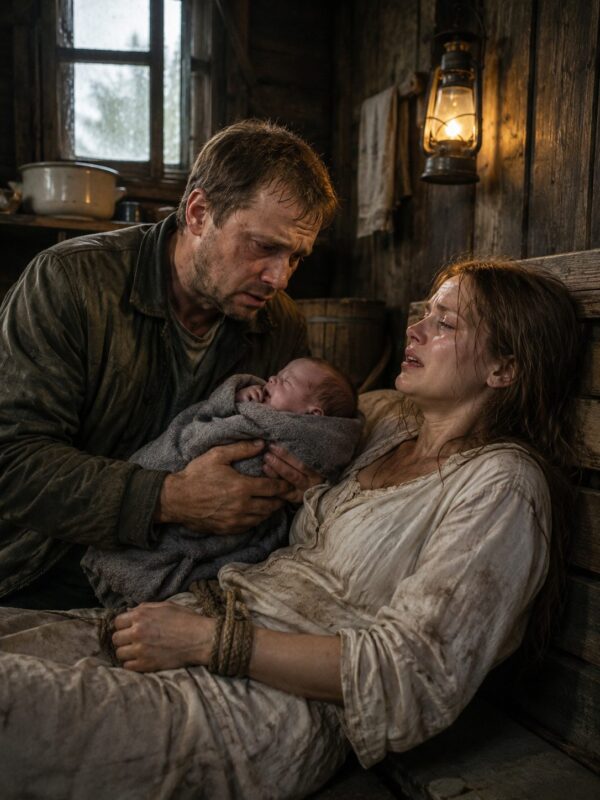
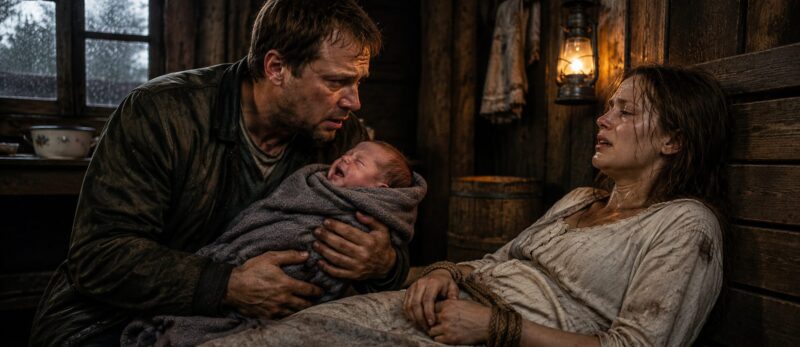
Inside, on a pile of rags in the dim light, lay Elena. She was barely alive. Her face was white as chalk, her lips cracked, her hair matted. Her hands were tied behind her back with dirty rope. She lay in a pool of dried blood. Matvey rushed to her, cutting the ties with his pocketknife.
«Lena! Lenochka! Can you hear me?»
She opened her hazy, wandering eyes and wheezed. Matvey leaned closer.
«Son… my son… he took him… where is he…» she whispered.
«He’s alive. He’s safe. He’s with Aunt Polya. Everything is okay, do you hear me? Everything is okay, my girl,» Matvey stroked her hair, feeling tears stream down his own face. «I’m here, hang on. I’m calling an ambulance. Just tell me one thing: did German do this?»
«Yes…» she breathed, losing consciousness. «He… the birth… he delivered the baby himself… took the child… said he would get rid of it…»
She couldn’t finish. Matvey scooped her up—light as a feather—and carried her out of the sauna. At that moment, tires screeched: the district officer’s old «UAZ» pulled up at the gate, and Senya Kovalchuk jumped out with two officers from Svyatogorsk. Aunt Polya hadn’t just called; she had roused the whole village.
German Voldemarovich von Lange was arrested that same evening. He was taken right in his «estate» while, unsuspecting, he sipped cognac by the fireplace. He tried to resist, shouting about his immunity and his connections to the governor, but the handcuffs snapped onto his manicured wrists with a final, metallic clash. The investigation uncovered his dark dealings: he had been using his office for land fraud, and his «weekends» in Zaozyorye were just a cover. But his primary crime was the attempted murder of an infant and the kidnapping of Elena.
Elena spent almost a month in the Svyatogorsk hospital. The doctors fought for her life, and Matvey was by her side the entire time. He sat by her bed, held her hand, read to her, and brought her news of the little one every day. The boy, whom the nurses nicknamed «The Foundling,» turned out to be remarkably strong and healthy.
When Elena first opened her eyes after her long recovery and saw Matvey dozing in a chair with a newspaper on his lap, she smiled. And when he brought her son—a little bundle smelling of milk and baby soap—she wept with joy.
«I’ll name him Matvey,» she said softly, clutching the baby to her chest. «After the man who saved us.»
«Don’t,» he muttered, embarrassed. «That’s an… old-fashioned name.»
«I have to,» she looked him straight in the eyes, and there was such depth and seriousness in her gaze that Matvey stopped.
It turned out that German was not just a wealthy vacationer. He was the head of the property relations department in the Svyatogorsk mayor’s office and was preparing to run for the regional duma. The scandal was colossal. The mayor of Svyatogorsk, a man of the old school, was so appalled that he personally visited Elena in the hospital.
«I am shocked,» he said, his voice ringing with genuine anger. «Such people disgrace the authorities. Rest assured, justice will be served. And if you need help—any help—my office door is always open. And I will personally see to it that von Lange rots in prison, even if it costs me every connection I have.»
He kept his word.
May arrived—a true, blooming, wild spring. Zaozyorye was drowning in lilac and bird cherry blossoms. Elena was discharged, carrying little Matyusha in her arms, and Matvey met them on the steps. He had driven up in his old but well-maintained «Niva,» in the back seat of which a baby bassinet was already waiting.
«Well, why are you squeezing him so tight? The kid needs to breathe. Give him here,» he grumbled, carefully taking the baby and deftly placing him in the bassinet. Then he turned to Elena: «And why are you standing there? Get in. We have a lot to do. We need to file our paperwork at the registrar’s office.»
Elena froze halfway to the car.
«The registrar’s office? What paperwork, Matvey?»
He closed the back door and, leaning against it, looked at Elena with a long, serious gaze. The sun played in his brown hair, and the old, hopeless melancholy that had haunted him for years was gone from his eyes.
«What do you mean, what?» he smiled at the corner of his mouth. «So we can get married as soon as possible. Or do you plan on living together? I promised the boy he’d have a complete family. I gave my word when we were sitting at Aunt Polya’s that night. And I never take my words back.»
She stood there, not believing her ears. Tears flowed down her cheeks, but they were tears of incredible, dizzying happiness. She had thought her life was over, that she was alone, that only shame and poverty awaited her. But fate, which had once taken her best friend, had given her love, a family, and a savior.
«Matvey…» she whispered. «I’m…»
«Quiet,» he stepped toward her, pulled her close, and kissed the top of her head. «We’ll discuss how we’ll live later. For now, let’s go home. Aunt Polya is setting the table, she’s baked pies. We’re going to celebrate our boy. And, yeah, Len…» he paused. «I promised Anya that I would be happy. It seems I’m finally able to keep that promise, too.»
They drove down the dusty country road, breathing in the intoxicating scent of lilacs, and both felt light and at peace. In the rearview mirror, little Matyusha was sleeping soundly in his bassinet—a living proof that one can break free from even the darkest of tragedies if there is a heart nearby ready to love and fight. The high brick fence, which still loomed gloomily in the distance, was left in the past—a reminder that no walls are capable of hiding evil, and no darkness is capable of extinguishing the light burning in a human soul.