Ever since my younger brother, Tomás, moved into our home with his new wife, Lucía, a nightly ritual began that made my skin crawl.
Each evening, Lucía would appear at our bedroom door with a pillow and blanket in hand, insisting on sleeping in our bed—right in the middle, between my husband, Esteban, and me.
At first, I tried to brush it off as a difficult adjustment. «Sleep wherever you want,» I’d say, forcing a smile while resentment curdled in my stomach. When I finally confronted her on the fifth night, she looked at me with tear-reddened eyes and whispered, «In my village, a woman new to her husband’s family gets scared at night. Sleeping between family keeps the bad dreams away.»
It was a bizarre explanation, but Esteban insisted I just let it go. «Being crowded is better than leaving her scared,» he told me.
But it wasn’t just the lack of space; it was the atmosphere. Every night, Lucía would lay her pillow down with eerie precision, remain perfectly still, and stare into the darkness as if she were waiting or watching for something. During the day, she was impossibly helpful—cooking, cleaning, and acting the perfect houseguest. That only made it worse. Her kindness didn’t explain why she felt the need to wedge her body between us every single night, almost as if she were guarding a space neither of us could see.
Everything changed on the seventeenth night.
I was startled awake by a sharp, metallic *click* in the darkness. The silence that followed was suffocating. Before I could even react, Lucía’s hand snaked under the covers and gripped mine tightly. One quick, firm squeeze.

*Don’t move.*
My blood ran cold. Then, I saw it: a thin line of light crawled from under the bedroom door, sweeping across the floor and climbing up the wall. A second, softer sound followed—*tac*. A deliberate tap of a fingernail against the wood.
I shifted to look at Esteban, but he was facing away, breathing with the rhythmic, steady cadence of a man fast asleep. Or so I thought.
Suddenly, Lucía moved. She inched upward in the bed just enough so that her head completely blocked the line of light from the door. In that moment, the horrifying truth shattered my world: Lucía wasn’t sleeping between us because she was afraid of bad dreams. She was using my presence as a human shield.
And the monster she was hiding from was lying right next to me.
I lay paralyzed, the warmth radiating from Esteban’s back feeling like an open furnace against my arm. Every instinct screamed at me to bolt, but the tapping at the door had stopped.
The mattress shifted. Esteban’s breathing changed instantly, transitioning from the deep, slow hum of sleep to the sharp, calculated rhythm of someone wide awake and listening. He hadn’t been sleeping; he had been waiting to see if the light would wake me.
I gripped Lucía’s trembling hand, a silent vow in the dark, and forced my eyes shut just as the bed groaned. He was rolling over to face us.
I felt his breath brush against my cheek in the pitch black.
«Are you awake?» he whispered. His voice was too smooth, too calculated. My heart hammered against my ribs like a trapped bird. If I opened my eyes now… what would he do?
The moment Lucía pulls herself higher under the heavy wool blanket, using her own head to eclipse that razor-thin sliver of light, every trace of sleep leaves my body. My heart hammers against my ribs so violently I’m certain whoever is standing outside the bedroom door can hear it. I still don’t fully grasp what is happening in the suffocating dark, but one truth hits me with gut-wrenching certainty: my sister-in-law isn’t in my bed because she’s eccentric, or because she’s clinging to some outdated village superstition.
She’s here because she’s acting as a shield.
The sharp, invasive strip of light holds for two agonizing seconds, painting a harsh yellow line against the baseboard. Then, it slips away.
A faint rustle follows in the hall. It’s so slight, so meticulously controlled, it could be mistaken for the house settling or a draft moving through the eaves. Then, silence rushes back into the room—a dense, suffocating weight.
Lucía keeps a steady grip on my hand. She isn’t trembling; she’s just waiting for my breathing to slow enough that I don’t betray our panic. Beside her, Esteban remains deep in sleep—or so it seems. His arm is thrown casually over his pillow, his chest rising and falling with the maddeningly rhythmic calm of a man who hasn’t heard a thing.
When Lucía finally lets go of my hand, she doesn’t speak. She just stares into the pitch-black ceiling, waiting for the sun to rise. I stay awake, my spine rigid against the headboard, my mouth tasting like ash.
At dawn, I find Lucía in the kitchen. She’s standing at the stove, stirring oatmeal as if the night had been uneventful. The morning light catches the dark strands of hair framing her exhausted face. If not for the lingering sensation of her hand on mine, I might have convinced myself it was just a nightmare.
«Coffee’s ready,» she says, not turning around.
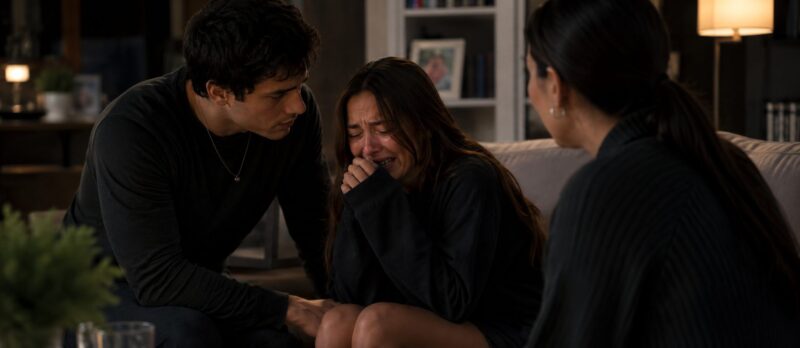
I stay where I am, my feet cold against the tile. «Who was outside our room last night?»
The wooden spoon stills in the pot. She freezes for a fraction of a second, then resumes stirring with forced casualness. «I don’t know what you mean,» she murmurs.
I almost laugh. It’s a bad lie, and I’m looking straight at it. Lucía is quiet and modest to a fault, but she has never been careless with her words. Hearing her feign ignorance so poorly tells me the truth is far darker than a strange noise.
«You took my hand,» I say, my voice a sharp hiss. «And you moved your head into the light. Deliberately.»
Lucía sets the spoon aside and turns to face me. Her eyes are hollow, as if she’s been worn down to the bone. «Please,» she says, glancing nervously at the ceiling. «Not here.»
Her answer frustrates me more than her denial. In this house, fear moves from room to room, wrapped in daily chores and polite, manufactured explanations. I’ve spent two weeks enduring the whispers of neighbors and the strain on my own marriage, all while people assume twisted things about my home.
«Then where?» I demand.
She flicks her gaze toward the stairwell. Upstairs, my mother is moving around. Esteban is still asleep. My brother, Tomás—Lucía’s husband—is already at work.
«Tonight,» she whispers. «On the roof. After everyone is asleep.»
I know I should demand the truth now, but something in her face—a terror so taut it mimics courtesy—paralyzes me. I give her a tight nod. «Tonight.»
All day, the house feels like a stage play. My mother complains about her arthritis; Esteban appears later, scratching his chest, pressing a lazy kiss to my cheek, and complaining about sleeping poorly. A lie. I know he slept like a rock. But when he turns and sees Lucía, his expression shifts. It’s not desire or irritation; it’s something colder. Recognition.
It lasts a heartbeat before he smiles warmly. «Morning,» he says. Lucía refuses to meet his eyes.
Until this moment, I saw Lucía’s nightly intrusion as a boundary issue. But now, a canyon of a possibility opens beneath my feet. What if the monster she’s hiding from isn’t in her head? What if he’s lying right beside me?
Later that afternoon, I’m on the roof hanging sheets when my mother joins me. «The neighbors are talking,» she says, her tone dripping with disapproval. «They say they saw Lucía sneaking into your room with a pillow. Twice.»
«I’ll handle it,» I say sharply.
«Will you?» she asks, studying me.
I swallow the truth and say, «I will.»
Dinner that night is a blur. Lucía serves everyone and barely speaks, her eyes lowered as if the table itself might accuse her. When bedtime comes, my pulse thuds in my throat. Lucía appears at my door, clutching her pillow like armor. I sit on the edge of the mattress, and she looks at me—a desperate, wordless question.
I give a sharp, imperceptible nod.
She places her pillow in the middle. We wait in the dark. At 1:13 a.m., it happens. *Click.*
The LED strip appears under the door, rising slowly. I lock my muscles. Beside her, Esteban lies with his back to us. His breathing is steady—too steady. It lacks the natural rhythm of sleep; it sounds rehearsed.
The light pauses by the headboard. Then: *Tac.* A soft, sickening tap.
Lucía shifts, eclipsing the light. After two beats of silence, the light vanishes. A floorboard creaks in the hall, followed by the sound of someone slowly walking away.
I wait. Five minutes later, Lucía whispers, «Now.»
I watch Esteban. He doesn’t move. She’s right—he’s waiting. He’s in on the rhythm. The monster was always him.
We creep out to the roof. The air is cool, the city lights flickering below. Lucía sits on an overturned bucket.
«Talk,» I say.
«It started before we moved in here,» she says, her voice fragile. «Esteban would visit our apartment. He was always ‘helpful.’ Then, one afternoon, he stood too close. He made small, insidious comments about my hair, my mouth—things he could claim were compliments if I ever repeated them.»
«And you didn’t tell Tomás?»
«If I articulated it wrong, I would be branded the jealous woman who poisoned the perfect family,» she says. «Men like him rely on our hesitation.»
«Why sleep between us?» I ask.
«Because he won’t dare try anything with you right there,» she says, tears filling her eyes. «I thought if I made myself impossible to reach without exposing himself to you, he’d give up.»
I feel sick. «We are not handling this quietly anymore.»
«No,» she says, panic rising. «If Tomás hears it wrong, he might kill him. If Esteban denies it with that calm smile, it all turns to smoke. He’ll weaponize the shame.»
She’s right. That’s how men like him survive—by being charmingly believable in the light.
«We need more,» I say. «Proof.»
The next morning, I begin watching him. I notice the way his eyes linger when Lucía bends over the laundry. I notice how he checks where Tomás is before entering a room.
While he’s in the shower, I slip into his office. In his desk, I find a burner phone. No passcode. I open it to find hundreds of screenshots of local women. And at the bottom, there’s a three-second video: a view from a dark hallway, creeping toward our bedroom door.
My hand shakes as I send the files to my own phone and return the device. I have my proof. Now, I have to survive the confrontation.