The CEO’s son-in-law fired me at 9:14 a.m. There was no meeting invite, no heads-up, and certainly no thank-you for nineteen years of service. Just a cheap cardboard box shoved across my desk and a man in an expensive gray suit saying, «We’re modernizing leadership, Clara. You get it.»
I looked down at the box. Someone from HR had already cleared out my desk—my coffee mug, my old calculator, and three framed photos. But then Martin reached in, grabbed the engraved silver pen the company founder had gifted me the year we survived the recession, scoffed at it as an «antique,» and tossed it into my trash can.
That hurt more than the termination notice.
For nearly two decades, I’d been the person who kept the lights on. I hunted down payroll errors, uncovered supplier fraud, and salvaged shipping contracts when natural disasters destroyed our logistics. I’d worked through audits, answered urgent emails from hospital beds, and driven through blizzards to get critical compliance documents to lenders before they could freeze our credit.
But to Martin Vale, the CEO’s son-in-law, I was just obsolete office furniture.
He’d married the boss’s daughter six months ago, bringing nothing but buzzwords, shiny shoes, and a secret agenda. He wasn’t «refreshing the talent pool»; he was bleeding our cash reserves dry to facilitate a hostile takeover by our most ruthless competitor—a move that would put four thousand people out of work by Christmas.
He knew his way around a PowerPoint presentation. And he knew how to smile while clearing out anyone who remembered how the company was actually built.
“You’re taking this surprisingly well,” he noted.

I knelt down, retrieved my silver pen from the trash, wiped it off, and met his eyes. The office was deathly silent; my coworkers were staring over their monitors, afraid to move. My assistant, Nina, was openly crying by the copier, and the warehouse supervisor looked like he was about to rip the door off its hinges.
I picked up my box. “Have a nice morning,” I said.
Martin blinked. He had expected pleading, or maybe a scene. He got nothing but chilling, absolute politeness. It clearly annoyed him.
Security escorted me to the lobby, looking embarrassed the entire way. As I walked out, I passed the massive portrait of the founder, Arthur Tennant—standing in front of his first factory with his sleeves rolled up and sawdust on his boots.
My grandfather.
Martin walked past that painting every single day, but he was so busy looking up at the C-suite that he never bothered to read the brass plaque at the bottom: *»To the true heir, C.T. – Protect the house.»*
He’d taught me never to act out of anger and never to reveal my power until it was ready to be used. Martin had never bothered to ask for my maiden name.
At 10:03 a.m., my phone buzzed. It was Nina, whispering frantically.
“Clara, he’s in the boardroom trying to force the buyout vote! Legal just opened your file to process the severance. He’s throwing papers everywhere, yelling, ‘Clara Tennant—who the hell is she?!’”
I looked at the cardboard box in my lap and felt the cool weight of the silver pen in my pocket.
“Tell him,” I said softly, “that I’m the woman he needed written permission to fire.”
I hung up and let the cold city air hit my face for three seconds. Then, I turned around and walked straight back into my building. The security guards who had just escorted me out froze in panic. I didn’t stop or scan a badge; I just kept moving, my heels clicking a steady rhythm against the marble floor as I headed for the private executive elevator.
The pen felt heavy in my pocket—ready.
As the elevator doors opened on the 40th floor, I could hear Martin’s voice echoing down the hall. I marched toward the boardroom, ready to show him exactly what happens when you try to erase a Tennant.
But as I shoved the heavy oak doors open, the person standing beside him wasn’t who I expected at all.
I didn’t stop at the doorway. I walked slowly to the head of the table, my heels clicking like a countdown on the polished wood floor. When I reached the center of the room, I turned and looked every single board member in the eye—the venture capitalists who didn’t know the first thing about manufacturing, the family friends who had grown soft, and finally, my aunt.
“I was dismissed, Elaine,” I said, my voice steady enough to chill the air. “But you cannot fire the person who owns the foundation upon which this table sits.”
Martin let out a sharp, incredulous laugh. “She’s had a breakdown. Security, get her out of here!”
None of them moved. They were looking at Marcus and his crew, and they were looking at the sheer weight of the people standing behind me.
I reached into my blazer and pulled out the silver fountain pen. It caught the harsh boardroom light, glinting with a lethal, polished edge. I placed it on the mahogany surface, right on top of Martin’s printed-out merger proposal.
“You’re a man who understands pricing, Martin,” I said, turning my gaze to him. “You’ve spent the last six months trying to strip-mine this company for parts. You calculated the liquidation value of the machines, the real estate, and the brand. But you forgot to calculate the cost of the people who actually make this company run.”
I pulled my phone out and tapped a single command.
Instantly, the wall-mounted monitor—which had been displaying Martin’s sleek, deceptive «modernization» slides—flickered. The boardroom’s internal network, accessed through the back-door root credentials I’d kept since 2018, bypassed the projector’s firewall.
A document appeared on the screen. It wasn’t a presentation. It was a digital trail: bank transfers, shell company registrations, and encrypted emails between Martin Vale and a third-party consultant representing Apex Global. It was the «smoking gun» evidence of his self-dealing, his intentional manipulation of our cash flow, and his secret commitment to liquidate the factories by Christmas.
The room went deathly still. You could hear the hum of the cooling fans.
“I’m not a ‘disgruntled employee,’” I said, my voice cutting through the silence like a scalpel. “I am the majority shareholder of the Tennant Family Trust. My grandfather didn’t leave the company to his children; he left it to the person who proved they could keep the lights on when the world went dark. That was me.”
I walked over to the board’s lead director, a man who had been looking at his watch since I walked in. I leaned down and placed my hand on the table.
“Martin has been using his position to facilitate a hostile takeover. This is a felony breach of fiduciary duty. If you vote to move forward with this merger in the next five minutes, you are all officially co-conspirators. My legal team—the ones who handle my private interests—are already on a conference call with the SEC. They are waiting for my signal.”
Elaine looked at the monitor, then at me, and finally at her son-in-law. Her face went slack. She realized, for the first time, that she had been holding a seat at a table she didn’t actually control.
Martin was shaking, his face a mottled, ugly shade of red. He reached for his phone, but Marcus stepped forward, his massive frame looming over the table.
“Don’t,” Marcus said, his voice a low, gravelly warning.
I looked at the board. “The motion to sell is dead. Martin Vale is to be escorted out of this building immediately. And as of 10:45 a.m., the board of directors is being dissolved pending a full internal audit.”
I picked up my silver pen.
“Does anyone have a question?”
Nobody moved. Nobody spoke.
I turned to my assistant, Nina, who was standing by the door, tears still streaming down her face—but this time, she was smiling.
“Nina,” I said, “call HR. Tell them to rescind my termination, and then clear out the executive suite. I have a lot of work to do, and I’d prefer to do it in an office that doesn’t smell like corporate greed.”
I walked toward the door. As I passed Martin, he looked like a man who had just realized he’d walked off a cliff. He looked small, pathetic, and entirely forgotten.
I didn’t even glance his way. I just kept walking, my grandfather’s pen held firmly in my hand, ready to start the real work of saving the house.
I walked slowly toward the center of the room, my eyes locked on my aunt. “I was dismissed by a man who didn’t have the legal authority to sign that paperwork, Elaine.”
Martin let out a harsh, incredulous laugh. “I am the Chief Operating Officer! I have unilateral authority over departmental restructuring!” He looked wildly at the board. “Someone call security! This is a corporate hijacking!”
At the far end of the table, Harrison Sterling, my grandfather’s attorney, slowly stood up. He didn’t look panicked. He looked like a shark that had just smelled blood in the water.
“Mr. Vale,” Harrison said, his voice calm and legally lethal. “I suggest you lower your voice and sit down before you further embarrass yourself and expose this board to catastrophic liability.”
Martin’s face twisted. “Who the hell are you?”
“I am the chief executor of the Arthur Tennant Family Stewardship Trust,” Harrison replied, adjusting his glasses. He reached into his leather briefcase, pulled out a thick, red-bound document, and dropped it onto the mahogany table. It landed with a definitive thud.
“Why wasn’t her status in her employee profile?!” Martin demanded, pointing an accusing finger at the HR director.
“It was, Mr. Vale,” Harrison corrected smoothly. “You simply failed to read the governance appendix. Page forty-two, subsection C.”
“Nobody reads the damn appendices!” Martin snapped, running a frantic hand through his hair.
The chairman of the board, Richard, looked at Martin with freezing contempt. “People firing protected corporate officers do.”
*Protected officer.*
The phrase hung in the air, immovable. Martin had completely missed the trap. After my grandfather retired, he knew the second generation—specifically my aunt, Elaine—cared more about profit margins and galas than the people who built the company. So, he placed 38% of Tennant Manufacturing into an irrevocable family stewardship trust. It was a massive, blocking minority share.
The trust required one Tennant family representative to remain within the company, operating independently of the CEO to oversee finance, labor relations, and vendor ethics. For nineteen years, that representative had been me. I stayed in the trenches because my grandfather trusted the factory floor more than the C-suite, and he trusted me to listen.
Harrison opened the red document. “According to the bylaws of the trust,” he read, “the termination of the Executive Steward without a unanimous vote from the trust board triggers a Level One governance breach. This mandates an immediate suspension of all restructuring, a freeze on all financial mergers, and a forensic review of the terminating officer’s actions.”
Martin’s face drained of color. “Executive Steward?” he whispered. He looked at me. “Her name is Clara Mercer.”
“Mercer is my married name, Martin,” I said softly. “My maiden name is Tennant.”
Every head in the room swiveled toward me. The silence was absolute.
“Clara…” Elaine whispered, her voice trembling. “Why didn’t you just tell him?”
I shifted my gaze to the aunt who had allowed him to run rampant. “He never asked who he was firing, Elaine. He was too busy tossing my grandfather’s legacy into the trash to read a file.”
“And perhaps that was fortunate,” Harrison added, placing a second folder on the table. “Because Mr. Vale’s urgent proposal appears deeply connected to replacing our loyal vendors with his own private consulting group.”
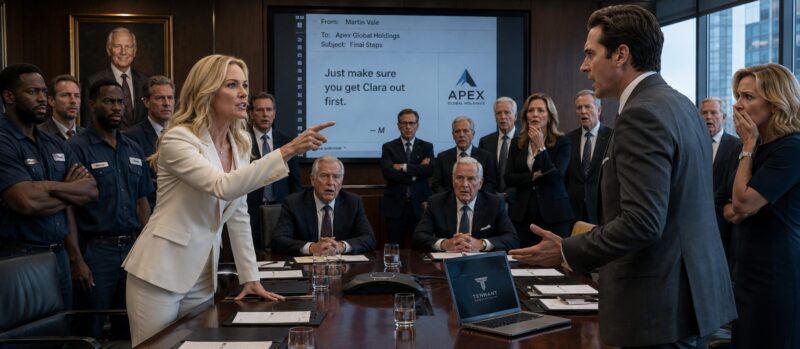
I reached into my blazer, pulled out my phone, and tapped a button, activating the root access I had maintained for years. “Connected by shared residential addresses, Richard,” I said, walking toward the projector. “Shared corporate directors hiding behind Delaware LLCs. Inflated bids designed to drain our cash reserves.”
I tapped my phone again. The projector flashed, and an internal email appeared on the screen—a message from Martin to a senior executive at Apex Global: *“The cash bleed is accelerating as planned. Valuation is dropping. Make sure you get Clara out first. She’s been here too long; she’ll recognize the dummy vendor names.”*
The room went silent. It was the kind of silence that precedes an explosion.
I looked directly at my aunt. She wasn’t wide-eyed with shock; she was tight with calculation. “You knew,” I whispered.
Elaine stiffened. “Clara, don’t be ridiculous—”
“Don’t lie to me!” I snapped, slamming my hands on the table. “You sign off on every expense over fifty thousand dollars. Martin couldn’t have bled our reserves this far without your authorization.”
Martin tried to deflect. “Elaine authorized the strategic realignments! She agreed the company needed to shed its archaic dead weight!”
“Shut up, Martin,” Richard growled. He looked at the CEO. “Elaine… were you aware of back-channel communications with Apex Global?”
Elaine looked around the room—at the furious board, the warehouse crew blocking the doors, and finally at me. The polished, elegant facade finally cracked. She stood up, smoothing her blazer. “Yes,” she said.
A collective gasp echoed through the room.
“How could you?” I asked, my voice trembling with rage. “This is your father’s company. Apex will strip this place down to the copper wiring and fire every single person in this room.”
“Oh, grow up, Clara!” Elaine fired back, her voice turning shrill. “This company is a dinosaur! Apex offered a golden parachute that would make everyone in this room wealthy. I’m tired of the margins.”
“You would walk away rich,” I corrected her, gesturing toward the workers. “They walk away with nothing. No pensions. No severance.”
Martin stepped in, desperate. “It’s just business, Clara. Not personal.”
“It is entirely personal!” I roared. “You used fake contracts to artificially deflate earnings and panic this board into a lowball offer, all so you could collect a kickback!”
The board erupted. Shouts of “Fraud!” and “Fiduciary breach!” filled the air. Elaine panicked, realizing her son-in-law had left a digital paper trail of treason. “I didn’t know about the kickbacks!” she stammered.
“It doesn’t matter!” Martin shouted, looking like a cornered rat. He slammed his fist on the table. “You might be a protected officer, Clara, but the trust only holds thirty-eight percent! Elaine is still the CEO, and together, we still control the board majority! I call for a vote on the merger—now!”
Elaine hesitated, then nodded. “I second the motion.”
If they voted out of panic, the company was dead. I reached into my pocket, my fingers closing around my grandfather’s silver fountain pen.
“You really should have read the entire appendix, Martin,” I whispered.
I turned to the lawyer. “Harrison.”
Harrison stepped forward. “As I stated, the termination of the Executive Steward triggers a Level One governance breach. However, subsection D details the consequences when coupled with evidence of fiduciary fraud. Upon presentation of evidence—such as a written confession to a competitor—the Steward’s minority share converts.”
Martin froze. “Converts to what?”
“It converts to a supermajority proxy,” Harrison said softly. “A fail-safe mechanism designed by Arthur Tennant to prevent internal sabotage.”
Elaine gasped. “That’s impossible.”
“Your father knew exactly who you were, Elaine,” I said. “He gave you the CEO title to save your pride, but he gave me the loaded gun to protect the house.”
I looked at Martin, who was shaking. “The trust protocol doesn’t just freeze the vote, Martin. It triggers an automatic, immediate suspension of the CEO and the COO, pending a forensic audit.”
The room erupted in a stampede of survival. The board members, realizing they were sitting with executives about to be indicted, turned on them.
“I withdraw my support!” one board member shouted.
“The motion is dead!” Richard roared. “Security, escort these two out. Do not let them touch their computers.”
Martin tried laughing, but it sounded like a dry heave. “This is a misunderstanding! I was playing hardball with Apex to drive up our stock price!”
“No, Martin,” I replied. “You were eliminating witnesses. You just didn’t realize you were trying to eliminate the landlord.”
By 3:00 p.m., Martin was leaving the building with security, clutching his pathetic cardboard box. He saw me standing near the lobby, right beneath my grandfather’s portrait. He broke away from the guards and rushed over, his voice frantic.
“Clara… please. We can fix this quietly,” he pleaded, sweat staining his expensive suit. “If I had known who you were…”
I held up a hand. “That is exactly the problem. You only care about power when it has a title you recognize.”
Six weeks later, the dust settled. The board formally removed Martin and filed a civil lawsuit. Elaine was forced to step down, signing a humiliating admission that she had allowed gross negligence. The suspicious contracts were canceled, restoring millions to our reserves.
And me? I didn’t go back to the corner office. I moved into the boardroom.
The trust appointed me Acting CEO. My first action was eliminating the ambush-firing policy Martin had used like a weapon. No employee would ever again be walked out without a transparent review and human dignity.
On my first official day as CEO, Nina, now my Chief of Staff, placed my silver fountain pen on the contract to formally kill the Apex Global merger.
I picked it up, running my thumb across the engraving. My grandfather once told me that a company isn’t inherited by the person in the most expensive suit, but by the person willing to protect the foundation.
I pressed the nib to the paper. “Antiques,” I murmured, “are sometimes the only things sharp enough to cut out tumors.”
I signed my name.
The company was safe, the house was protected, and for the first time in nineteen years, I was finally leading from the front.