Eleanor had only stopped by to tuck her daughter in, the way she used to when Chloe was six and terrified of summer thunderstorms. She smoothed the blanket over the bed, but as it drifted upward, she froze.
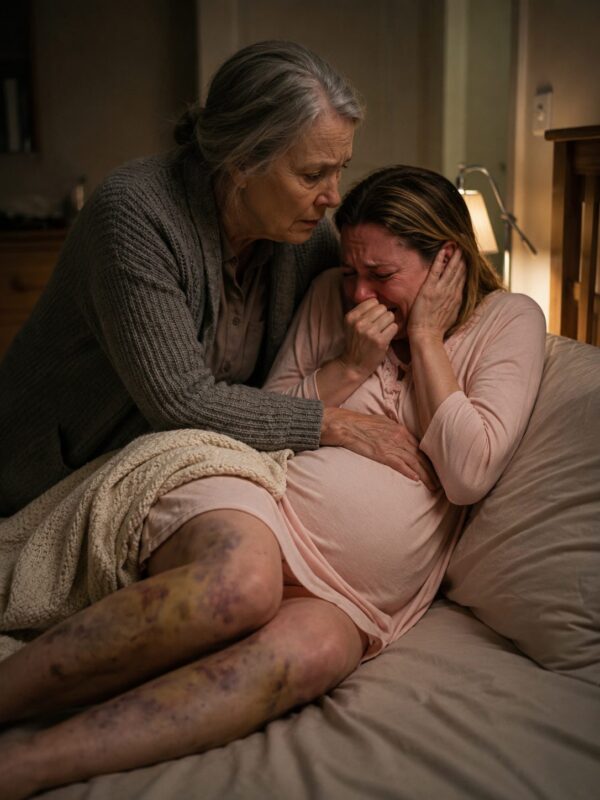
Dark, finger-shaped bruises stained Chloe’s thighs. More marks circled her calves—not old or healing, but fresh, ugly violence blooming under her pale skin.
“Who did this to you?” Eleanor whispered.
Chloe buried her face in the pillow, tears sliding silently down her nose. “Please, Mom… don’t ask.”
Downstairs, the dining room was alive with laughter. Chloe’s husband, Sterling Vance, was holding court, entertaining his parents with wine and a brand of cruelty thinly veiled as charm. Earlier that evening, Sterling’s mother, Beatrice, had dismissed Eleanor as “sweet but simple,” while his father, Arthur, had mockingly asked if she still clipped coupons.
Eleanor had smiled back at them then. It was a common mistake to confuse a quiet woman for a harmless one.
She turned back to her daughter, her voice deathly calm. “Was it Sterling?”
Chloe shook her head, her movements frantic.
“Beatrice?”
Another sob.
Eleanor felt her pulse turn to ice.
“They said if I told anyone, they’d take the baby,” Chloe whispered, her voice trembling. “Sterling said no judge would believe me. Beatrice said I’m unstable—she has recordings.”
“What kind of recordings?”
“They provoke me until I cry, then they record it,” Chloe said, covering her mouth as if to keep the words from escaping. “They want me to sign over the trust Dad left me. They told me that once the baby comes, I won’t be useful anymore.”
Eleanor glanced at the bedroom door.
*Useful.*
The word settled into her core like a blade sliding into a sheath.
“Mom, please,” Chloe begged, clutching her wrist. “Don’t fight them. They own half this town.”
Eleanor gently pulled her hand away and kissed Chloe’s forehead. “No, sweetheart. They just rent fear in half this town.”
Chloe stared, searching her mother’s face. The soft, widowed woman in the modest shoes had vanished. In her place stood the professional who had spent twenty-two years as a senior forensic accountant for the state attorney’s office—the woman who had dismantled entire embezzlement rings while men earning twice her salary called her “honey.”
“Sleep,” Eleanor said.
Downstairs, Sterling raised his glass. Eleanor walked toward the laughter, a cold smile forming on her lips.
The dining room was a masterclass in inherited arrogance. Sterling Vance stood at the head of the mahogany table, his wine glass catching the chandelier’s light.
“To family,” he toasted. His mother, Beatrice, raised her glass in a mocking salute toward the empty chair where my daughter should have been.
They thought I was upstairs, wringing my hands in helpless suburban panic. They believed my silence was submission.
I paused in the shadowed archway, adjusting the cuffs of my sensible cardigan. My thumb slipped into my pocket, finding the sharp edge of my smartphone. With two deliberate presses, I activated the hidden audio recording software.
I took a breath, letting the hardened veteran investigator dissolve, and painted on the mask of a meek, overwhelmed mother.
“Sterling?” I murmured softly, stepping into the light.
He turned, a predator’s smirk playing on his lips. He had no idea he had just poured a drink for his own executioner.
The Vance estate’s dining room smelled of roasted rosemary, expensive gin, and old, suffocating money. It was designed to make you feel small. The ceiling vaulted into a cathedral arch of dark mahogany, and the chandelier dripped with crystals that fractured the evening light into cold, sharp slivers.
I sat at the far end of the table, cutting my steak into deliberate, precise squares. I was playing a role: Eleanor, the quiet, widowed mother from the suburbs who wore sensible cardigans and bought her shoes on sale. It was the role they had assigned me the moment my daughter, Chloe, married into their family, and I had played it flawlessly for two years.
People often mistake quiet women for harmless ones. It is a fatal error in judgment.
Across from me sat Arthur Vance, a man whose wealth was only eclipsed by his arrogance. He swirled a glass of Merlot that probably cost more than my first car. Next to him was his wife, Beatrice, a woman whose face was pulled tight by money and malice. Her pearls gleamed at her throat like small, polished teeth.
Then there was Sterling, my son-in-law.
Sterling was handsome in that aggressively polished way that makes strangers trust him instantly—and makes waiters despise him. He had a smile that didn’t quite reach his eyes, a practiced charm that felt like a tailored suit hiding a hollow interior.
“More wine, Eleanor?” Arthur asked, his voice dripping with condescension. “I know you aren’t used to vintages with an actual cork.”
I offered a soft, self-deprecating smile. “No thank you, Arthur. A little goes a long way for me.”
Beatrice let out a breathy, brittle laugh. “She really is sweet, isn’t she, Sterling? So simple. It’s refreshing, in a quaint sort of way.”
I kept cutting my steak, refusing to look at them. I was focused on the empty chair to Sterling’s right.
Chloe had excused herself halfway through the appetizer. She was seven months pregnant with my first grandchild, but pregnancy hadn’t brought a glow to her cheeks. Over the last few months, my bright, vivacious daughter had withered. She was pale, skittish, and jumped at sudden noises. Tonight, she hadn’t touched her food; her hands had trembled so violently she kept them hidden in her lap.
“Pregnancy does make girls terribly dramatic,” Beatrice sighed, dabbing her lips with a linen napkin. “We’ve been quite worried about Chloe’s mental state. She’s so… fragile.”
“Vance women are strong,” Arthur declared, slicing his meat. “Outsiders just take time to adjust to our standard of excellence.”
Sterling chuckled, taking a sip of his wine. “She’ll learn. I’m making sure she understands her responsibilities.”
A cold, heavy knot formed in the pit of my stomach. The way he said *making sure* sent a primitive, biological warning straight to my brain.
“If you’ll excuse me,” I said, my voice barely above a whisper. “I think I’ll go up and check on her. Make sure she’s resting.”
“Don’t coddle her, Eleanor,” Beatrice snapped.
“I’ll just be a moment,” I said, already rising from my seat.
I left the dining room, the sound of their soft, cruel laughter following me down the long, shadowed hallway. I climbed the sweeping marble staircase, my hand trailing along the cold iron banister. The house felt less like a home and more like a beautifully decorated mausoleum.
The door to their guest suite was slightly ajar. Only a single yellow bedside lamp was on, casting long, bruised shadows across the walls.
Chloe lay curled on her side beneath the duvet. One hand rested protectively over her swollen belly; the other gripped the edge of the sheet so tightly her knuckles were white. She looked like a frightened child hiding from a thunderstorm.
“Chloe, sweetheart?” I murmured.
She flinched violently, a small gasp escaping her lips. When she saw it was me, her shoulders slumped, but the terror in her eyes didn’t fade.
“Mom,” she whispered, her voice raw.
“I just came to tuck you in,” I said, moving to the side of the bed. The air in the room felt heavy, suffocating. I reached down to pull the thick duvet up over her shoulders, the way I had done when she was six.
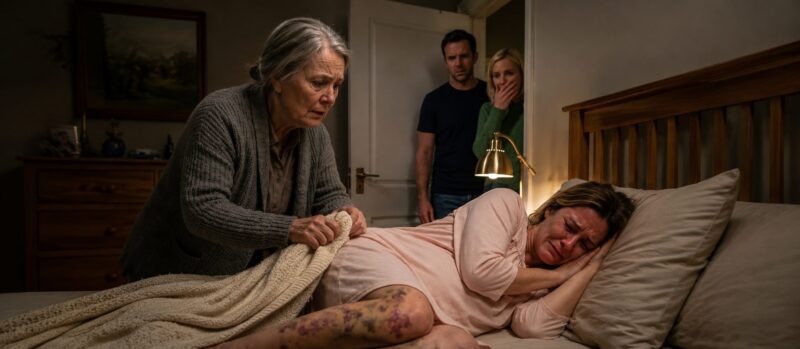
As I lifted the blanket, the fabric caught on her nightgown, pulling it up slightly above her knees.
The breath left my lungs in a violent rush.
I froze, the blanket suspended in my hands. The silence in the room became so absolute, so ringing, that I could hear my pregnant daughter trying desperately not to draw a breath.
Dark, ugly marks stained the pale skin of her thighs. Finger-shaped contusions, turning a sickening shade of violet and yellow. More marks circled her calves like iron shackles.
These were not old. These were not accidents. This was fresh, deliberate violence blooming under my little girl’s skin.
The bedside lamp seemed to pulse in time with the frantic beating of my heart. My mind momentarily rejected what my eyes were reporting—a cognitive dissonance so sharp it caused physical pain behind my eyes.
Slowly, with trembling hands, I lowered the blanket to hide the horrors underneath.
I sat on the edge of the mattress. My voice, when it finally emerged, sounded like it belonged to someone else—someone standing at the bottom of a deep, dark well.
“Who did this to you?”
Chloe turned her face into the pillow. Her shoulders began to shake, and silent tears soaked into the silk pillowcase.
“Please, Mom,” she choked out. “Please… don’t ask.”
I sat perfectly still, my hands folded in my lap, knuckles white. The cold knot in my stomach had hardened into a block of solid ice.
“Was it Sterling?” I asked. The name tasted like ash.
Chloe shook her head side to side, too quickly. A panicked, frantic motion.
“Was it Beatrice?”
A sharp sob ripped through her throat. She curled into a tighter ball.
“Chloe. Tell me.”
She reached out, her fingers wrapping around my wrist with desperate strength. “They said if I told anyone, they’d take the baby. Sterling said no judge in this county would believe me over him. His father plays golf with the appellate judges. Beatrice says I’m clinically unstable. She says she has proof.”
“What proof?” I kept my voice steady, though every instinct I had was screaming to run downstairs and tear them apart with my bare hands.
“Recordings,” Chloe whispered, her eyes wide with a hunted, animal terror. “They provoke me. They lock me in rooms, they take my phone, they say horrible things about Dad, about you… and when I finally break down, when I start screaming and crying… they record me. Out of context, I sound crazy, Mom.”
She covered her mouth to stifle a sob. “They want me to sign over the trust Dad left me. They said after the baby comes, I won’t be useful to them anymore.”
I looked toward the heavy oak door.
*Useful.*
That word settled inside me. It didn’t bring tears. It brought a terrifying, absolute clarity. It felt like a cold steel blade finding its sheath in the center of my chest. They weren’t just abusing her; they were orchestrating a legal and psychological execution.
“Mom,” Chloe begged, her nails digging into my skin. “You can’t fight them. They own half this town. They can destroy us.”
I looked down at my daughter—my beautiful, brilliant girl, reduced to a trembling prisoner in a gilded cage. I gently unpried her fingers from my wrist and leaned down, pressing a firm, lingering kiss to her forehead.
“No, sweetheart,” I said softly, the quiet widow persona evaporating. “They *rent* fear in half this town. There’s a difference.”
Chloe stared at me, blinking through her tears. She knew the shift. The soft, simple mother in the cardigan was gone. In her place sat the woman who had spent twenty-two years as a senior forensic accountant for the state attorney’s office. I was the woman who had dismantled multi-million-dollar embezzlement rings, who had untangled dark-money webs for the FBI, and who had sat across from men twice Sterling’s size and wealth, smiling while I sent them to federal prison.
I had retired. I hadn’t died.
“Sleep,” I told her, my voice echoing with an authority she hadn’t heard since she was a teenager. “Lock the door behind me. Do not open it for anyone but me.”
I stood, smoothing the wrinkles from my skirt. Downstairs, I could hear the muffled sound of Sterling laughing at something his father said.
I walked toward the door, my mind already calculating variables, assessing risks, and building a timeline. I stepped into the dark hallway, pulling the heavy door shut, waiting for the soft *click* of the lock.
When I turned around, my blood ran cold.
Standing at the top of the grand staircase, halfway down the long, shadowed hall, was Sterling. He was holding a fresh glass of bourbon, watching me in the gloom.
“Is everything all right with my emotional little wife, Eleanor?” he asked.
Sterling took a slow step toward me, the ice in his glass clinking against the crystal. The sound was deafening in the cavernous hallway. He was smiling, but it was the kind of smile a predator gives a wounded animal before breaking its neck.
I let my shoulders slump. I brought a trembling hand up to my mouth, playing the frightened, overwhelmed mother perfectly.
“She’s… she’s just very tired, Sterling,” I stammered, looking away from his dead eyes. “The pregnancy is taking a toll.”
Beatrice’s voice floated up from the base of the stairs. She swept up to join her son, her silk dress rustling like dry leaves. “As I said at dinner, Eleanor, the girl is unstable. We are deeply concerned for the welfare of our grandchild. Chloe requires… management.”
Arthur joined us on the landing, forming a solid wall of wealth and malice between me and the stairs. “Harlow women don’t break, Eleanor. If your daughter can’t handle the pressure of our lifestyle, perhaps she isn’t fit to be part of it.”
“Is that what she is to you?” I asked, letting a tremor of genuine emotion into my voice. I needed them to believe I was cracking. “Just an outsider you made a mistake on?”
Sterling stepped closer, invading my personal space. The scent of bourbon and expensive cologne was nauseating. “She is family, Eleanor,” he said, his voice dropping to a dangerous, low register. “When she behaves like family. And right now, her behavior is a liability.”
There it was. That unvarnished, suffocating arrogance—the ingrained belief that their money built an impenetrable fortress around their actions. They truly thought I was a bug they could step on.
I looked down at my sensible shoes and let a single, well-timed tear slip down my cheek. “I don’t want any trouble, Sterling. I just want my daughter to be happy.”
Beatrice scoffed, a vicious, ugly sound. “Then I suggest you don’t create any trouble. Leave tomorrow morning as planned. Chloe needs a stable environment, not the panic of a woman who still clips coupons and drives a ten-year-old sedan.”
I nodded slowly, subserviently, as if deeply wounded by the insult. “Of course,” I whispered. “I’ll pack my things.”
I turned my back on them and walked toward my guest room. I heard Sterling chuckle—a dark, victorious sound—before the three of them descended the stairs to finish their drinks.
The moment I was behind closed doors, the tears stopped instantly.
I reached into the deep pocket of my cardigan, pressed the volume-down button on my smartphone twice, and stopped the hidden recorder I’d activated the moment I stepped out of Chloe’s room.
*“She is family when she behaves like family.”*
*“Chloe requires management.”*
It wasn’t a conviction yet, but it was a thread. And in my line of work, you only need one thread to unravel a sweater.
I waited in the dark, listening to the grandfather clock in the foyer chime eleven, then midnight, then one. I waited until the master suites clicked shut and the house settled into a resonant, eerie silence.
At 2:00 AM, I moved.
Dressed in dark clothes, I slipped a penlight and a pair of latex gloves into my pockets and opened my door without a sound. I scratched lightly at Chloe’s door. She opened it a crack, her eyes wide. I slipped inside.
“Mom, what are you doing?” she whispered.
“Gathering ammunition,” I replied.
I took high-resolution, timestamped photographs of the bruises on her legs and the faint, yellowish thumbprint on her jaw she’d tried to hide with makeup. I photographed the splintered deadbolt on her bedroom door. Finally, I found it: her prenatal vitamins in the bathroom trash, crushed and mixed with the residue of something else. I scraped a sample into a tissue and pocketed it.
“Lock the door,” I told her.
I slipped to the east wing. Sterling’s office was locked, but a flat piece of plastic from a binder manipulated the latch in seconds. The office smelled of leather and secrets. I ignored the desk drawers—men like Sterling don’t hide their true sins in wood. I moved to the oil painting on the far wall. Behind it was a digital wall safe.
How does a narcissist think? They are arrogant. They believe they are untouchable. I bypassed his birthdate and his company’s founding date. Instead, I typed in the date his grandfather passed away—the day Sterling inherited his fortune.
The light flashed green.
I pulled out a thick leather folio and photographed every page. It was worse than I’d feared. There was a legal document designed to drain Chloe’s trust into an offshore company, and a psychiatric evaluation—signed by a doctor on a charity board Beatrice ran—diagnosing Chloe with postpartum psychosis months before she’d even given birth.
Then, the final folder: *Post-Birth Custody*. It was a petition citing Chloe’s “violent instability,” requesting sole custody for Sterling and Beatrice, with a motion to commit Chloe to a private psychiatric facility in Switzerland.
They weren’t just stealing her money. They were stealing her baby and locking her away where no one would ever hear her scream.
My hands were shaking—not from fear, but from a rage so pure it felt like physical heat.
As I photographed the final page, a mechanical whirring sound caught my attention. I froze. High on a mahogany bookcase, a tiny black lens with a blinking red light stared back at me.
Motion-activated. Connected to the cloud.
They would have footage of me breaking into the safe by morning. They would call the police. They would destroy the evidence before I could leave.
I stood there, bathed in the blinking red light. I didn’t panic. I didn’t run.
I looked directly into the lens and offered a cold, terrifying smile. “Perfect,” I whispered.
My phone vibrated. A text from Chloe: *Mom. I hear footsteps in the hall. He’s waking up.*
I had sixty seconds. I shoved the folders back, slammed the safe, and spun the dial. I didn’t bother wiping my prints; the camera had already seen me. I straightened the painting, doused the light, and slipped out just as floorboards overhead groaned under a heavy weight.
Sterling.
I ducked into the downstairs powder room and waited in the pitch black. Sterling walked past, paused at the office door, jiggled the handle, grunted when it wouldn’t open, and continued to the kitchen.
I glided up the stairs and locked myself in my room just as he started back up.
I didn’t sleep. I didn’t blink. I spent four hours in the glow of my laptop screen, transferring encrypted files, drafting affidavits, and organizing my evidence into an impenetrable digital fortress.
At 5:00 AM, I made three phone calls.
By dawn, I was downstairs in the kitchen, looking perfectly ordinary and suitably defeated. Beatrice was there, wearing a silk robe and looking like a queen surveying her conquest.
“You look exhausted,” she said, her voice dripping with false sympathy.
“Not much sleep, no,” I replied, my hand trembling slightly—a deliberate touch.
Sterling entered a moment later, looking invigorated. “It’s a big day. Chloe is signing the trust amendment at ten. The notary is coming here so she doesn’t have to stress.”
Arthur scoffed without looking up from his tablet. “Don’t start, Eleanor. You’re leaving after breakfast. You think you can stop what’s happening?”
Sterling leaned against the marble island, invading my space. “Let me explain, so you don’t do something stupid,” he purred. “Chloe is fragile. I am a respected CEO. My father golfs with the judges. You are a retired old woman with a crazy daughter and no leverage. If you make a scene, I’ll have you arrested for trespassing, and Chloe will be in a padded room by sunset.”
I looked down into my black coffee. I let the silence stretch, letting them bask in their perceived power.
Then, I looked up. I met Sterling’s dead eyes. “No leverage?” I asked, my voice no longer small. It was the sharp, cold tone of a woman who had sent billionaires to concrete cells.
I glanced at the grandfather clock. 6:55 AM.
“You should check your phone, Sterling,” I said softly. “The cloud notification for your office security camera usually triggers when there’s an unauthorized download. I imagine the email hit your inbox about four hours ago.”
Sterling froze. The color drained from his face until he looked like a corpse. He frantically pulled his phone out.
Before he could unlock it, the sound of multiple large vehicles roared up the driveway.
*Bang. Bang. Bang.*
“Open up! Police department! We have a warrant!”
Sterling turned to me, terror finally breaking his veneer. “What did you do?”
I smiled. “I audited you.”
He shoved past me to open the door. Standing on the porch was a tactical team, Detective Ruiz, a social worker, Dr. Hannah Bell—the obstetrician Beatrice had tried to silence—and Marcus Thorne, the District Attorney.
“Sterling Vance,” Ruiz said, her voice cutting through the morning air. “You are under arrest for domestic assault, coercive control, financial exploitation, and the falsification of medical records.”
Beatrice shrieked, pointing a manicured finger at me. “On whose authority? That simpleton’s word?”
I stepped forward. “Mine.”
Arthur emerged, purple with rage. “I’ll have your badges for this! I’m calling Judge Harrison!”
Marcus Thorne stepped forward, his expression bored. “I’d be careful, Arthur. Judge Harrison signed the warrant at 5:30 this morning. And I wouldn’t call Mrs. Eleanor a ‘simpleton.’”
“Who is she to you?” Sterling stammered.
Marcus smiled faintly. “She’s the woman who trained half my fraud division. She wrote the textbook on financial coercion we use at the academy.”
I kept my eyes locked on Sterling. “I still consult.”
The shift in the room was palpable. The invisible architecture of their dominance collapsed.
“Execute the warrant,” Marcus ordered.
As the officers surged past, Sterling tried one final, pathetic turn of the knife. He looked up at the stairs, where Chloe stood, and shifted into his ‘loving husband’ persona. “Chloe, baby,” he called out, his voice cracking. “Tell them your mother is confused. Tell them you’re safe.”
Dr. Bell stepped forward, bypassing Sterling entirely. “No, Mr. Vance. As her physician of record, I am overriding your bogus psychiatric hold. She and the baby are leaving this house immediately.”
Beatrice lunged, but I stepped into her path. I grabbed her wrists, squeezing until she gasped. For the first time, she looked into my eyes and saw me clearly—not as a widow, but as a predator.
“Touch my daughter again,” I whispered, “and the only board of directors you will ever sit on will be the one deciding who cleans the toilets in the women’s correctional facility.”
I shoved her back into Arthur’s arms.
Detective Ruiz held up a tablet and pressed play. The audio of their conversation—the one I’d recorded in the hall—echoed through the foyer. Then, she swiped to a video: Sterling gripping Chloe’s bruised thigh, forcing her to sign papers.
The Vance name, polished and untouchable for four generations, disintegrated in minutes.
Three months later, I sat in a rocking chair in a sun-drenched hospital room. There were no mahogany walls, no hidden cameras, and no threats. There was only the soft hum of the heart monitor and the weight of baby Rose against my chest.
Chloe sat in the hospital bed, looking radiant. The fear in her shoulders had vanished.
“Did you ever get scared?” she asked quietly. “That night in his office, or when they cornered you? Weren’t you terrified they’d find out who you really were?”
I looked down at baby Rose, watching her chest rise and fall in a peaceful rhythm.
“Terrified,” I admitted. “I was more frightened that night than I had ever been in my life.”
Chloe frowned. “But you didn’t show it. You were like ice.”
I walked over to the bed and gently placed Rose into Chloe’s waiting arms. I brushed a stray lock of hair from my daughter’s forehead.
“Because, sweetheart,” I said, “fear is just love looking for a weapon. And when it comes to you, I will always find one.”
The Vance estate sat empty behind yellow police tape, gathering dust. I looked at my daughter and granddaughter, wrapped in the warmth of a ledger finally, perfectly balanced.